


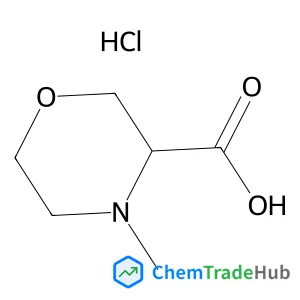
4-Methyl-3-morpholinecarboxylic acid hydrochloride (1:1)
CAS Number:
1240518-90-4
Molecular Formula:
C6H12ClNO3
Xue Dong, Li Chen, Rong-Tao Duan, Yu-Zhong Wang
The concept of incorporating cross-linkable precursor as the copolymerizing monomer has been proved efficient for polyesters to achieve low flammability and anti-dripping property. Adapting this concept, in our latest paper, a new co-monomer named 5-(2,5-dioxo-3-phenyl-2,5-dihydro-1H-pyrrol-1-yl) isophthalic acid (DPDPI) was synthesized and incorporated into PET chain. Results from limiting oxygen index (LOI), UL-94 and the cone calorimetric test demonstrated that these PET-co-DPDPI copolyesters possess excellent flame retardance and anti-dripping performance. UL-94 V-0 rating could be achieved with a DPDPI content of as low as 10 mol% (PET-co-DPDPI10). Results from thermogravimetry-differential scanning calorimetry (TG-DSC) and dynamic oscillatory rheology proved the existence of the cross-linking behaviour during heat. The cross-linked polymer structures were stable at high temperature and could promote the char formation during burning. According to the results of Raman spectroscopy, X-ray photoelectron spectrometry (XPS) and pyrolysis/gas chromatography-mass spectrometry (Py/GC-MS), the cross-linking and flame-retardant mechanism were proposed for PET-co-DPDPIX, that during combustion, 2π + π cycloaddition which occurred between the phenylmaleimide groups as the cross-linking reaction. Afterward, the cross-linked networks promoted aromatization and carbonization, which resulted in self-extinguishing and anti-dripping.

Journal of Enzyme inhibition and Medicinal Chemistry

Current Pharmaceutical Biotechnology

Advanced Engineering Materials

Molecular Diversity

Green Chemistry

Faraday Discussions

Nature Reviews Drug Discovery

European Journal of Organic Chemistry

Photochemical & Photobiological Sciences

Contact Lens & Anterior Eye
Yahao Shi, Chunting Chen, Yahui Zhang, Yongping Dong, Shangbing Wang
DOI: 10.1039/D3AN00002H
Chenhui Hao, Jinxiu Wei, Shenfei Zong, Zhuyuan Wang, Hong Wang, Yiping Cui
DOI: 10.1039/D2AN01662A
Miaomiao Li, Xiuying Peng, Zhiguang Liu, Yan Dai, Yujie Han, Lifang Fan, Yujing Guo
DOI: 10.1039/D3AN00327B
Joachim Jose
DOI: 10.1039/D2AN01753A
Jianglong Yao, Yujie Liu, Bingying Jiang, Ruo Yuan, Yun Xiang
DOI: 10.1039/D3AN00524K
DOI: 10.1039/D3AN00147D
Xu Chen, Yue Ma, Shuangyu Miao, Dongnan Li, Ye Zhang
DOI: 10.1039/D2AN02002E
Lin Jiang, Hang Yang, Weiqi Cheng, Zhonghua Ni, Nan Xiang
DOI: 10.1039/D2AN01747D
Miguel Aller Pellitero, Nandini Kundu, Jonathan Sczepanski
DOI: 10.1039/D2AN01901A
4-Nitrophenyl phosphate disodium salt hexahydrate is primarily used as a substra...
2-(Trifluoromethyl)-1,3-oxazole-4-carboxylic Acid (CAS: 1060816-01-4) is widely ...
2-Fluoro-4-biphenylcarboxylic acid should be stored in a cool, dry place at room...
Prednisolone-21-Carboxylic Acid is primarily used in the pharmaceutical industry...
4-(Hydrazinomethyl)-1,2,3-benzenetriol (CAS: 3614-72-0) should be stored in a co...
4-Amino-1-methyl-1H-pyrazole-5-carboxylic acid hydrochloride (CAS: 92534-70-8) i...
Dehydropachymic acid (CAS: 77012-31-8) is regulated by various agencies. It fall...
The market and research trends for 6-[(2,2-Dimethylpropanoyl)amino]nicotinic aci...
1,10-Phenanthroline-2,9-dicarbaldehyde should be stored in a cool, dry place awa...
5-Carbamoyl-11-oxo-10,11-dihydro-5H-dibenzo[b,f]azepin-10-yl acetate can be synt...

Polymer Chemistry welcomes submissions in all areas of polymer science that have a strong focus on macromolecular chemistry. Manuscripts may cover a broad range of fields, yet no direct application focus is required.
![1-[(4-Methylphenyl)sulfonyl]-3-(4,4,5,5-tetramethyl-1,3,2-dioxaborolan-2-yl)-1H-pyrrolo[2,3-b]pyridine-5-carbonitrile structure](https://static.chemtradehub.com/structs/143/1434747-57-5-fc0d.webp "1-[(4-Methylphenyl)sulfonyl]-3-(4,4,5,5-tetramethyl-1,3,2-dioxaborolan-2-yl)-1H-pyrrolo[2,3-b]pyridine-5-carbonitrile structure")




