













An aptamer triple helix molecular switch for sensitive electrochemical assay of lipocalin 1 biomarker via dual signal amplifications
Literature Information
Publication Date
2023-05-17
DOI
10.1039/D3AN00524K
Impact Factor
4.616
Authors
Jianglong Yao, Yujie Liu, Bingying Jiang, Ruo Yuan, Yun Xiang
View Original
Abstract
Sensitively monitoring the concentration change of lipocalin 1 (LCN1) can provide data support for accurately diagnosing diabetic retinopathy and efficacy of treatment. Using a new aptamer triplex switch (ATS) probe and catalytic hairpin assembly (CHA) and hybridization chain reaction (HCR) dual signal amplifications, a highly sensitive electrochemical and enzyme-free biosensor for detecting LCN1 is reported. The ATS probes recognize and bind LCN1 to change its structure and release ssDNA sequences, which trigger the capture of methylene blue (MB)-tagged DNA on the sensor electrode via the CHA and HCR reactions. These MB tags are then subjected to electrochemical measurements to obtain highly amplified current outputs to sensitively detect LCN1 from 5 pM to 1 nM with a detection limit of 0.85 pM. This sensor also exhibits high interfering protein discrimination capability and can be employed to monitor low levels of LCN1 in diluted tear samples. Our established sensor significantly outperforms current major LCN1 detection methods based on immunoassays and thus holds promising potential for evaluating the severity of diabetic retinopathy and monitoring treatment response.
Related Literature
Strand displacement activated peroxidase activity of hemin for fluorescent DNA sensing
Quanbo Wang, Nan Xu, Zhen Gui, Jianping Lei, Huangxian Ju, Feng Yan
2015-08-07
Paper
DOI: 10.1039/C5AN01206F
Label-free detection of missense mutations and methylation differences in the p53 gene using optically diffracting hydrogels
Kelsey I. MacConaghy, Duncan M. Chadly, Mark P. Stoykovich, Joel L. Kaar
2015-08-06
Paper
DOI: 10.1039/C5AN01191D
Quantitative evaluation of proteins with bicinchoninic acid (BCA): resonance Raman and surface-enhanced resonance Raman scattering-based methods
Zhi Yu, Youngju Lee, Xu Wang, Bing Zhao, Young Mee Jung
2012-10-09
Paper
DOI: 10.1039/C2AN35715A
A new electrochemical substrate for rapid and sensitive in vivo monitoring of β-galactosidase gene expressions
Kesavan Manibalan, Veerappan Mani
2015-07-10
Paper
DOI: 10.1039/C5AN01036E
A label-free and time-resolved luminescence strategy for the detection of proteins based on DNA–Tb3+ luminescence quenched by graphene oxide
Hao Li, Wang Li, Zhou Nie, Shouzhuo Yao
2015-07-27
Paper
DOI: 10.1039/C5AN01343G
Evaluation of UV radiation-induced toxicity and biophysical changes in various skin cells with photo-shielding molecules
Devasier Bennet
2015-07-30
Paper
DOI: 10.1039/C5AN00979K
Highly sensitive determination of reduced glutathione based on a cobalt nanoparticle implanted-modified indium tin oxide electrode
Tong Wang, Wen Su, Zhengjun Xiao, Shuang Hao, Yuanchun Li
2015-05-15
Paper
DOI: 10.1039/C5AN00631G
Single molecular recognition force spectroscopy study of a DNA aptamer with the target epithelial cell adhesion molecule
Jilin Tang
2015-07-21
Communication
DOI: 10.1039/C5AN00945F
Methylation-blocked enzymatic recycling amplification for highly sensitive fluorescence sensing of DNA methyltransferase activity
Feng Chen, Yongxi Zhao
2012-10-19
Paper
DOI: 10.1039/C2AN36329A
You might also like
Compound Q&A
What are the main uses of 4-Nitrophenyl phosphate disodium salt hexahydrate (CAS: 333338-18-4)?
4-Nitrophenyl phosphate disodium salt hexahydrate is primarily used as a substra...
333338-18-44-Nitrophenyl phosph...
Compound Q&A
What are the main uses of 2-(Trifluoromethyl)-1,3-oxazole-4-carboxylic Acid (CAS: 1060816-01-4)?
2-(Trifluoromethyl)-1,3-oxazole-4-carboxylic Acid (CAS: 1060816-01-4) is widely ...
1060816-01-42-(Trifluoromethyl)-...
Compound Q&A
How should 2-Fluoro-4-biphenylcarboxylic acid (CAS: 137045-30-8) be stored?
2-Fluoro-4-biphenylcarboxylic acid should be stored in a cool, dry place at room...
137045-30-82-Fluoro-4-biphenylc...
Compound Q&A
What industries use Prednisolone-21-Carboxylic Acid (CAS: 61549-70-0)?
Prednisolone-21-Carboxylic Acid is primarily used in the pharmaceutical industry...
61549-70-0Prednisolone-21-Carb...
Compound Q&A
How should 4-(Hydrazinomethyl)-1,2,3-benzenetriol (CAS: 3614-72-0) be stored?
4-(Hydrazinomethyl)-1,2,3-benzenetriol (CAS: 3614-72-0) should be stored in a co...
3614-72-04-(Hydrazinomethyl)-...
Compound Q&A
What industries use 4-Amino-1-methyl-1H-pyrazole-5-carboxylic acid hydrochloride (CAS: 92534-70-8)?
4-Amino-1-methyl-1H-pyrazole-5-carboxylic acid hydrochloride (CAS: 92534-70-8) i...
92534-70-84-Amino-1-methyl-1H-...
Compound Q&A
What regulatory guidelines apply to dehydropachymic acid (CAS: 77012-31-8)?
Dehydropachymic acid (CAS: 77012-31-8) is regulated by various agencies. It fall...
77012-31-8Dehydropachymic acid
Compound Q&A
What is the market or research trend for 6-[(2,2-Dimethylpropanoyl)amino]nicotinic acid (CAS: 898561-66-5)?
The market and research trends for 6-[(2,2-Dimethylpropanoyl)amino]nicotinic aci...
898561-66-56-[(2,2-Dimethylprop...
Compound Q&A
How should 1,10-Phenanthroline-2,9-dicarbaldehyde (CAS: 57709-62-3) be stored?
1,10-Phenanthroline-2,9-dicarbaldehyde should be stored in a cool, dry place awa...
57709-62-31,10-Phenanthroline-...
Compound Q&A
How is 5-Carbamoyl-11-oxo-10,11-dihydro-5H-dibenzo[b,f]azepin-10-yl acetate (CAS: 113952-21-9) typically synthesized?
5-Carbamoyl-11-oxo-10,11-dihydro-5H-dibenzo[b,f]azepin-10-yl acetate can be synt...
113952-21-95-Carbamoyl-11-oxo-1...
Source Journal
Analyst

CiteScore:
7.8
Self-citation Rate:
5.6%
Articles per Year:
653
Analyst publishes analytical and bioanalytical research that reports premier fundamental discoveries and inventions, and the applications of those discoveries, unconfined by traditional discipline barriers.
Recommended Compounds

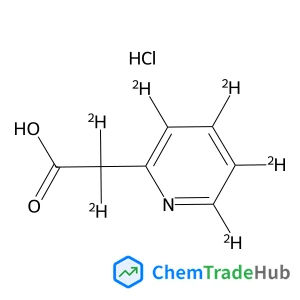
2,2-dideuterio-2-(3,4,5,6-tetradeuterio-2-pyridyl)acetic acid;hydrochloride
CAS Number:
1329799-67-8
Molecular Formula:
C7H2ClD6NO2

Recommended Suppliers






Disclaimer
This page provides academic journal information for reference and research purposes only. We are not affiliated with any journal publishers and do not handle publication submissions. For publication-related inquiries, please contact the respective journal publishers directly.
If you notice any inaccuracies in the information displayed, please contact us at support@chemtradehub.com. We will promptly review and address your concerns.