












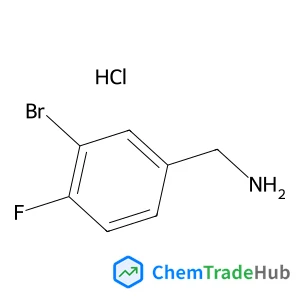
1-(3-Bromo-4-fluorophenyl)methanamine hydrochloride (1:1)
CAS Number:
202865-68-7
Molecular Formula:
C7H8BrClFN
Donghyeon Kim, Jae Ryeol Jeong, Yujin Jang, Jong-Seong Bae, In Chung, Runli Liang, Dong-Kyun Seo, Seung-Joo Kim, Jung-Chul Park
Self-emitting blue and red EuOX (X = F, Cl, Br, and I) were successfully synthesized and characterized. Far-infrared and Raman measurements revealed that the vibration modes prominently reflected the Eu–O and Eu–X bond characters of these materials. X-ray photoelectron spectroscopy (XPS) of the red-emitting EuOX compounds showed that Eu exclusively existed as Eu3+, while in the blue-emitting EuOX, a mixed Eu3+/Eu2+ state was observed. For the red-emitting EuOX (X = F, Cl, and Br), the maximum wavelengths of the charge-transfer (CT) bands were red-shifted: F → Cl → Br (282, 320, and 330 nm for F, Cl, and Br, respectively). Using one-electron spin-polarized band structure calculations, it was verified that the red-shift of the CT energy from F to Br in EuOX was mainly due to the relative positions of the halogen orbital energies being gradually increased, following the trend in their electronegativity. For the blue-emitting EuOX (X = Cl, Br, and I), the emission band maxima were red-shifted from Cl to I (409, 414, and 432 nm for Cl, Br, and I, respectively), which was quite opposite to the trend predicted based on the spectrochemical series in crystal field theory, which was in good agreement with the previous results of the calculated 5d → 4f transition energies of the Eu2+ activator based on the crystal field theory. Through photoluminescence, UV-visible absorbance, and XPS, it was elucidated that the red emission due to Eu3+ was strongly masked by the intensified blue emission associated with the small amount of Eu2+ in the blue-emitting EuOX (X = Cl, Br, and I). These materials may provide a platform for modeling new phosphors for application in solid-state lighting.
Michael Z. Hu, Donglu Shi, Douglas Blom
DOI: 10.1039/B717461F
Matthew A. Henderson, J. Scott McIndoe
DOI: 10.1039/B606938J
Jon P. Nietfeld, Christopher L. Heth, Seth C. Rasmussen
DOI: 10.1039/B713126G
Ruibing Wang, Lina Yuan, Donal H. Macartney
DOI: 10.1039/B605919H
Suguru Higashida, Aiko Harada, Rikako Kawakatsu, Noriko Fujiwara, Michio Matsumura
DOI: 10.1039/B604332A
Masakazu Morimoto, Seiya Kobatake, Masahiro Irie
DOI: 10.1039/B604388G
Junhui Xu
DOI: 10.1039/B606429A
Tadashi Ema, Daisuke Tanida, Tatsuya Matsukawa, Takashi Sakai
DOI: 10.1039/B718763G
Ah-Rim Han, Yu Jin Jeong, Yaeun Kang, Jung Yoon Lee, Mi Sook Seo, Wonwoo Nam
DOI: 10.1039/B716558G
Laurent El Kaïm, Rocio Gamez-Montaño, Laurence Grimaud, Tannya Ibarra-Rivera
DOI: 10.1039/B716849G
When considering alternatives to 1-(4-Chlorophenyl)-N-hydroxymethanimine (CAS: 3...
This compound should be stored in a cool, dry place away from direct sunlight. I...
3-(4-Bromophenyl)-5-(2-fluorophenyl)-1,2,4-oxadiazole is synthesized through a m...
5-Chloro-2-(4-chlorophenyl)-4-methyl-6-[3-(1-piperidinyl)propoxy]pyrimidine (CAS...
2-Chloro-4-(difluoromethoxy)pyridine is used in the pharmaceutical industry for ...
3-Chloro-6-methylpyridazine (CAS: 1121-79-5) is classified under the Globally Ha...
Several alternatives can be used in the synthesis of Methyl 4,5-dimethyl-2-nitro...
Alternatives to (2E,2'E)-3,3'-(1,4-Phenylene)bisacrylaldehyde include other acry...
3-Amino-5-chloropyridin-2-ol hydrochloride is an organic compound with the CAS n...
When handling 6,7-Difluoro-2,3-dihydro-4H-chromen-4-one, it is essential to wear...

Physical Chemistry Chemical Physics (PCCP) is an international journal co-owned by 19 physical chemistry and physics societies from around the world. This journal publishes original, cutting-edge research in physical chemistry, chemical physics and biophysical chemistry. To be suitable for publication in PCCP, articles must include significant innovation and/or insight into physical chemistry; this is the most important criterion that reviewers and Editors will judge against when evaluating submissions. The journal has a broad scope and welcomes contributions spanning experiment, theory, computation and data science. Topical coverage includes spectroscopy, dynamics, kinetics, statistical mechanics, thermodynamics, electrochemistry, catalysis, surface science, quantum mechanics, quantum computing and machine learning. Interdisciplinary research areas such as polymers and soft matter, materials, nanoscience, energy, surfaces/interfaces, and biophysical chemistry are welcomed if they demonstrate significant innovation and/or insight into physical chemistry. Joined experimental/theoretical studies are particularly appreciated when complementary and based on up-to-date approaches.
![6-Bromo-2,3-dihydro-1H-pyrido[2,3-b][1,4]oxazine structure](https://static.chemtradehub.com/structs/120/1203499-17-5-b4d1.webp "6-Bromo-2,3-dihydro-1H-pyrido[2,3-b][1,4]oxazine structure")
![[4-(Isobutyrylamino)phenyl]boronic acid structure](https://static.chemtradehub.com/structs/874/874219-50-8-6ab5.webp "[4-(Isobutyrylamino)phenyl]boronic acid structure")






