












Free radical polymerization of alkyl methacrylates with N,N-dimethylanilinium p-toluenesulfonate at above ambient temperature: a quasi-living system
Literature Information
Publication Date
2010-09-13
DOI
10.1039/C0PY00180E
Impact Factor
5.582
Authors
Atanu Kotal, Tapas K. Paira, Sanjib Banerjee, Chinmoy Bhattacharya, Tarun K. Mandal
View Original
Abstract
N,N-Dimethylanilinium p-toluenesulfonate (PTSA-DMA) has been successfully used as a versatile initiator for the quasi-living free radical polymerization of several alkyl methacrylate monomers such as methyl, ethyl, n-butyl, tert-butyl, and benzyl methacrylates (MMA, EMA, n-BuMA, t-BuMA and BzMA respectively) at 60 °C in dry THF. The initiator, PTSA-DMA was prepared by a simple complexation reaction of readily available p-toluenesulfonic acid (PTSA) and N,N-dimethylaniline (DMA). The yield of this polymerization system was moderate to good (60–75%). The produced poly(alkyl methacrylates) had narrow polydispersities (PDIs) (Mw/Mn = 1.16–1.45). Although, this polymerization follows first order kinetics but the obtained molecular weight remains almost unchanged with conversion. This polymerization proceeds through radical mechanism as confirmed by electron paramagnetic resonance spectroscopy. The ‘quasi-living’ nature of this polymerization was verified from the chain extension experiment as well as the successful synthesis of a block copolymer, poly(methyl methacrylate)-b-poly(methyl methacrylate-co-benzyl methacrylate), by the sequential addition of the respective monomers. The obtained block copolymer was characterized by 1H NMR, differential scanning calorimetric and atomic force microscopic studies.
Related Literature
Thiophene-based conjugated microporous polymers: preparation, porosity, exceptional carbon dioxide absorption and selectivity
Long Qin, Guang-juan Xu, Chan Yao, Yan-hong Xu
2016-06-15
Communication
DOI: 10.1039/C6PY00666C
pH-Responsive cagelike porous polymer microspheres prepared via consecutive RAFT polymerization induced by γ-ray radiation
Hanqin Weng, Hanhong Huang, Yusong Wang, Mozhen Wang, Xuewu Ge
2015-09-10
Paper
DOI: 10.1039/C5PY01257K
Living polymerization of arylisocyanide initiated by the phenylethynyl palladium(ii) complex
Ya-Xin Xue, Jia-Li Chen, Zhi-Qiang Jiang, Zhipeng Yu, Na Liu, Jun Yin, Yuan-Yuan Zhu, Zong-Quan Wu
2014-08-11
Communication
DOI: 10.1039/C4PY01023J
Synthesis and photochemical properties of spiropyran graft and star polymers obtained by ‘click’ chemistry
Claudia Ventura, Paul Thornton, Silvia Giordani, Andreas Heise
2014-07-23
Paper
DOI: 10.1039/C4PY00778F
Dual-cure photochemical/thermal polymerization of acrylates: a photoassisted process at low light intensity
M. Retailleau, A. Ibrahim, X. Allonas
2014-07-25
Paper
DOI: 10.1039/C4PY00548A
Towards development of a versatile and efficient strategy for fabrication of GO based polymer nanocomposites
Qing Wan, Liucheng Mao, Meiying Liu, Ke Wang, Guangjian Zeng, Dazhuang Xu, Hongye Huang, Xiaoyong Zhang, Yen Wei
2015-08-31
Paper
DOI: 10.1039/C5PY01238D
Multifaceted glycodendrimers with programmable bioactivity through convergent, divergent, and accelerated approaches using polyfunctional cyclotriphosphazenes
Leïla Abbassi, Yoann M. Chabre, Naresh Kottari, Alexandre A. Arnold, Sabine André, Johan Josserand, Hans-Joachim Gabius, René Roy
2015-09-11
Paper
DOI: 10.1039/C5PY01283J
You might also like
Compound Q&A
Is 6-(3-Fluorophenyl)picolinic acid (CAS: 887982-40-3) safe?
6-(3-Fluorophenyl)picolinic acid is generally considered safe for laboratory use...
887982-40-36-(3-Fluorophenyl)pi...
Compound Q&A
What industries use (3R)-3-Pyrrolidinol (CAS: 2799-21-5)?
(3R)-3-Pyrrolidinol is used in the pharmaceutical industry as a precursor for dr...
2799-21-5(3R)-3-Pyrrolidinol
Compound Q&A
What precautions should be taken when handling (4R,5R)-4,5-Diethoxycarbonyl-2,2-dimethyldioxolane (CAS: 59779-75-8)?
When handling (4R,5R)-4,5-Diethoxycarbonyl-2,2-dimethyldioxolane (CAS: 59779-75-...
59779-75-8(4R,5R)-4,5-Diethoxy...
Compound Q&A
How is 1-(6-Chloroimidazo[1,2-b]pyridazin-3-yl)ethanone (CAS: 90734-71-7) typically synthesized?
1-(6-Chloroimidazo[1,2-b]pyridazin-3-yl)ethanone is often synthesized via a mult...
90734-71-71-(6-Chloroimidazo[1...
Compound Q&A
What is the market or research trend for N-Ethyl-3,4-dimethylbenzylamine (CAS: 39180-83-1)?
The market for N-Ethyl-3,4-dimethylbenzylamine (CAS: 39180-83-1) remains steady,...
39180-83-1N-Ethyl-3,4-dimethyl...
Compound Q&A
What is Tert-butyl 3-(pyrrolidin-1-yl)azetidine-1-carboxylate (CAS: 1019008-21-9)?
Tert-butyl 3-(pyrrolidin-1-yl)azetidine-1-carboxylate is a chemical compound wit...
1019008-21-9Tert-butyl 3-(pyrrol...
Compound Q&A
What regulatory guidelines apply to 1-Bromo-3-chloro-2,4-dimethoxybenzene (CAS: 1228956-93-1)?
1-Bromo-3-chloro-2,4-dimethoxybenzene (CAS: 1228956-93-1) falls under the classi...
1228956-93-11-Bromo-3-chloro-2,4...
Compound Q&A
Is 8-Bromo-2-methyl-3,4-dihydroisoquinolin-1(2H)-one (CAS: 1368622-07-4) safe?
The safety of 8-Bromo-2-methyl-3,4-dihydroisoquinolin-1(2H)-one (CAS: 1368622-07...
1368622-07-48-Bromo-2-methyl-3,4...
Compound Q&A
Is Benzyl [(3S)-2,6-dioxo-3-piperidinyl]carbamate (CAS: 22785-43-9) safe?
Benzyl [(3S)-2,6-dioxo-3-piperidinyl]carbamate is generally safe when handled wi...
22785-43-9Benzyl [(3S)-2,6-dio...
Compound Q&A
How should 1-{[4-(4,4,5,5-Tetramethyl-1,3,2-dioxaborolan-2-yl)phenyl]sulfonyl}pyrrolidine (CAS: 928657-21-0) be stored?
1-{[4-(4,4,5,5-Tetramethyl-1,3,2-dioxaborolan-2-yl)phenyl]sulfonyl}pyrrolidine s...
928657-21-01-{[4-(4,4,5,5-Tetra...
Source Journal
Polymer Chemistry

CiteScore:
8.6
Self-citation Rate:
7.3%
Articles per Year:
457
Polymer Chemistry welcomes submissions in all areas of polymer science that have a strong focus on macromolecular chemistry. Manuscripts may cover a broad range of fields, yet no direct application focus is required.
Recommended Compounds
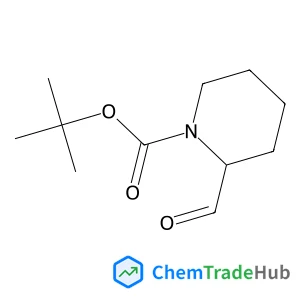
2-Methyl-2-propanyl (2R)-2-formyl-1-piperidinecarboxylate
CAS Number:
134526-69-5
Molecular Formula:
C11H19NO3
Recommended Suppliers




Disclaimer
This page provides academic journal information for reference and research purposes only. We are not affiliated with any journal publishers and do not handle publication submissions. For publication-related inquiries, please contact the respective journal publishers directly.
If you notice any inaccuracies in the information displayed, please contact us at support@chemtradehub.com. We will promptly review and address your concerns.