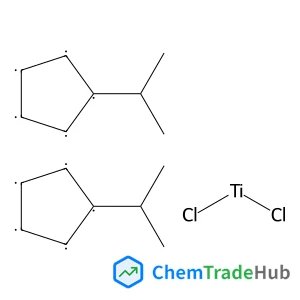
BIS(I-PROPYLCYCLOPENTADIENYL)TITANIUM DICHLORIDE
CAS Number:
12130-65-3
Molecular Formula:
C16H22Cl2Ti
Esther Heid, Wanda Moser, Christian Schröder
The time-dependent fluorescence of a chromophore can be calculated from either nonequilibrium simulations, or, as long as linear response theory holds true, from equilibrium solvent fluctuations in the ground or excited state if the perturbation inflicted by the chromophore is small. The assumption of Gaussian statistics, in contrast, links the nonequilibrium dynamics to solvent fluctuations solely in the excited state, as long as the energy gap distribution is Gaussian throughout the process. The validity of linear response theories on the ground and excited state surface as well as Gaussian statistics is thoroughly tested in this study by calculating the time-dependent Stokes shift of different benzene-like solutes. The effect of the size of change in partial charges of the solute, the multipolar order of charge distribution, the direction of change, as well as the influence of different solvents on the validity of linear response theory is examined by simulating 54 different systems. Calculation of the Gaussian character of the energy distribution in equilibrium, as well as the time-evolution of the peak width in the nonequilibrium simulation sheds light on the validity of Gaussian statistics in a nonstationary regime. We observed that a large intermediate broadening of the width of the energy distribution correlates with a failure of correlation functions to describe the nonequilibrium event. These results are accompanied by analysis of higher order correlation functions, as well as the structure of the solvents water, acetonitrile and methanol around the solute, to yield a comprehensive view, as well as general guidelines, on when and why equilibrium solvent fluctuations can correctly depict solvation dynamics.

Russian Journal of Coordination Chemistry

Russian Journal of Bioorganic Chemistry

Saudi Pharmaceutical Journal

Organic Process Research & Development

Russian Journal of Organic Chemistry

Chemistry Education Research and Practice

Acta Materialia

Journal of Saudi Chemical Society

Crystallography Reports

Drug Discovery Today
Mary K. Phillips-Jones, Shalini Edara, Jiro Nakayama, Rohanah Hussain, Giuliano Siligardi
DOI: 10.1039/C2CP43722H
Min Zhou, Lijie Zhong, Xiandui Dong, Jens Ulstrup, Dongxue Han
DOI: 10.1039/C2CP23184K
Michael Lartey, Jihan Kim, Maciej Haranczyk, David R. Luebke
DOI: 10.1039/C3CP43923B
Karan Bobuatong, Sangita Karanjit, Hidehiro Sakurai
DOI: 10.1039/C2CP23446G
Ilja Ignatjev, Edyta Proniewicz, Leonard M. Proniewicz, Gediminas Niaura
DOI: 10.1039/C2CP42077E
Chris Medcraft, Don McNaughton, Chris D. Thompson, Dominique R. T. Appadoo, Sigurd Bauerecker, Evan G. Robertson
DOI: 10.1039/C3CP43974G
Jong-Sook Lee, Jaekook Kim, Xiao-Ling Xiao
DOI: 10.1039/C2CP23363K
Oliver Welz, Judit Zádor, John D. Savee, Martin Y. Ng, Giovanni Meloni, Leonid Sheps, Taek Soon Lee, David L. Osborn, Craig A. Taatjes
DOI: 10.1039/C2CP23248K
Vaida Arcisauskaite, Stefan Knecht, Stephan P. A. Sauer, Lars Hemmingsen
DOI: 10.1039/C2CP23080A
2-Methylbenzene-1,4-diamine dihydrochloride (CAS: 615-45-2) should be stored in ...
(1S,4S)-2,5-Diazabicyclo[2.2.1]heptane dihydrobromide is generally considered sa...
(6-Chloropyridazin-3-YL)methanamine finds applications in the pharmaceutical ind...
2-Fluoro-3-methylphenol is primarily used in the synthesis of pharmaceuticals, p...
When handling 3-Methoxy-4-nitrobenzonitrile, it is important to wear appropriate...
When handling 1,3-Oxazolo[4,5-b]pyridine-2(3H)-thione (CAS: 211949-57-4), it is ...
4-Ethynylbenzamide (CAS: 90347-86-7) falls under various regulatory guidelines i...
3-(2-Ethylphenyl)-2-thioxo-4-imidazolidinone is primarily used as an intermediat...
(2-Fluoro-6-methoxyphenyl)acetic acid, also known as 4-fluoro-3-methoxybenzoic a...
Market trends for 2-[4-(Hydroxymethyl)phenoxy]ethanol (CAS: 102196-18-9) indicat...

Physical Chemistry Chemical Physics (PCCP) is an international journal co-owned by 19 physical chemistry and physics societies from around the world. This journal publishes original, cutting-edge research in physical chemistry, chemical physics and biophysical chemistry. To be suitable for publication in PCCP, articles must include significant innovation and/or insight into physical chemistry; this is the most important criterion that reviewers and Editors will judge against when evaluating submissions. The journal has a broad scope and welcomes contributions spanning experiment, theory, computation and data science. Topical coverage includes spectroscopy, dynamics, kinetics, statistical mechanics, thermodynamics, electrochemistry, catalysis, surface science, quantum mechanics, quantum computing and machine learning. Interdisciplinary research areas such as polymers and soft matter, materials, nanoscience, energy, surfaces/interfaces, and biophysical chemistry are welcomed if they demonstrate significant innovation and/or insight into physical chemistry. Joined experimental/theoretical studies are particularly appreciated when complementary and based on up-to-date approaches.
![trans-2-{[(Tert-butoxy)carbonyl]amino}cyclobutane-1-carboxylic acid structure](https://static.chemtradehub.com/structs/951/951173-25-4-27cd.webp "trans-2-{[(Tert-butoxy)carbonyl]amino}cyclobutane-1-carboxylic acid structure")