












![N-[2-(2-Pyridinyl)ethyl]-1-propanamine structure](https://static.chemtradehub.com/structs/554/55496-57-6-22b4.webp "N-[2-(2-Pyridinyl)ethyl]-1-propanamine structure")
A quinine-based quaternized polymer: a potent scaffold with bactericidal properties without resistance
Literature Information
Publication Date
2021-03-25
DOI
10.1039/D0PY01751E
Impact Factor
5.582
Authors
Huan-Huan Ding, Mu-Han Zhao, Le Zhai, Jian-Bin Zhen, Le-Yun Sun, Jia-Zhu Chigan, Cheng Chen, Jia-Qi Li, Han Gao, Ke-Wu Yang
View Original
Abstract
The drug resistance caused due to the overuse of antibiotics has grown into an emerging threat. It is urgent to develop novel strategies to combat bacterial resistance. In this work, a quinine-based quaternized polymer with amphiphilicity (QMTA) was prepared by free-radical copolymerization of quinine and (2-methacryloyloxyethyl) trimethyl ammonium chloride (MTA). Biological activity assays revealed that the polymer sterilized the drug-resistant Gram-negative E. coli and non-resistant Gram-positive bacteria B. subtilis, exhibiting a MIC value of 2 μg mL−1 and a bactericidal rate of more than 95%. Most importantly, both E. coli and B. subtilis treated with the polymer didn't develop resistance even after their 16th passages. Also, the polymer has low toxicity at a dose of up to 128 μg mL−1. The mechanism studies through SEM and 3D-SIM images, fluorescence staining and membrane potential determination reveal that the positively charged QMTA initially concentrates on the surface of bacteria by electrostatic adsorption, changes the membrane potential, binds to the bacteria by its quinine chain, and destroys the membrane structure of the bacteria. This study provides a potential approach through the existing drug to develop new bactericidal reagent/polymer materials without resistance.
Related Literature
A novel PdC monolayer with fully dispersed Pd atoms and a rigid carbon backbone: an intrinsic versatile electrocatalyst for overall water splitting and the corresponding reverse reaction
Kai Zhu, Dong Fan, Xiaojun Hu
2022-02-16
Paper
DOI: 10.1039/D1CP05392B
Performance of the nitrogen reduction reaction on metal bound g-C6N6: a combined approach of machine learning and DFT
Moumita Mukherjee, Sayan Dutta, Madhusudan Ghosh, Partha Basuchowdhuri, Ayan Datta
2022-06-27
Paper
DOI: 10.1039/D2CP01901A
Cu2+-Induced self-assembly and amyloid formation of a cyclic d,l-α-peptide: structure and function
Daniel Klose, Michal Richman, Vered Aisha, Meital Abayev, Marina Chemerovski, Katharina Majer, Nino Wili, Gil Goobes, Christian Griesinger, Gunnar Jeschke, Shai Rahimipour
2022-02-22
Paper
DOI: 10.1039/D1CP05415E
Absolute determination of chemical kinetic rate constants by optical tracking the reaction on the second timescale using cavity-enhanced absorption spectroscopy
Hongming Yi, Tao Wu, Amélie Lauraguais, Cecile Coeur, Alexandre Tomas, Hongbo Fu, Xiaoming Gao, Weidong Chen
2022-02-28
Paper
DOI: 10.1039/D2CP00206J
Multicomponent chiral hydrogel fibers with block configurations based on the chiral liquid crystals of cellulose nanocrystals and M13 bacteriophages
Yuhan Wang, Xiaonan Zheng, Weiting Zhong, Zihan Ye, Xinzhi Wang, Ziyue Dong, Zhenkun Zhang
2022-08-17
Paper
DOI: 10.1039/D2PY00965J
Potential energy surfaces of a stacked dimer of benzene and its radical cation: what remains and what appears
Irina V. Beregovaya, Lyudmila N. Shchegoleva
2022-06-29
Paper
DOI: 10.1039/D2CP01691E
Zooming in on the initial steps of catalytic NO reduction using metal clusters
Joost M. Bakker, Fumitaka Mafuné
2022-03-04
Perspective
DOI: 10.1039/D1CP05760J
Predicted structures and superconductivity of LiYHn (n = 5–10) under high pressure
Tao Gao, Shiyin Ma, Xiaoqiu Ye
2022-03-28
Paper
DOI: 10.1039/D2CP00059H
A SERS platform based on diatomite modified by gold nanoparticles using a combination of layer-by-layer assembly and a freezing-induced loading method
Julijana Cvjetinovic, Anastasiia A. Merdalimova, Maria A. Kirsanova, Pavel A. Somov, Daniil V. Nozdriukhin, Alexey I. Salimon, Alexander M. Korsunsky, Dmitry A. Gorin
2022-03-23
Paper
DOI: 10.1039/D2CP00647B
First principles assessment of the phase stability and transition mechanisms of designated crystal structures of pristine and Janus transition metal dichalcogenides
Öznur Demirkol, İlker Demiroğlu
2022-02-23
Paper
DOI: 10.1039/D1CP05642E
You might also like
Compound Q&A
What precautions should be taken when handling lithium chloride hydrate (1:1:1) (CAS: 16712-20-2)?
When handling lithium chloride hydrate (1:1:1) (CAS: 16712-20-2), it is importan...
16712-20-2Lithium chloride hyd...
Compound Q&A
Is 4-(4H-1,2,4-Triazol-4-yl)piperidine (CAS: 690261-92-8) safe?
4-(4H-1,2,4-Triazol-4-yl)piperidine is generally considered safe for use in phar...
690261-92-84-(4H-1,2,4-Triazol-...
Compound Q&A
How should waste containing 1,3-Thiazole-2-carboxamide (CAS: 16733-85-0) be handled?
Waste containing 1,3-Thiazole-2-carboxamide (CAS: 16733-85-0) should be collecte...
16733-85-01,3-Thiazole-2-carbo...
Compound Q&A
What regulatory guidelines apply to 5-(Difluoromethyl)-2-fluorobenzonitrile (CAS: 934175-58-3)?
5-(Difluoromethyl)-2-fluorobenzonitrile (CAS: 934175-58-3) is subject to regulat...
934175-58-35-(Difluoromethyl)-2...
Compound Q&A
How is Methyl 3-acetamido-2-thiophenecarboxylate (CAS: 22288-79-5) typically synthesized?
Methyl 3-acetamido-2-thiophenecarboxylate can be synthesized by the reaction of ...
22288-79-5Methyl 3-acetamido-2...
Compound Q&A
What is 4-Isoquinolinecarbonitrile (CAS: 34846-65-6)?
4-Isoquinolinecarbonitrile is a chemical compound with the CAS number 34846-65-6...
34846-65-64-Isoquinolinecarbon...
Compound Q&A
How should Methyl 1H-1,2,3-triazole-4-carboxylate (CAS: 877309-59-6) be stored?
Store Methyl 1H-1,2,3-triazole-4-carboxylate (CAS: 877309-59-6) in a cool, dry p...
877309-59-6Methyl 1H-1,2,3-tria...
Compound Q&A
What regulatory guidelines apply to 6-Bromo[1,3]thiazolo[5,4-b]pyridin-2-amine (CAS: 1160791-13-8)?
6-Bromo[1,3]thiazolo[5,4-b]pyridin-2-amine (CAS: 1160791-13-8) is subject to the...
1160791-13-86-Bromo[1,3]thiazolo...
Compound Q&A
Is (2S,3S)-2-Ammonio-3-(3,4-dihydroxyphenyl)-3-hydroxypropanoate (CAS: 23651-95-8) safe?
(2S,3S)-2-Ammonio-3-(3,4-dihydroxyphenyl)-3-hydroxypropanoate (CAS: 23651-95-8) ...
23651-95-8(2S,3S)-2-Ammonio-3-...
Compound Q&A
What are the physical and chemical properties of 7-bromo-3-methyl-3,4-dihydroquinazolin-4-one (CAS: 1293987-84-4)?
7-Bromo-3-methyl-3,4-dihydroquinazolin-4-one is a solid with a crystalline form....
1293987-84-47-bromo-3-methyl-3,4...
Source Journal
Polymer Chemistry

CiteScore:
8.6
Self-citation Rate:
7.3%
Articles per Year:
457
Polymer Chemistry welcomes submissions in all areas of polymer science that have a strong focus on macromolecular chemistry. Manuscripts may cover a broad range of fields, yet no direct application focus is required.
Recommended Compounds
![6-(Benzyloxy)-8-(2-bromoacetyl)-2H-benzo[b][1,4]oxazin-3(4H)-one structure](https://static.chemtradehub.com/structs/926/926319-53-1-2287.webp "6-(Benzyloxy)-8-(2-bromoacetyl)-2H-benzo[b][1,4]oxazin-3(4H)-one structure")
6-(Benzyloxy)-8-(2-bromoacetyl)-2H-benzo[b][1,4]oxazin-3(4H)-one
CAS Number:
926319-53-1
Molecular Formula:
C17H14BrNO4
![8-Bromo-6-fluoro[1,2,4]triazolo[1,5-a]pyridin-2-amine structure](https://static.chemtradehub.com/structs/125/1257705-51-3-9f4a.webp "8-Bromo-6-fluoro[1,2,4]triazolo[1,5-a]pyridin-2-amine structure")
8-Bromo-6-fluoro[1,2,4]triazolo[1,5-a]pyridin-2-amine
CAS Number:
1257705-51-3
Molecular Formula:
C6H4BrFN4

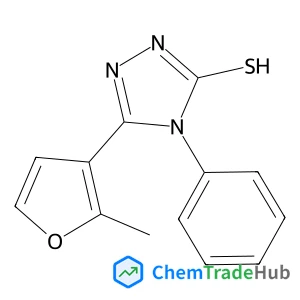
5-(2-Methyl-3-furyl)-4-phenyl-2,4-dihydro-3H-1,2,4-triazole-3-thione
CAS Number:
346464-59-3
Molecular Formula:
C13H11N3OS
Recommended Suppliers





Disclaimer
This page provides academic journal information for reference and research purposes only. We are not affiliated with any journal publishers and do not handle publication submissions. For publication-related inquiries, please contact the respective journal publishers directly.
If you notice any inaccuracies in the information displayed, please contact us at support@chemtradehub.com. We will promptly review and address your concerns.