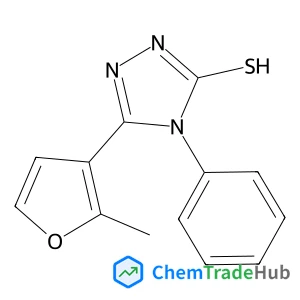
5-(2-Methyl-3-furyl)-4-phenyl-2,4-dihydro-3H-1,2,4-triazole-3-thione
CAS Number:
346464-59-3
Molecular Formula:
C13H11N3OS
Yunkai Dai, Zhitao Hu, Xiaoying Wang, Xingliang Liu, Yuanchao Li, Yi Shi, Yongming Chen
Synthesis of cationic polymers possessing significant therapeutic potential is of tremendous research interest. Here, we report a facile synthesis of poly(ε-caprolactone) (PCL) based cationic polymers with controlled topological structures and tunable charge densities via postpolymerization modification using thio-bromo “click” chemistry. Three types of polymeric precursors were prepared by ring-opening polymerization (ROP) or combination of ROP and azide–alkyne click reaction, including linear homopolymer poly(α-bromo-ε-caprolactone) (P(CL-Br)), block copolymer PCL-b-P(CL-Br), and bottlebrush polymer PCL-g-(PCL-b-P(CL-Br)), and then the P(CL-Br) blocks or segments were modified using the thio-bromo click reaction with a thiol bearing a tertiary amino group, yielding the corresponding cationic polymers, respectively. Size exclusion chromatography (SEC) and 1H NMR characterization demonstrated successful synthesis of the cationic polymers with controlled molecular weights and topological structures that may have great potential for biomedical applications.
Chahinez Abdellaoui, Volker Hermanns, Maximilian Scheurer, Andreas Dreuw, Alexander Heckel, Josef Wachtveitl
DOI: 10.1039/D1CP05292F
Bifeng Zhu, Junjie Jiang, Bo Lu, Xiaolong Li, Xiaoqing Zeng
DOI: 10.1039/D1CP05556A
Hongming Yi, Tao Wu, Amélie Lauraguais, Cecile Coeur, Alexandre Tomas, Hongbo Fu, Xiaoming Gao, Weidong Chen
DOI: 10.1039/D2CP00206J
Hao Wang, Yang Zheng, Xinyue Zhang, Xuefang Xu
DOI: 10.1039/D2CP00703G
Kai Zhu, Dong Fan, Xiaojun Hu
DOI: 10.1039/D1CP05392B
Paolo Restuccia, Ehsan A. Ahmad, Nicholas M. Harrison
DOI: 10.1039/D2CP01572B
Janine Lorenz, Timo Jacob
DOI: 10.1039/D1CP05126A
Mohaddeseh Habibzadeh Mashatooki, Bahram Ghalami-Choobar
DOI: 10.1039/D1CP04006E
Shengjiang Zhang, Xiuniang Tan, Yan Zhou, Jinyang Liu, Xiangyao Liang, Xuehuan Ding, Guangmiao Lyu, Ying Wei, Junxin Chen, Yidan Mao, Jinmei Wu, Yushan Huang, Yusen Huang
DOI: 10.1039/D1CP04619E
Bingjie Ye, Xuecheng Jiang, Yan Gu, Guofeng Yang, Yushen Liu, Huiqin Zhao, Xifeng Yang, Chunlei Wei, Xiumei Zhang, Naiyan Lu
DOI: 10.1039/D2CP00086E
When handling lithium chloride hydrate (1:1:1) (CAS: 16712-20-2), it is importan...
4-(4H-1,2,4-Triazol-4-yl)piperidine is generally considered safe for use in phar...
Waste containing 1,3-Thiazole-2-carboxamide (CAS: 16733-85-0) should be collecte...
5-(Difluoromethyl)-2-fluorobenzonitrile (CAS: 934175-58-3) is subject to regulat...
Methyl 3-acetamido-2-thiophenecarboxylate can be synthesized by the reaction of ...
4-Isoquinolinecarbonitrile is a chemical compound with the CAS number 34846-65-6...
Store Methyl 1H-1,2,3-triazole-4-carboxylate (CAS: 877309-59-6) in a cool, dry p...
6-Bromo[1,3]thiazolo[5,4-b]pyridin-2-amine (CAS: 1160791-13-8) is subject to the...
(2S,3S)-2-Ammonio-3-(3,4-dihydroxyphenyl)-3-hydroxypropanoate (CAS: 23651-95-8) ...
7-Bromo-3-methyl-3,4-dihydroquinazolin-4-one is a solid with a crystalline form....

Polymer Chemistry welcomes submissions in all areas of polymer science that have a strong focus on macromolecular chemistry. Manuscripts may cover a broad range of fields, yet no direct application focus is required.
![5,10-Dihydroindeno[2,1-a]indene structure](https://static.chemtradehub.com/structs/654/6543-29-9-71ca.webp "5,10-Dihydroindeno[2,1-a]indene structure")
![6-(Benzyloxy)-8-(2-bromoacetyl)-2H-benzo[b][1,4]oxazin-3(4H)-one structure](https://static.chemtradehub.com/structs/926/926319-53-1-2287.webp "6-(Benzyloxy)-8-(2-bromoacetyl)-2H-benzo[b][1,4]oxazin-3(4H)-one structure")