












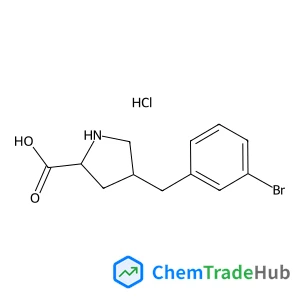
(2S,4R)-4-(3-Bromobenzyl)pyrrolidine-2-carboxylic acid hydrochloride
CAS Number:
1049734-10-2
Molecular Formula:
C12H15BrClNO2
Can the statistical properties of single-electron transfer events be correctly predicted within a common equilibrium ensemble description? This fundamental in nanoworld question of ergodic behavior is scrutinized within a very basic semi-classical curve-crossing problem. It is shown that in the limit of non-adiabatic electron transfer (weak tunneling) well-described by the Marcus–Levich–Dogonadze (MLD) rate the answer is yes. However, in the limit of the so-called solvent-controlled adiabatic electron transfer, a profound breaking of ergodicity occurs. Namely, a common description based on the ensemble reduced density matrix with an initial equilibrium distribution of the reaction coordinate is not able to reproduce the statistics of single-trajectory events in this seemingly classical regime. For sufficiently large activation barriers, the ensemble survival probability in a state remains nearly exponential with the inverse rate given by the sum of the adiabatic curve crossing (Kramers) time and the inverse MLD rate. In contrast, near to the adiabatic regime, the single-electron survival probability is clearly non-exponential, even though it possesses an exponential tail which agrees well with the ensemble description. Initially, it is well described by a Mittag-Leffler distribution with a fractional rate. Paradoxically, the mean transfer time in this classical on the ensemble level regime is well described by the inverse of the nonadiabatic quantum tunneling rate on a single particle level. An analytical theory is developed which perfectly agrees with stochastic simulations and explains our findings.
Adam D. Smith, Hannah M. Watts, Edward Jager, Daniel A. Horke, Emma Springate, Oliver Alexander, Cephise Cacho, Richard T. Chapman, Russell S. Minns
DOI: 10.1039/C6CP05279G
Jongseob Kim, Choong-Heui Chung, Ki-Ha Hong
DOI: 10.1039/C6CP02886A
Thach V. Can, Marc A. Caporini, Albert A. Smith, Robert G. Griffin
DOI: 10.1039/C6CP04623A
Pradeep Kumar, Partha Biswas, Biman Bandyopadhyay
DOI: 10.1039/C6CP04544H
Zhenghua Li, Dapeng Dong, Dedi Liu, Jia Liu, Dongping Liu, Xiang Li
DOI: 10.1039/C6CP04583A
Carlos Franco, Núria Crivillers, Gonca Seber, Andrea Droghetti, Ivan Rungger, Ilya V. Pobelov, Jaume Veciana, Marta Mas-Torrent, Concepció Rovira
DOI: 10.1039/C6CP05658J
Kyeounghak Kim, Jeong Woo Han
DOI: 10.1039/C6CP04122A
J. Zhu, H. L. Zhan, X. Y. Miao, Y. Song, K. Zhao
DOI: 10.1039/C6CP05593A
Sacha Noimark, Rafael Gómez-Bombarelli, Alexander J. MacRobert, Ivan P. Parkin, Christopher W. M. Kay
DOI: 10.1039/C6CP02529C
2-(2-Chloroacetamido)-3-phenylpropanoic acid (CAS: 7765-11-9) is generally consi...
2-(Benzyloxy)-5-bromobenzoic acid can be handled safely if appropriate precautio...
(4-Methyl-1,2,5-oxadiazol-3-yl)methanamine hydrochloride is a chemical compound ...
2-(5-Hexylthiophen-2-yl)-4,4,5,5-tetramethyl-1,3,2-dioxaborolane (CAS: 917985-54...
While 4-(8-Methyl-9H-1,3-dioxolo[4,5-h][2,3]benzodiazepin-5-yl)benzenamine (CAS:...
The market for tert-butyl 3-hydroxy-4,5,7,8-tetrahydro-2H-pyrazolo[3,4-d]azepine...
Waste containing 3,5-Diamino-1H-pyrazole-4-carbonitrile (CAS: 6844-58-2) should ...
(6-Fluoro-3-pyridinyl)boronic acid can be synthesized through the reaction of 6-...
Dibenzyl carbonimidoylbiscarbamate (CAS: 10065-79-9) finds applications in vario...
The market for (beta,beta,2,3,4,5,6-~2~H_7_)Phenylalanine (CAS: 74228-83-4) is g...

Physical Chemistry Chemical Physics (PCCP) is an international journal co-owned by 19 physical chemistry and physics societies from around the world. This journal publishes original, cutting-edge research in physical chemistry, chemical physics and biophysical chemistry. To be suitable for publication in PCCP, articles must include significant innovation and/or insight into physical chemistry; this is the most important criterion that reviewers and Editors will judge against when evaluating submissions. The journal has a broad scope and welcomes contributions spanning experiment, theory, computation and data science. Topical coverage includes spectroscopy, dynamics, kinetics, statistical mechanics, thermodynamics, electrochemistry, catalysis, surface science, quantum mechanics, quantum computing and machine learning. Interdisciplinary research areas such as polymers and soft matter, materials, nanoscience, energy, surfaces/interfaces, and biophysical chemistry are welcomed if they demonstrate significant innovation and/or insight into physical chemistry. Joined experimental/theoretical studies are particularly appreciated when complementary and based on up-to-date approaches.
![3,7-Di(1,1':3',1''-terphenyl-5'-yl)-10,11,12,13-tetrahydrodiindeno[7,1-de:1',7'-fg][1,3,2]dioxaphosphocin-5-ol 5-oxide structure](https://static.chemtradehub.com/structs/135/1352810-38-8-3f10.webp "3,7-Di(1,1':3',1''-terphenyl-5'-yl)-10,11,12,13-tetrahydrodiindeno[7,1-de:1',7'-fg][1,3,2]dioxaphosphocin-5-ol 5-oxide structure")
![(3S,4aS,8aS)-2-[(2R,3S)-3-Amino-2-hydroxy-4-phenylbutyl]-N-(2-methyl-2-propanyl)decahydro-3-isoquinolinecarboxamide structure](https://static.chemtradehub.com/structs/136/136522-17-3-4d77.webp "(3S,4aS,8aS)-2-[(2R,3S)-3-Amino-2-hydroxy-4-phenylbutyl]-N-(2-methyl-2-propanyl)decahydro-3-isoquinolinecarboxamide structure")
![{3-[Bis(4-hydroxyphenyl)methyl]-1-[2-(dimethylamino)ethyl]-1H-indol-2-yl}[4-(2-chlorophenyl)-1-piperazinyl]methanone structure](https://static.chemtradehub.com/structs/170/170365-25-0-e4d7.webp "{3-[Bis(4-hydroxyphenyl)methyl]-1-[2-(dimethylamino)ethyl]-1H-indol-2-yl}[4-(2-chlorophenyl)-1-piperazinyl]methanone structure")





