












New insight into the roles of oxygen vacancies in hematite for solar water splitting
Literature Information
Publication Date
2016-10-27
DOI
10.1039/C6CP06410H
Impact Factor
3.676
Authors
Xin Zhao, Jianyong Feng, Shi Chen, Yizhong Huang, Tze Chien Sum, Zhong Chen
View Original
Abstract
Oxygen vacancies play an important role in the performance improvement of oxide semiconductors as photoanodes for water splitting, such as TiO2, WO3, and Fe2O3. Conductivity improvement due to the presence of oxygen vacancies was reported to be the main reason for the enhanced performance. However, oxygen vacancies may also affect light absorption and charge transfer through the solid/electrolyte interface. The roles of oxygen vacancies have not been thoroughly discussed in the past. Herein, with hematite as an example, the effects of oxygen vacancies on bulk charge transport and surface catalysis are quantitatively analyzed by decoupling photon absorption, interfacial charge transfer and charge separation processes. Oxygen vacancies improve the charge separation of both pristine and Ti-doped hematite. However, opposite observations are found in the charge transfer process for pristine and Ti-doped hematite: the positive effect in pristine hematite but the negative effect in the Ti-doped one. An electrochemical technique is used to analyze the different influences on pristine and Ti-doped hematite to unravel the mechanism of the opposite observations caused by oxygen vacancies. The current study sheds lights on how oxygen vacancies affect various aspects of important factors behind PEC performance, which is helpful to the development of more efficient photoanodes in the future.
Related Literature
Mechanistical investigation on the self-enhanced photocatalytic activity of CuO/Cu2O hybrid nanostructures by density functional theory calculations
Feiyu Diao, FengHui Tian, Wenshuang Liang, Honglei Feng, Yiqian Wang
2016-09-14
Paper
DOI: 10.1039/C6CP03977D
Prediction of flatness-driven quantum spin Hall effect in functionalized germanene and stanene
Run-wu Zhang, Wei-xiao Ji, Chang-wen Zhang, Ping Li, Pei-ji Wang
2016-09-21
Paper
DOI: 10.1039/C6CP06216D
Maximizing ion current rectification in a bipolar conical nanopore fluidic diode using optimum junction location
2016-09-15
Paper
DOI: 10.1039/C6CP05280K
Physical chemistry of hybrid perovskite solar cells
Aron Walsh, Nitin P. Padure, Sang Il Seok
2016-09-02
Editorial
DOI: 10.1039/C6CP90212J
Two-dimensional exciton properties in monolayer semiconducting phosphorus allotropes
A. S. Rodin, Alexandra Carvalho, A. R. Rocha
2016-09-13
Paper
DOI: 10.1039/C6CP05566D
Half-metallic YN2 monolayer: dual spin filtering, dual spin diode and spin Seebeck effects
Jie Li, Guoying Gao, Yi Min, Kailun Yao
2016-09-16
Paper
DOI: 10.1039/C6CP05626A
Photochemistry of Zr-based MOFs: ligand-to-cluster charge transfer, energy transfer and excimer formation, what else is there?‡
Mario Gutierrez, Boiko Cohen, Félix Sánchez, Abderrazzak Douhal
2016-08-09
Paper
DOI: 10.1039/C6CP03791G
How photon pump fluence changes the charge carrier relaxation mechanism in an organic–inorganic hybrid lead triiodide perovskite
Piotr Piatkowski, Boiko Cohen, Samrana Kazim, Shahzada Ahmad, Abderrazzak Douhal
2016-06-10
Paper
DOI: 10.1039/C6CP02682F
Molecular origin of photoluminescence of carbon dots: aggregation-induced orange-red emission
Venkatesh Gude, Ananya Das, Tanmay Chatterjee, Prasun K. Mandal
2016-09-16
Paper
DOI: 10.1039/C6CP05321A
Wetting behavior of water on silicon carbide polar surfaces
Y. F. Huang, D. Gan, J. Y. Xu, H. Li, G. Wang
2016-09-13
Paper
DOI: 10.1039/C6CP04686J
You might also like
Compound Q&A
Is 2-(2-chloroacetamido)-3-phenylpropanoic acid (CAS: 7765-11-9) safe?
2-(2-Chloroacetamido)-3-phenylpropanoic acid (CAS: 7765-11-9) is generally consi...
7765-11-92-(2-chloroacetamido...
Compound Q&A
Is 2-(Benzyloxy)-5-bromobenzoic acid (CAS: 62176-31-2) safe?
2-(Benzyloxy)-5-bromobenzoic acid can be handled safely if appropriate precautio...
62176-31-22-(Benzyloxy)-5-brom...
Compound Q&A
What is (4-Methyl-1,2,5-oxadiazol-3-yl)methanamine hydrochloride (CAS: 1159825-48-5)?
(4-Methyl-1,2,5-oxadiazol-3-yl)methanamine hydrochloride is a chemical compound ...
1159825-48-5(4-Methyl-1,2,5-oxad...
Compound Q&A
What is 2-(5-Hexylthiophen-2-yl)-4,4,5,5-tetramethyl-1,3,2-dioxaborolane (CAS: 917985-54-7)?
2-(5-Hexylthiophen-2-yl)-4,4,5,5-tetramethyl-1,3,2-dioxaborolane (CAS: 917985-54...
917985-54-72-(5-Hexylthiophen-2...
Compound Q&A
Are there alternatives to 4-(8-Methyl-9H-1,3-dioxolo[4,5-h][2,3]benzodiazepin-5-yl)benzenamine (CAS: 102771-26-6) in synthesis?
While 4-(8-Methyl-9H-1,3-dioxolo[4,5-h][2,3]benzodiazepin-5-yl)benzenamine (CAS:...
102771-26-64-(8-Methyl-9H-1,3-d...
Compound Q&A
What is the market or research trend for tert-butyl 3-hydroxy-4,5,7,8-tetrahydro-2H-pyrazolo[3,4-d]azepine-6-carboxylate (CAS: 851376-80-2)?
The market for tert-butyl 3-hydroxy-4,5,7,8-tetrahydro-2H-pyrazolo[3,4-d]azepine...
851376-80-2tert-butyl 3-hydroxy...
Compound Q&A
How should waste containing 3,5-Diamino-1H-pyrazole-4-carbonitrile (CAS: 6844-58-2) be handled?
Waste containing 3,5-Diamino-1H-pyrazole-4-carbonitrile (CAS: 6844-58-2) should ...
6844-58-23,5-Diamino-1H-pyraz...
Compound Q&A
How is (6-Fluoro-3-pyridinyl)boronic acid (CAS: 351019-18-6) typically synthesized?
(6-Fluoro-3-pyridinyl)boronic acid can be synthesized through the reaction of 6-...
351019-18-6(6-Fluoro-3-pyridiny...
Compound Q&A
What industries use Dibenzyl carbonimidoylbiscarbamate (CAS: 10065-79-9)?
Dibenzyl carbonimidoylbiscarbamate (CAS: 10065-79-9) finds applications in vario...
10065-79-9Dibenzyl carbonimido...
Compound Q&A
What is the market or research trend for (beta,beta,2,3,4,5,6-~2~H_7_)Phenylalanine (CAS: 74228-83-4)?
The market for (beta,beta,2,3,4,5,6-~2~H_7_)Phenylalanine (CAS: 74228-83-4) is g...
74228-83-4(beta,beta,2,3,4,5,6...
Source Journal
Physical Chemistry Chemical Physics

CiteScore:
5.5
Self-citation Rate:
10.3%
Articles per Year:
3036
Physical Chemistry Chemical Physics (PCCP) is an international journal co-owned by 19 physical chemistry and physics societies from around the world. This journal publishes original, cutting-edge research in physical chemistry, chemical physics and biophysical chemistry. To be suitable for publication in PCCP, articles must include significant innovation and/or insight into physical chemistry; this is the most important criterion that reviewers and Editors will judge against when evaluating submissions. The journal has a broad scope and welcomes contributions spanning experiment, theory, computation and data science. Topical coverage includes spectroscopy, dynamics, kinetics, statistical mechanics, thermodynamics, electrochemistry, catalysis, surface science, quantum mechanics, quantum computing and machine learning. Interdisciplinary research areas such as polymers and soft matter, materials, nanoscience, energy, surfaces/interfaces, and biophysical chemistry are welcomed if they demonstrate significant innovation and/or insight into physical chemistry. Joined experimental/theoretical studies are particularly appreciated when complementary and based on up-to-date approaches.
Recommended Compounds
![Ethyl thieno[3,2-f]quinoline-2-carboxylate structure](https://static.chemtradehub.com/structs/299/29948-26-3-f62b.webp "Ethyl thieno[3,2-f]quinoline-2-carboxylate structure")
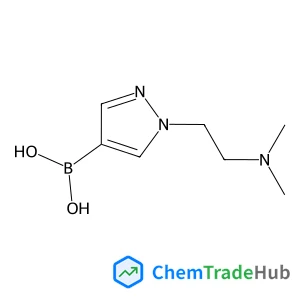
(1-(2-(Dimethylamino)ethyl)-1H-pyrazol-4-yl)boronic acid
CAS Number:
1086063-73-1
Molecular Formula:
C7H14BN3O2
![{3-[Bis(4-hydroxyphenyl)methyl]-1-[2-(dimethylamino)ethyl]-1H-indol-2-yl}[4-(2-chlorophenyl)-1-piperazinyl]methanone structure](https://static.chemtradehub.com/structs/170/170365-25-0-e4d7.webp "{3-[Bis(4-hydroxyphenyl)methyl]-1-[2-(dimethylamino)ethyl]-1H-indol-2-yl}[4-(2-chlorophenyl)-1-piperazinyl]methanone structure")
{3-[Bis(4-hydroxyphenyl)methyl]-1-[2-(dimethylamino)ethyl]-1H-indol-2-yl}[4-(2-chlorophenyl)-1-piperazinyl]methanone
CAS Number:
170365-25-0
Molecular Formula:
C36H37ClN4O3
Recommended Suppliers





Disclaimer
This page provides academic journal information for reference and research purposes only. We are not affiliated with any journal publishers and do not handle publication submissions. For publication-related inquiries, please contact the respective journal publishers directly.
If you notice any inaccuracies in the information displayed, please contact us at support@chemtradehub.com. We will promptly review and address your concerns.