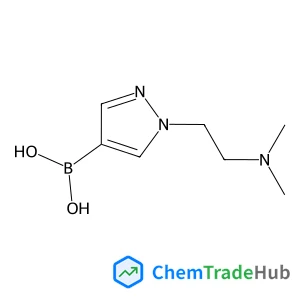
(1-(2-(Dimethylamino)ethyl)-1H-pyrazol-4-yl)boronic acid
CAS Number:
1086063-73-1
Molecular Formula:
C7H14BN3O2
Y. F. Huang, D. Gan, J. Y. Xu, H. Li, G. Wang
Technically important wide band-gap semiconductors such as GaN, AlN, ZnO and SiC are crystallized in polar structures. Taking SiC as an example, we investigate the effect of surface polarity on the wetting behavior by water using experiments and molecular dynamic simulations. It is found that the contact angle (CA) of deionized water on the carbon-face (C-face) is significantly larger than that on the silicon-face (Si-face) for both 6H-SiC and 4H-SiC, while the CA of tetrachloromethane is almost the same on these two faces. This finding clearly indicates that polar interactions between water and SiC induce such a large difference in the CA. Extensive molecular dynamics simulations suggest that a larger CA on the C-face than that on the Si-face is resulted from the different charge agglomeration on the two faces. These results will not only be helpful in improving the state of the art processes such as rinsing and wet etching in device fabrication, but also offer a reliable method to determine the polarity of SiC crystals quickly, simply, accurately and nondestructively, which is easily extendable for the measurement of other polar crystals.

New Journal of Chemistry

Journal of Saudi Chemical Society

Chemical Communications

Current Opinion in Solid State & Materials Science

Journal of Peptide Science

Current Opinion in Colloid & Interface Science

Russian Journal of Organic Chemistry

Saudi Pharmaceutical Journal

Russian Journal of Applied Chemistry

Russian Chemical Bulletin
Mirco Zerbetto, Diego Frezzato
DOI: 10.1039/C4CP03815K
Matteo Baldoni, Francesco Mercuri
DOI: 10.1039/C4CP04848B
Ananya Sen, Thomas F. M. Luxford, Naruo Yoshikawa, Caroline E. H. Dessent
DOI: 10.1039/C4CP00989D
Yong Na, Yulin Yang, Ruiqing Fan, Ping Wang, Liang Li
DOI: 10.1039/C4CP04240A
Lu Wang, Caiying Zhang, Wenliang Wang, Suotian Min, Daodao Hu
DOI: 10.1039/C4CP00387J
B. Carlotti, A. Cesaretti, C. G. Fortuna, A. Spalletti, F. Elisei
DOI: 10.1039/C4CP04963B
Zaiping Zeng, Alexia Petoni, Christos S. Garoufalis, Sotirios Baskoutas, Gabriel Bester
DOI: 10.1039/C4CP04551C
K. Zberecki, R. Swirkowicz, M. Wierzbicki
DOI: 10.1039/C4CP04884A
Sebastian Zuluaga, Li-Hong Liu, Natis Shafiq, Sara M. Rupich, Jean-François Veyan, Yves J. Chabal, Timo Thonhauser
DOI: 10.1039/C4CP05164E
Igor A. Baburin, Vladimir A. Saleev, Alexandra V. Shipilova
DOI: 10.1039/C4CP04569F
2-(2-Chloroacetamido)-3-phenylpropanoic acid (CAS: 7765-11-9) is generally consi...
2-(Benzyloxy)-5-bromobenzoic acid can be handled safely if appropriate precautio...
(4-Methyl-1,2,5-oxadiazol-3-yl)methanamine hydrochloride is a chemical compound ...
2-(5-Hexylthiophen-2-yl)-4,4,5,5-tetramethyl-1,3,2-dioxaborolane (CAS: 917985-54...
While 4-(8-Methyl-9H-1,3-dioxolo[4,5-h][2,3]benzodiazepin-5-yl)benzenamine (CAS:...
The market for tert-butyl 3-hydroxy-4,5,7,8-tetrahydro-2H-pyrazolo[3,4-d]azepine...
Waste containing 3,5-Diamino-1H-pyrazole-4-carbonitrile (CAS: 6844-58-2) should ...
(6-Fluoro-3-pyridinyl)boronic acid can be synthesized through the reaction of 6-...
Dibenzyl carbonimidoylbiscarbamate (CAS: 10065-79-9) finds applications in vario...
The market for (beta,beta,2,3,4,5,6-~2~H_7_)Phenylalanine (CAS: 74228-83-4) is g...

Physical Chemistry Chemical Physics (PCCP) is an international journal co-owned by 19 physical chemistry and physics societies from around the world. This journal publishes original, cutting-edge research in physical chemistry, chemical physics and biophysical chemistry. To be suitable for publication in PCCP, articles must include significant innovation and/or insight into physical chemistry; this is the most important criterion that reviewers and Editors will judge against when evaluating submissions. The journal has a broad scope and welcomes contributions spanning experiment, theory, computation and data science. Topical coverage includes spectroscopy, dynamics, kinetics, statistical mechanics, thermodynamics, electrochemistry, catalysis, surface science, quantum mechanics, quantum computing and machine learning. Interdisciplinary research areas such as polymers and soft matter, materials, nanoscience, energy, surfaces/interfaces, and biophysical chemistry are welcomed if they demonstrate significant innovation and/or insight into physical chemistry. Joined experimental/theoretical studies are particularly appreciated when complementary and based on up-to-date approaches.