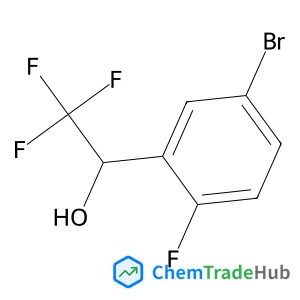
1-(5-Bromo-2-fluorophenyl)-2,2,2-trifluoroethanol
CAS Number:
1039827-16-1
Molecular Formula:
C8H5BrF4O
Run-wu Zhang, Wei-xiao Ji, Chang-wen Zhang, Ping Li, Pei-ji Wang
Searching for realistic materials able to realize room-temperature quantum spin Hall (QSH) effects is currently a growing field, especially when compatibility with the current group-IV electronics industry is required. Here we predict, through first-principles calculations, a new class of QSH phases in flattened germanene and stanene functionalized with X atoms (f-GeX2 and f-SnX2; X = H, F, Cl, Br, I) with a bulk gap as large as 0.56 eV, that can be tuned efficiently under mechanical strain. More interestingly, different from the normal band order in buckled germanane and stanane, the structural flatness leads to an inverted band order without spin–orbit coupling (SOC), whereas the SOC only opens the band gap. We also find that the characteristics of edge states, such as the Fermi velocity, are enhanced greatly by edge modification. When these films are deposited on a BN substrate, a nontrivial QSH state is preserved with a Dirac cone lying within the nontrivial band gap. These findings provide a promising platform for future realistic applications of the QSH effect at room temperature in two-dimensional group-IV films.
Martin Dulle, Sarah Jaber, Sabine Rosenfeldt, Aurel Radulescu, Stephan Förster, Paul Mulvaney, Matthias Karg
DOI: 10.1039/C4CP04816D
Keying Guo, Zhifeng Liu, Jianhua Han, Zhichao Liu, Yajun Li, Bo Wang, Ting Cui, Cailou Zhou
DOI: 10.1039/C4CP01971G
Alexander Kothe, Martin Wilke, Alexandre Moguilevski, Nicholas Engel, Bernd Winter, Igor Yu. Kiyan
DOI: 10.1039/C4CP02482F
Weihong Wu, Yunxiang Lu, Hairong Ding, Changjun Peng, Honglai Liu
DOI: 10.1039/C4CP04603J
Martin Volk, Lilia Milanesi, Christopher A. Hunter, Godfrey S. Beddard
DOI: 10.1039/C4CP03058C
Chuan Fei Guo, Jianming Zhang
DOI: 10.1039/C4CP04520C
Yunqing Chen, Yi Wang, Yuan Yuan, Yan Jiao, Xuemei Pu, Zhiyun Lu
DOI: 10.1039/C4CP04213A
B. Carlotti, A. Cesaretti, C. G. Fortuna, A. Spalletti, F. Elisei
DOI: 10.1039/C4CP04963B
Guang-Feng Wei, Cheng Shang, Zhi-Pan Liu
DOI: 10.1039/C4CP04145C
Hitoshi Kusama, Takashi Funaki, Nagatoshi Koumura, Kazuhiro Sayama
DOI: 10.1039/C4CP01880J
2-(2-Chloroacetamido)-3-phenylpropanoic acid (CAS: 7765-11-9) is generally consi...
2-(Benzyloxy)-5-bromobenzoic acid can be handled safely if appropriate precautio...
(4-Methyl-1,2,5-oxadiazol-3-yl)methanamine hydrochloride is a chemical compound ...
2-(5-Hexylthiophen-2-yl)-4,4,5,5-tetramethyl-1,3,2-dioxaborolane (CAS: 917985-54...
While 4-(8-Methyl-9H-1,3-dioxolo[4,5-h][2,3]benzodiazepin-5-yl)benzenamine (CAS:...
The market for tert-butyl 3-hydroxy-4,5,7,8-tetrahydro-2H-pyrazolo[3,4-d]azepine...
Waste containing 3,5-Diamino-1H-pyrazole-4-carbonitrile (CAS: 6844-58-2) should ...
(6-Fluoro-3-pyridinyl)boronic acid can be synthesized through the reaction of 6-...
Dibenzyl carbonimidoylbiscarbamate (CAS: 10065-79-9) finds applications in vario...
The market for (beta,beta,2,3,4,5,6-~2~H_7_)Phenylalanine (CAS: 74228-83-4) is g...

Physical Chemistry Chemical Physics (PCCP) is an international journal co-owned by 19 physical chemistry and physics societies from around the world. This journal publishes original, cutting-edge research in physical chemistry, chemical physics and biophysical chemistry. To be suitable for publication in PCCP, articles must include significant innovation and/or insight into physical chemistry; this is the most important criterion that reviewers and Editors will judge against when evaluating submissions. The journal has a broad scope and welcomes contributions spanning experiment, theory, computation and data science. Topical coverage includes spectroscopy, dynamics, kinetics, statistical mechanics, thermodynamics, electrochemistry, catalysis, surface science, quantum mechanics, quantum computing and machine learning. Interdisciplinary research areas such as polymers and soft matter, materials, nanoscience, energy, surfaces/interfaces, and biophysical chemistry are welcomed if they demonstrate significant innovation and/or insight into physical chemistry. Joined experimental/theoretical studies are particularly appreciated when complementary and based on up-to-date approaches.
![19-[Chloro(dideuterio)methyl]-19-deuterio-20,20-dideuteriooxyoctatriacontane-18,21-dione structure](https://static.chemtradehub.com/structs/124/1246818-85-8-6244.webp "19-[Chloro(dideuterio)methyl]-19-deuterio-20,20-dideuteriooxyoctatriacontane-18,21-dione structure")
![{3-[Bis(4-hydroxyphenyl)methyl]-1-[2-(dimethylamino)ethyl]-1H-indol-2-yl}[4-(2-chlorophenyl)-1-piperazinyl]methanone structure](https://static.chemtradehub.com/structs/170/170365-25-0-e4d7.webp "{3-[Bis(4-hydroxyphenyl)methyl]-1-[2-(dimethylamino)ethyl]-1H-indol-2-yl}[4-(2-chlorophenyl)-1-piperazinyl]methanone structure")