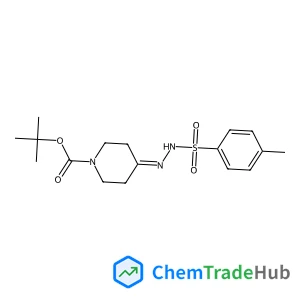
tert-Butyl 4-(2-(p-Tolylsulfonyl)hydrazono)piperidine-1-carboxylate
CAS Number:
1046478-89-0
Molecular Formula:
C17H25N3O4S
Amelia W. Ray, Jay Agarwal, Ben B. Shen, H. F. Schaefer, III, Robert E. Continetti
The F + HOCH3 → HF + OCH3 reaction is a system with 15 internal degrees of freedom that can provide a benchmark for the development of theory for increasingly complex chemical reactions. The dynamics of this reaction were studied by photoelectron–photofragment coincidence (PPC) spectroscopy carried out on the F−(HOCH3) anion, aided by a computational study of both the anion and neutral potential energy surfaces, with energies extrapolated to the CCSDT(Q)/CBS level of theory. Photodetachment at 4.80 eV accesses both the reactant and product channels for this reaction. In the product channel (HF + OCH3 + e−) of the neutral potential energy surface, vibrationally excited HF products in addition to the stable product-channel hydrogen-bonded complex (FH–OCH3) are observed in the PPC and photoelectron spectra. In addition, experimental evidence is observed for the reactant-channel van der Waals complex (F–HOCH3), in good agreement with the theoretical predictions. The relative stability of these long-lived complexes was probed by reducing the ion beam energy, increasing the product time-of-flight, indicating lifetimes on the microsecond timescale for the reactant- and product-channel complexes as well as providing evidence for long-lived vibrational Feshbach resonances associated with the HF(v > 0) + OCH3 product states. This system will provide a model for extending full-dimensionality quantum dynamics to larger numbers of degrees of freedom.
Nadia Dozova, Fabien Lacombat, Charles Bou-Nader, Djemel Hamdane, Pascal Plaza
DOI: 10.1039/C8CP06072J
Jacek Wójcik, Andrzej Ejchart, Michał Nowakowski
DOI: 10.1039/C9CP00590K
Amir A. Farajian, Reza Mortezaee, Tim H. Osborn, Olga V. Pupysheva, Michael Wang, Aruna Zhamu, Bor Z. Jang
DOI: 10.1039/C8CP07115B
Xiang Liu, Wenbo Mi
DOI: 10.1039/C9CP00033J
Yu Chen, Junyi Liu, Jiabing Yu
DOI: 10.1039/C8CP04669G
Hao Wang, Wei Wei, Fengping Li, Baibiao Huang, Ying Dai
DOI: 10.1039/C9CP01196J
H. Gokberk Ozcelik, Murat Barisik
DOI: 10.1039/C9CP00706G
I. Hanghofer, M. Brinek, S. L. Eisbacher, B. Bitschnau, M. Volck, V. Hennige, D. Rettenwander
DOI: 10.1039/C9CP00664H
Marco Fioroni, Robert E. Savage, Nathan J. DeYonker
DOI: 10.1039/C9CP00547A
Shuchang Wu, Yangming Lin, Bingwei Zhong, Guodong Wen, Hongyang Liu, Dang Sheng Su
DOI: 10.1039/C8CP06175K
When considering alternatives to 1-(4-Chlorophenyl)-N-hydroxymethanimine (CAS: 3...
This compound should be stored in a cool, dry place away from direct sunlight. I...
3-(4-Bromophenyl)-5-(2-fluorophenyl)-1,2,4-oxadiazole is synthesized through a m...
5-Chloro-2-(4-chlorophenyl)-4-methyl-6-[3-(1-piperidinyl)propoxy]pyrimidine (CAS...
2-Chloro-4-(difluoromethoxy)pyridine is used in the pharmaceutical industry for ...
3-Chloro-6-methylpyridazine (CAS: 1121-79-5) is classified under the Globally Ha...
Several alternatives can be used in the synthesis of Methyl 4,5-dimethyl-2-nitro...
Alternatives to (2E,2'E)-3,3'-(1,4-Phenylene)bisacrylaldehyde include other acry...
3-Amino-5-chloropyridin-2-ol hydrochloride is an organic compound with the CAS n...
When handling 6,7-Difluoro-2,3-dihydro-4H-chromen-4-one, it is essential to wear...

Physical Chemistry Chemical Physics (PCCP) is an international journal co-owned by 19 physical chemistry and physics societies from around the world. This journal publishes original, cutting-edge research in physical chemistry, chemical physics and biophysical chemistry. To be suitable for publication in PCCP, articles must include significant innovation and/or insight into physical chemistry; this is the most important criterion that reviewers and Editors will judge against when evaluating submissions. The journal has a broad scope and welcomes contributions spanning experiment, theory, computation and data science. Topical coverage includes spectroscopy, dynamics, kinetics, statistical mechanics, thermodynamics, electrochemistry, catalysis, surface science, quantum mechanics, quantum computing and machine learning. Interdisciplinary research areas such as polymers and soft matter, materials, nanoscience, energy, surfaces/interfaces, and biophysical chemistry are welcomed if they demonstrate significant innovation and/or insight into physical chemistry. Joined experimental/theoretical studies are particularly appreciated when complementary and based on up-to-date approaches.
![4-[(3-Chloro-2-fluorophenyl)amino]-7-methoxy-6-quinazolinyl acetate structure](https://static.chemtradehub.com/structs/740/740081-22-5-f58f.webp "4-[(3-Chloro-2-fluorophenyl)amino]-7-methoxy-6-quinazolinyl acetate structure")