












Shape adaptation of quinine in cyclodextrin cavities: NMR studies
Literature Information
Publication Date
2019-03-01
DOI
10.1039/C9CP00590K
Impact Factor
3.676
Authors
Jacek Wójcik, Andrzej Ejchart, Michał Nowakowski
View Original
Abstract
Complex formation between quinine and natural cyclodextrins (CD) was studied using NMR spectroscopy. The strongest association was observed for complexes of neutral quinine molecules with βCD. Association constants for monocationic quinine were one order of magnitude smaller, while dicationic quinine did not bind to CDs. The distribution of complexation-induced shifts and ROESY spectra revealed bimodal quinine binding in complexes formed with βCD and γCD. Complex formation resulted in a decrease of the vicinal coupling constant between H2 and H9 protons owing to the rotation about the C2−C9 bond and in consequence in mutual reorientation of two main constituents of quinine: quinoline and quinuclidine. DFT calculations allowed establishing that H2 and H9 protons are antiperiplanar in the prevailing quinine conformer(s) in aqueous solution. Conformers with synclinal H2 and H9 protons participated in quinine complexation with CDs.
Recommended Journals
Related Literature
Unprecedented twofold intramolecular hydroamination in diam(m)ine-dicarboxylatodichloridoplatinum(iv) complexes – ethane-1,2-diaminevs.ammine ligands
Michael R. Reithofer, Mathea S. Galanski, Vladimir B. Arion, Bernhard K. Keppler
2008-01-09
Communication
DOI: 10.1039/B715680D
Evolved CYP102A1 (P450BM3) variants oxidise a range of non-natural substrates and offer new selectivity options
Christopher J. C. Whitehouse, Stephen G. Bell, Henry G. Tufton, Richard J. P. Kenny, Lydia C. I. Ogilvie, Luet-Lok Wong
2008-01-11
Communication
DOI: 10.1039/B718124H
Simple dimer containing dissociatively stable mono-imidazole ligated ferrohemes
Qing-Zheng Yang, Daria Khvostichenko, John D. Atkinson, Roman Boulatov
2008-01-04
Communication
DOI: 10.1039/B717858A
Facile routes to Alkyl-BIAN ligands
Jennifer A. Moore, Kalyan Vasudevan, Nicholas J. Hill, Gregor Reeske, Alan H. Cowley
2006-06-05
Communication
DOI: 10.1039/B606390J
Synthesis of a coumarin compound from phenanthrene by a TiO2-photocatalyzed reaction
Suguru Higashida, Aiko Harada, Rikako Kawakatsu, Noriko Fujiwara, Michio Matsumura
2006-05-31
Communication
DOI: 10.1039/B604332A
Organocatalysis “on water”. Regioselective [3 + 2]-cycloaddition of nitrones and allenolates
Ezequiel Q. Morales
2006-05-26
Communication
DOI: 10.1039/B606096J
Second harmonic generation from multilayered hybrid polymer nanoassemblies enhanced by coupled surface plasmon resonance
Miki Ishifuji, Masaya Mitsuishi, Tokuji Miyashita
2007-10-24
Communication
DOI: 10.1039/B714832A
The quest for secondary structure in chiral dendrimers
Susan E. Gibson, Jacob T. Rendell
2007-11-26
Feature Article
DOI: 10.1039/B712298E
You might also like
Compound Q&A
Are there alternatives to 1-(4-Chlorophenyl)-N-hydroxymethanimine (CAS: 3848-36-0) in synthesis?
When considering alternatives to 1-(4-Chlorophenyl)-N-hydroxymethanimine (CAS: 3...
3848-36-01-(4-Chlorophenyl)-N...
Compound Q&A
How should (1R,9S,10S,12S,14E,16S,19R,20R,21S,22R)-3,9,21-Trihydroxy-5,10,12,14,16,20,22-heptamethyl-23,24-dioxatetracyclo[17.3.1.1~6,9~.0~2,7~]tetracosa-2,5,7,14-tetraen-4-one (CAS: 183202-73-5) be stored?
This compound should be stored in a cool, dry place away from direct sunlight. I...
183202-73-5(1R,9S,10S,12S,14E,1...
Compound Q&A
How is 3-(4-Bromophenyl)-5-(2-fluorophenyl)-1,2,4-oxadiazole (CAS: 419553-16-5) typically synthesized?
3-(4-Bromophenyl)-5-(2-fluorophenyl)-1,2,4-oxadiazole is synthesized through a m...
419553-16-53-(4-Bromophenyl)-5-...
Compound Q&A
How is 5-Chloro-2-(4-chlorophenyl)-4-methyl-6-[3-(1-piperidinyl)propoxy]pyrimidine (CAS: 1639220-19-1) typically synthesized?
5-Chloro-2-(4-chlorophenyl)-4-methyl-6-[3-(1-piperidinyl)propoxy]pyrimidine (CAS...
1639220-19-15-Chloro-2-(4-chloro...
Compound Q&A
What industries use 2-Chloro-4-(difluoromethoxy)pyridine (CAS: 1206978-15-5)?
2-Chloro-4-(difluoromethoxy)pyridine is used in the pharmaceutical industry for ...
1206978-15-52-Chloro-4-(difluoro...
Compound Q&A
What regulatory guidelines apply to 3-Chloro-6-methylpyridazine (CAS: 1121-79-5)?
3-Chloro-6-methylpyridazine (CAS: 1121-79-5) is classified under the Globally Ha...
1121-79-53-Chloro-6-methylpyr...
Compound Q&A
Are there alternatives to Methyl 4,5-dimethyl-2-nitrobenzoate in synthesis?
Several alternatives can be used in the synthesis of Methyl 4,5-dimethyl-2-nitro...
90922-74-0Methyl 4,5-dimethyl-...
Compound Q&A
Are there alternatives to (2E,2'E)-3,3'-(1,4-Phenylene)bisacrylaldehyde in synthesis?
Alternatives to (2E,2'E)-3,3'-(1,4-Phenylene)bisacrylaldehyde include other acry...
63405-68-5(2E,2'E)-3,3'-(1,4-P...
Compound Q&A
What is 3-Amino-5-chloropyridin-2-ol hydrochloride (CAS: 1261906-29-9)?
3-Amino-5-chloropyridin-2-ol hydrochloride is an organic compound with the CAS n...
1261906-29-93-Amino-5-chloropyri...
Compound Q&A
What precautions should be taken when handling 6,7-Difluoro-2,3-dihydro-4H-chromen-4-one (CAS: 1092349-93-3)?
When handling 6,7-Difluoro-2,3-dihydro-4H-chromen-4-one, it is essential to wear...
1092349-93-36,7-Difluoro-2,3-dih...
Source Journal
Physical Chemistry Chemical Physics

CiteScore:
5.5
Self-citation Rate:
10.3%
Articles per Year:
3036
Physical Chemistry Chemical Physics (PCCP) is an international journal co-owned by 19 physical chemistry and physics societies from around the world. This journal publishes original, cutting-edge research in physical chemistry, chemical physics and biophysical chemistry. To be suitable for publication in PCCP, articles must include significant innovation and/or insight into physical chemistry; this is the most important criterion that reviewers and Editors will judge against when evaluating submissions. The journal has a broad scope and welcomes contributions spanning experiment, theory, computation and data science. Topical coverage includes spectroscopy, dynamics, kinetics, statistical mechanics, thermodynamics, electrochemistry, catalysis, surface science, quantum mechanics, quantum computing and machine learning. Interdisciplinary research areas such as polymers and soft matter, materials, nanoscience, energy, surfaces/interfaces, and biophysical chemistry are welcomed if they demonstrate significant innovation and/or insight into physical chemistry. Joined experimental/theoretical studies are particularly appreciated when complementary and based on up-to-date approaches.
Recommended Compounds
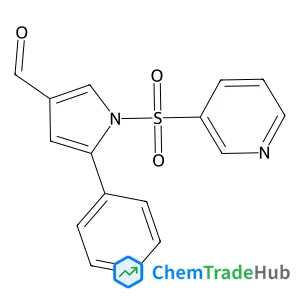
5-Phenyl-1-(pyridin-3-ylsulfonyl)-1H-pyrrole-3-carbaldehyde
CAS Number:
881676-90-0
Molecular Formula:
C16H12N2O3S
Recommended Suppliers



Disclaimer
This page provides academic journal information for reference and research purposes only. We are not affiliated with any journal publishers and do not handle publication submissions. For publication-related inquiries, please contact the respective journal publishers directly.
If you notice any inaccuracies in the information displayed, please contact us at support@chemtradehub.com. We will promptly review and address your concerns.