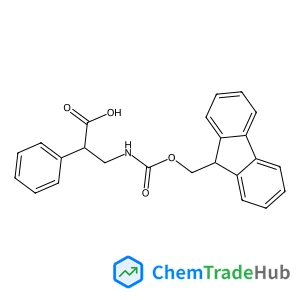
(S)-3-((((9H-Fluoren-9-yl)methoxy)carbonyl)amino)-2-phenylpropanoic acid
CAS Number:
1217663-60-9
Molecular Formula:
C24H21NO4
Cheng-chau Chiu, Hsin-Yi Liao, Hai Thi Huynh
This study demonstrates how the intermode coupling in the hydronium ion (H3O+) is modulated by the composition of the first solvation shell. A series of rare gas solvated hydronium ions (H3O+Rg3, where Rg = Ne, Ar, Kr, and Xe) is examined via reduced-dimensional anharmonic vibrational (RDAV) ab initio calculations. We considered six key vibrational normal modes, namely: a hindered rotation, two H–O–H bends, and three O–H stretches. Between the O–H stretches and the H–O–H bends, the first is more sensitive to solvation strength. Our calculations revealed that the Fermi resonance between the first overtones of O–H bends and the fundamentals of O–H stretches led to complex spectral features from 3000 to 3500 cm−1. Such an interaction is not only sensitive to the type of rare gas messengers surrounding the H3O+ ion, it also exhibits an anomalous H → D isotope effect. Although it is accepted that visible combination tones (∼1900 cm−1) arise from the complex coupling between the hindered rotation and the H–O–H bends, the origin of their intensities is not yet clearly understood. We found that the intensity of these combination tones could be much stronger than their fundamental H–O–H bends. Within our theoretical framework, we tracked the combination tone's intensity back to the asymmetric O–H stretches. This simple notion of intensity borrowing is confirmed by examining eight complexes (H3O+·Rg3 and D3O+·Rg3) with spectral features awaiting experimental confirmations.
DOI: 10.1039/C9CP00257J
DOI: 10.1039/C9CP01234F
William D. Hong, Christopher N. Lam, Yangyang Wang, Youjun He, Luis E. Sánchez-Díaz, Changwoo Do
DOI: 10.1039/C8CP07520D
Xiaojun Lv, Zexun Han, Hengxing Zhang, Qingsheng Liu, Jiangan Chen, Liangxing Jiang
DOI: 10.1039/C9CP00377K
Andrzej Poniewierski, Krzysztof Sozański, Ying Zhou, Anna Brzozowska-Elliott, Robert Holyst
DOI: 10.1039/C8CP06752J
E. Kathleen Carter, Thomas Dodd, W. David Wilson, Ivaylo Ivanov
DOI: 10.1039/C8CP05537H
Emilia Olsson, Jonathon Cottom, Xavier Aparicio-Anglès
DOI: 10.1039/C9CP00995G
Narasimhan Loganathan, Geoffrey M. Bowers, Brice F. Ngouana Wakou, Andrey G. Kalinichev
DOI: 10.1039/C9CP00851A
Jacek Wójcik, Andrzej Ejchart, Michał Nowakowski
DOI: 10.1039/C9CP00590K
Yensil Park
DOI: 10.1039/C9CP00967A
When considering alternatives to 1-(4-Chlorophenyl)-N-hydroxymethanimine (CAS: 3...
This compound should be stored in a cool, dry place away from direct sunlight. I...
3-(4-Bromophenyl)-5-(2-fluorophenyl)-1,2,4-oxadiazole is synthesized through a m...
5-Chloro-2-(4-chlorophenyl)-4-methyl-6-[3-(1-piperidinyl)propoxy]pyrimidine (CAS...
2-Chloro-4-(difluoromethoxy)pyridine is used in the pharmaceutical industry for ...
3-Chloro-6-methylpyridazine (CAS: 1121-79-5) is classified under the Globally Ha...
Several alternatives can be used in the synthesis of Methyl 4,5-dimethyl-2-nitro...
Alternatives to (2E,2'E)-3,3'-(1,4-Phenylene)bisacrylaldehyde include other acry...
3-Amino-5-chloropyridin-2-ol hydrochloride is an organic compound with the CAS n...
When handling 6,7-Difluoro-2,3-dihydro-4H-chromen-4-one, it is essential to wear...

Physical Chemistry Chemical Physics (PCCP) is an international journal co-owned by 19 physical chemistry and physics societies from around the world. This journal publishes original, cutting-edge research in physical chemistry, chemical physics and biophysical chemistry. To be suitable for publication in PCCP, articles must include significant innovation and/or insight into physical chemistry; this is the most important criterion that reviewers and Editors will judge against when evaluating submissions. The journal has a broad scope and welcomes contributions spanning experiment, theory, computation and data science. Topical coverage includes spectroscopy, dynamics, kinetics, statistical mechanics, thermodynamics, electrochemistry, catalysis, surface science, quantum mechanics, quantum computing and machine learning. Interdisciplinary research areas such as polymers and soft matter, materials, nanoscience, energy, surfaces/interfaces, and biophysical chemistry are welcomed if they demonstrate significant innovation and/or insight into physical chemistry. Joined experimental/theoretical studies are particularly appreciated when complementary and based on up-to-date approaches.