


Scaling of excitons in graphene nanodots
Literature Information
Publication Date
2016-09-19
DOI
10.1039/C6CP05825F
Impact Factor
3.676
Authors
Hao Wang
View Original
Abstract
The binding energy of an exciton in a semiconductor or an insulator is known to scale linearly with εr−2, where εr is its dielectric constant. In graphene however, since the kinetic energy scales linearly with the wave number instead of its square, the exciton binding energy is thus expected to scale with εr−1. In this work we make use of the configuration interaction approach to study the properties of excitons in graphene nanodots embedded in various dielectric environments. With tens of million configurations taken into account in the calculation, we find that the exciton binding energy can be well described by a single scaling rule in which the scaling factor is found to vary with the dimension of the nanodots as well as with the on-site interaction parameter, which agrees well with a recent experiment. The linear relation of the exciton binding energy found with the quasi-particle gap also agrees with the previous work on bulk graphene and other two-dimensional materials.
Recommended Journals

Journal of Natural Medicines

Russian Journal of Bioorganic Chemistry

Current Opinion in Solid State & Materials Science

Russian Chemical Bulletin

Journal of Saudi Chemical Society

Crystallography Reports

Acta Materialia

Current Opinion in Colloid & Interface Science

Chemical Communications

New Journal of Chemistry
Related Literature
Acetone and the precursor ligand acetylacetone: distinctly different electron beam induced decomposition?
Jonas Warneke, Willem F. Van Dorp, Petra Rudolf, Michal Stano, Peter Papp, Štefan Matejčík, Tobias Borrmann, Petra Swiderek
2014-11-14
Paper
DOI: 10.1039/C4CP04239E
Unequal effect of ethanol–water on the stability of ct-DNA, poly[(dA–dT)]2 and poly(rA)·poly(rU). Thermophysical properties
Rebeca Ruiz, Francisco J. Hoyuelos, Ana M. Navarro, José M. Leal, Begoña García
2014-11-21
Paper
DOI: 10.1039/C4CP03459G
Structural and silver/vanadium ratio effects on silver vanadium phosphorous oxide solution formation kinetics: Impact on battery electrochemistry
David C. Bock
2014-12-02
Paper
DOI: 10.1039/C4CP04819A
Towards bulk thermodynamics via non-equilibrium methods: gaseous methane as a case study
Mirco Zerbetto, Diego Frezzato
2014-12-05
Paper
DOI: 10.1039/C4CP03815K
Tunability of hybridized plasmonic waveguide mediated by surface plasmon polaritons
Ming-Ming Jiang, Chong-Xin Shan, De-Zhen Shen
2014-05-20
Paper
DOI: 10.1039/C4CP01437E
Confined platinum nanoparticle in carbon nanotube: structure and oxidation
Guang-Feng Wei, Cheng Shang, Zhi-Pan Liu
2014-11-19
Paper
DOI: 10.1039/C4CP04145C
Michaelis–Menten kinetics under non-isothermal conditions
Anders Lervik, Hong Qian
2014-11-18
Paper
DOI: 10.1039/C4CP04334K
Photoelectrocatalytic degradation of rhodamine B on TiO2 photonic crystals
Xiuzhen Zheng, Danzhen Li, Xiaofang Li, Linhui Yu, Peng Wang, Xiaoyun Zhang, Jialin Fang, Yu Shao, Yi Zheng
2014-06-09
Paper
DOI: 10.1039/C4CP01888E
A facile synthesis of highly stable and luminescent Ag clusters: a steady-state and time-resolved spectroscopy study
Nabin Kumar Pal, Carola Kryschi
2014-11-24
Paper
DOI: 10.1039/C4CP03683B
An efficient method to enhance the stability of sulphide semiconductor photocatalysts: a case study of N-doped ZnS
Yansong Zhou, Gang Chen, Yaoguang Yu, Yujie Feng, Yi Zheng, Fang He, Zhonghui Han
2014-11-27
Paper
DOI: 10.1039/C4CP03736G
You might also like
Compound Q&A
Is 2-(2-chloroacetamido)-3-phenylpropanoic acid (CAS: 7765-11-9) safe?
2-(2-Chloroacetamido)-3-phenylpropanoic acid (CAS: 7765-11-9) is generally consi...
7765-11-92-(2-chloroacetamido...
Compound Q&A
Is 2-(Benzyloxy)-5-bromobenzoic acid (CAS: 62176-31-2) safe?
2-(Benzyloxy)-5-bromobenzoic acid can be handled safely if appropriate precautio...
62176-31-22-(Benzyloxy)-5-brom...
Compound Q&A
What is (4-Methyl-1,2,5-oxadiazol-3-yl)methanamine hydrochloride (CAS: 1159825-48-5)?
(4-Methyl-1,2,5-oxadiazol-3-yl)methanamine hydrochloride is a chemical compound ...
1159825-48-5(4-Methyl-1,2,5-oxad...
Compound Q&A
What is 2-(5-Hexylthiophen-2-yl)-4,4,5,5-tetramethyl-1,3,2-dioxaborolane (CAS: 917985-54-7)?
2-(5-Hexylthiophen-2-yl)-4,4,5,5-tetramethyl-1,3,2-dioxaborolane (CAS: 917985-54...
917985-54-72-(5-Hexylthiophen-2...
Compound Q&A
Are there alternatives to 4-(8-Methyl-9H-1,3-dioxolo[4,5-h][2,3]benzodiazepin-5-yl)benzenamine (CAS: 102771-26-6) in synthesis?
While 4-(8-Methyl-9H-1,3-dioxolo[4,5-h][2,3]benzodiazepin-5-yl)benzenamine (CAS:...
102771-26-64-(8-Methyl-9H-1,3-d...
Compound Q&A
What is the market or research trend for tert-butyl 3-hydroxy-4,5,7,8-tetrahydro-2H-pyrazolo[3,4-d]azepine-6-carboxylate (CAS: 851376-80-2)?
The market for tert-butyl 3-hydroxy-4,5,7,8-tetrahydro-2H-pyrazolo[3,4-d]azepine...
851376-80-2tert-butyl 3-hydroxy...
Compound Q&A
How should waste containing 3,5-Diamino-1H-pyrazole-4-carbonitrile (CAS: 6844-58-2) be handled?
Waste containing 3,5-Diamino-1H-pyrazole-4-carbonitrile (CAS: 6844-58-2) should ...
6844-58-23,5-Diamino-1H-pyraz...
Compound Q&A
How is (6-Fluoro-3-pyridinyl)boronic acid (CAS: 351019-18-6) typically synthesized?
(6-Fluoro-3-pyridinyl)boronic acid can be synthesized through the reaction of 6-...
351019-18-6(6-Fluoro-3-pyridiny...
Compound Q&A
What industries use Dibenzyl carbonimidoylbiscarbamate (CAS: 10065-79-9)?
Dibenzyl carbonimidoylbiscarbamate (CAS: 10065-79-9) finds applications in vario...
10065-79-9Dibenzyl carbonimido...
Compound Q&A
What is the market or research trend for (beta,beta,2,3,4,5,6-~2~H_7_)Phenylalanine (CAS: 74228-83-4)?
The market for (beta,beta,2,3,4,5,6-~2~H_7_)Phenylalanine (CAS: 74228-83-4) is g...
74228-83-4(beta,beta,2,3,4,5,6...
Source Journal
Physical Chemistry Chemical Physics

CiteScore:
5.5
Self-citation Rate:
10.3%
Articles per Year:
3036
Physical Chemistry Chemical Physics (PCCP) is an international journal co-owned by 19 physical chemistry and physics societies from around the world. This journal publishes original, cutting-edge research in physical chemistry, chemical physics and biophysical chemistry. To be suitable for publication in PCCP, articles must include significant innovation and/or insight into physical chemistry; this is the most important criterion that reviewers and Editors will judge against when evaluating submissions. The journal has a broad scope and welcomes contributions spanning experiment, theory, computation and data science. Topical coverage includes spectroscopy, dynamics, kinetics, statistical mechanics, thermodynamics, electrochemistry, catalysis, surface science, quantum mechanics, quantum computing and machine learning. Interdisciplinary research areas such as polymers and soft matter, materials, nanoscience, energy, surfaces/interfaces, and biophysical chemistry are welcomed if they demonstrate significant innovation and/or insight into physical chemistry. Joined experimental/theoretical studies are particularly appreciated when complementary and based on up-to-date approaches.
Recommended Compounds
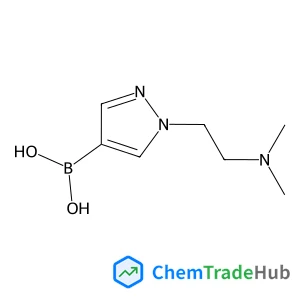
(1-(2-(Dimethylamino)ethyl)-1H-pyrazol-4-yl)boronic acid
CAS Number:
1086063-73-1
Molecular Formula:
C7H14BN3O2
![{3-[Bis(4-hydroxyphenyl)methyl]-1-[2-(dimethylamino)ethyl]-1H-indol-2-yl}[4-(2-chlorophenyl)-1-piperazinyl]methanone structure](https://static.chemtradehub.com/structs/170/170365-25-0-e4d7.webp "{3-[Bis(4-hydroxyphenyl)methyl]-1-[2-(dimethylamino)ethyl]-1H-indol-2-yl}[4-(2-chlorophenyl)-1-piperazinyl]methanone structure")
{3-[Bis(4-hydroxyphenyl)methyl]-1-[2-(dimethylamino)ethyl]-1H-indol-2-yl}[4-(2-chlorophenyl)-1-piperazinyl]methanone
CAS Number:
170365-25-0
Molecular Formula:
C36H37ClN4O3
Recommended Suppliers







Disclaimer
This page provides academic journal information for reference and research purposes only. We are not affiliated with any journal publishers and do not handle publication submissions. For publication-related inquiries, please contact the respective journal publishers directly.
If you notice any inaccuracies in the information displayed, please contact us at support@chemtradehub.com. We will promptly review and address your concerns.