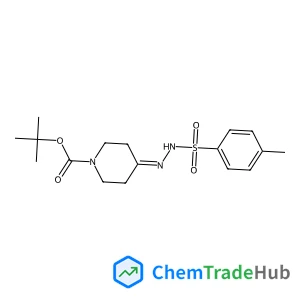
tert-Butyl 4-(2-(p-Tolylsulfonyl)hydrazono)piperidine-1-carboxylate
CAS Number:
1046478-89-0
Molecular Formula:
C17H25N3O4S
David Zanuy, Carlos A. Ferreira
Poly(hydroxymethyl-3,4-ethylendioxythiophene) (PHMeDOT), a very electroactive polythiophene derivative bearing a dioxane ring fused onto the thiophene ring and an exocyclic hydroxymethyl substituent, is able to electrocatalyze the oxidation of glucose in the presence of interferents (e.g. dopamine, uric acid and ascorbic acid) without the assistance of an enzymatic catalyst. In this work, after demonstrating that the chronoamperometric response of such polythiophene derivatives allows discrimination of glucose from fructose, the PHMeDOT⋯sugar recognition mechanism has been investigated using atomistic computer simulations. More specifically, molecular dynamics simulations were conducted on model systems formed by a steel surface covered with a nanometric film of PHMeDOT, which was immersed in an aqueous environment with a few explicit sugar molecules (i.e. glucose or fructose). Analyses of the trajectories indicate that glucose interacts with PHMeDOT forming a well-defined network of specific hydrogen bonds. More specifically, glucose prefers to interact as a hydrogen bonding donor using the hydroxyl group tether to the main sugar ring, while PHMeDOT acts as the hydrogen bonding acceptor. Interestingly, (glucose)O–H⋯O(PHMeDOT) interactions involve, as hydrogen bonding acceptors, not only the oxygen atoms of the dioxane ring but also the oxygen atom of the exocyclic hydroxymethyl substituent, which is a differential trend with respect to the other polythiophene derivatives that do not exhibit sensing ability. In contrast, fructose does not present such well-defined patterns of specific interactions, especially those that are distinctive because of the exocyclic hydroxymethyl substituent, making the experimental observations understandable.
Jordi Gómez-Segura, Ismael Díez-Pérez, Naoto Ishikawa, Motohiro Nakano, Jaume Veciana, Daniel Ruiz-Molina
DOI: 10.1039/B606276H
Qing-Zheng Yang, Daria Khvostichenko, John D. Atkinson, Roman Boulatov
DOI: 10.1039/B717858A
DOI: 10.1039/B710668H
Sébastien Royer, Xavier Sécordel, Markus Brandhorst, Franck Dumeignil, Sylvain Cristol, Christophe Dujardin, Mickaël Capron, Edmond Payen, Jean-Luc Dubois
DOI: 10.1039/B714260A
YooJeong Kwon, Jaephil Cho
DOI: 10.1039/B716694J
Gaojian Chen, Peter M. Wright, Jin Geng, Giuseppe Mantovani, David M. Haddleton
DOI: 10.1039/B718112D
Ruth Rawcliffe, Martin Heeney, Steven Tierney, Iain McCulloch, Alasdair Campbell
DOI: 10.1039/B715536K
Hang-Beom Bu, Günther Götz, Egon Reinold, Astrid Vogt, Sylvia Schmid, Raúl Blanco, Jose L. Segura, Peter Bäuerle
DOI: 10.1039/B718077B
Firmin Moingeon, Patrick Masson, Françoise Arnaud, Stéphane Méry
DOI: 10.1039/B718318F
Joo-Hyun Han, Bo-Mi Koo, Jin-Woong Kim, Kyung-Do Suh
DOI: 10.1039/B715557C
When considering alternatives to 1-(4-Chlorophenyl)-N-hydroxymethanimine (CAS: 3...
This compound should be stored in a cool, dry place away from direct sunlight. I...
3-(4-Bromophenyl)-5-(2-fluorophenyl)-1,2,4-oxadiazole is synthesized through a m...
5-Chloro-2-(4-chlorophenyl)-4-methyl-6-[3-(1-piperidinyl)propoxy]pyrimidine (CAS...
2-Chloro-4-(difluoromethoxy)pyridine is used in the pharmaceutical industry for ...
3-Chloro-6-methylpyridazine (CAS: 1121-79-5) is classified under the Globally Ha...
Several alternatives can be used in the synthesis of Methyl 4,5-dimethyl-2-nitro...
Alternatives to (2E,2'E)-3,3'-(1,4-Phenylene)bisacrylaldehyde include other acry...
3-Amino-5-chloropyridin-2-ol hydrochloride is an organic compound with the CAS n...
When handling 6,7-Difluoro-2,3-dihydro-4H-chromen-4-one, it is essential to wear...

Physical Chemistry Chemical Physics (PCCP) is an international journal co-owned by 19 physical chemistry and physics societies from around the world. This journal publishes original, cutting-edge research in physical chemistry, chemical physics and biophysical chemistry. To be suitable for publication in PCCP, articles must include significant innovation and/or insight into physical chemistry; this is the most important criterion that reviewers and Editors will judge against when evaluating submissions. The journal has a broad scope and welcomes contributions spanning experiment, theory, computation and data science. Topical coverage includes spectroscopy, dynamics, kinetics, statistical mechanics, thermodynamics, electrochemistry, catalysis, surface science, quantum mechanics, quantum computing and machine learning. Interdisciplinary research areas such as polymers and soft matter, materials, nanoscience, energy, surfaces/interfaces, and biophysical chemistry are welcomed if they demonstrate significant innovation and/or insight into physical chemistry. Joined experimental/theoretical studies are particularly appreciated when complementary and based on up-to-date approaches.
![2-{[(1R,2S)-2-Aminocyclohexyl]amino}-4-{[3-(2H-1,2,3-triazol-2-yl)phenyl]amino}-5-pyrimidinecarboxamide structure](https://static.chemtradehub.com/structs/137/1370261-96-3-40df.webp "2-{[(1R,2S)-2-Aminocyclohexyl]amino}-4-{[3-(2H-1,2,3-triazol-2-yl)phenyl]amino}-5-pyrimidinecarboxamide structure")