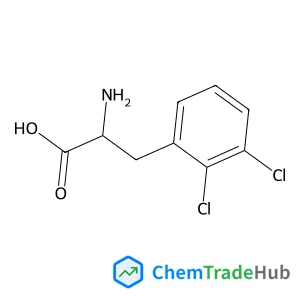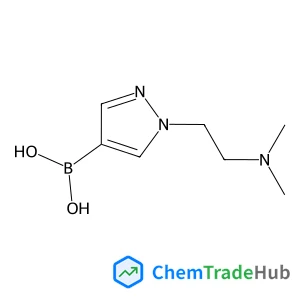
(1-(2-(Dimethylamino)ethyl)-1H-pyrazol-4-yl)boronic acid
CAS Number:
1086063-73-1
Molecular Formula:
C7H14BN3O2
Hsuan-Hsiao Yao, Hsu-Hsiang Cheng, Chao-Han Cheng, Cheng-Kai Lin, Jye-Shane Yang, I-Chia Chen
We studied the excited-state dynamics of trans-4-(N-arylamino)stilbenes with aryl = phenyl (p1H), 4-methoxyphenyl (p1OM), or 4-cyanophenyl (p1CN) in solvents of varied polarity and viscosity by using femtosecond transient absorption and time-correlated single photon counting techniques. In nonpolar solvents the decay is triexponential, in which the rapid component corresponds to vibrational cooling combined with solvation, the intermediate temporal component 41–120 ps to trans–cis isomerization, and the long one ∼1 ns to fluorescence decay of the S1 state. The S1 state has a delocalized geometry and charge-transfer characteristics, corresponding to a planar intramolecular charge transfer (PICT) state. In polar solvents, an excited-state absorption band appears near 520 and 480 nm for p1OM and p1CN, respectively but not for p1H. This band has a rise lifetime of 4.3/7.5, 16.3/9.4, and 29.5/16 ps for p1CN/p1OM in acetonitrile (ACN), dimethylformamide (DMF), and dimethyl sulfoxide (DMSO), respectively and matches the decay of the 600 nm PICT band. This band is thus assigned to the absorption of a singlet twisted intramolecular charge transfer state (TICT). The conversion rate decreases as the solvent viscosity is increased and is consistent with a large structural variation amplitude. Theoretical calculations using density functional theory (DFT), method PEB0, were employed to obtain the optimized structures and energies of those states. The PICT state possesses delocalized π electrons along the molecule. The TICT for p1CN is formed by twisting about the aminostilbene–benzonitrile C–N bond by ∼90°, but it is about the stilbene–aniline C–N bond for p1OM. We observed faster conversion rates for p1CN in alcoholic solvents, in which the lifetimes for both the PICT and TICT states are shortened to 20–99 ps and 120–660 ps, respectively, as a result of solvent–solute H-bonding interactions. In p1OM, the TICT state has an elongated CC bond in the stilbene moiety, which might facilitate the trans–cis isomerization reaction and thus account for the relatively short lifetime of 58–420 ps in polar solvents.

Russian Journal of Organic Chemistry

Journal of Natural Medicines

Chemistry Education Research and Practice

Nature Medicine

New Journal of Chemistry

Crystallography Reports

Russian Journal of Bioorganic Chemistry

Saudi Pharmaceutical Journal

Russian Journal of General Chemistry

Current Opinion in Colloid & Interface Science
Daohui Zhao, Chunwang Peng, Jian Zhou
DOI: 10.1039/C4CP04696J
H. Kearns, N. C. Shand, W. E. Smith, K. Faulds, D. Graham
DOI: 10.1039/C4CP04281F
Gustavo A. Garcia, Héloïse Dossmann, Laurent Nahon, Steven Daly, Ivan Powis
DOI: 10.1039/C4CP01941E
Pei-Hsing Huang, Shang-Chao Hung, Ming-Yueh Huang
DOI: 10.1039/C4CP01922A
Hitoshi Kusama, Takashi Funaki, Nagatoshi Koumura, Kazuhiro Sayama
DOI: 10.1039/C4CP01880J
L. L. Zou, M. Nadeem, S. C. Su, Z. L. Wang, W. Anwand, A. Wagner, J. H. Hao, C. W. Leung, R. Lortz, F. C. C. Ling
DOI: 10.1039/C4CP00951G
Xiao Zhang, Mingshan Zhu, Penglei Chen, Yongjun Li, Huibiao Liu, Yuliang Li, Minghua Liu
DOI: 10.1039/C4CP04683H
Aihua Wu
DOI: 10.1039/C4CP01858C
Pilar Redondo, Antonio Largo, Víctor Manuel Rayón, Germán Molpeceres, José Ángel Sordo, Carmen Barrientos
DOI: 10.1039/C4CP02094D
A. Shayeghi, D. Götz, J. B. A. Davis, R. Schäfer, R. L. Johnston
DOI: 10.1039/C4CP04323E
2-(2-Chloroacetamido)-3-phenylpropanoic acid (CAS: 7765-11-9) is generally consi...
2-(Benzyloxy)-5-bromobenzoic acid can be handled safely if appropriate precautio...
(4-Methyl-1,2,5-oxadiazol-3-yl)methanamine hydrochloride is a chemical compound ...
2-(5-Hexylthiophen-2-yl)-4,4,5,5-tetramethyl-1,3,2-dioxaborolane (CAS: 917985-54...
While 4-(8-Methyl-9H-1,3-dioxolo[4,5-h][2,3]benzodiazepin-5-yl)benzenamine (CAS:...
The market for tert-butyl 3-hydroxy-4,5,7,8-tetrahydro-2H-pyrazolo[3,4-d]azepine...
Waste containing 3,5-Diamino-1H-pyrazole-4-carbonitrile (CAS: 6844-58-2) should ...
(6-Fluoro-3-pyridinyl)boronic acid can be synthesized through the reaction of 6-...
Dibenzyl carbonimidoylbiscarbamate (CAS: 10065-79-9) finds applications in vario...
The market for (beta,beta,2,3,4,5,6-~2~H_7_)Phenylalanine (CAS: 74228-83-4) is g...

Physical Chemistry Chemical Physics (PCCP) is an international journal co-owned by 19 physical chemistry and physics societies from around the world. This journal publishes original, cutting-edge research in physical chemistry, chemical physics and biophysical chemistry. To be suitable for publication in PCCP, articles must include significant innovation and/or insight into physical chemistry; this is the most important criterion that reviewers and Editors will judge against when evaluating submissions. The journal has a broad scope and welcomes contributions spanning experiment, theory, computation and data science. Topical coverage includes spectroscopy, dynamics, kinetics, statistical mechanics, thermodynamics, electrochemistry, catalysis, surface science, quantum mechanics, quantum computing and machine learning. Interdisciplinary research areas such as polymers and soft matter, materials, nanoscience, energy, surfaces/interfaces, and biophysical chemistry are welcomed if they demonstrate significant innovation and/or insight into physical chemistry. Joined experimental/theoretical studies are particularly appreciated when complementary and based on up-to-date approaches.
![(1R)-N-((1R)-1-Phenylethyl)-1-[4-(tert-butyldimethylsilyloxymethyl)cyclohexyl]ethan-1-amine structure](https://static.chemtradehub.com/structs/672/672314-45-3-47ef.webp "(1R)-N-((1R)-1-Phenylethyl)-1-[4-(tert-butyldimethylsilyloxymethyl)cyclohexyl]ethan-1-amine structure")
![2-[(E)-(2-Methoxyphenyl)diazenyl]-3-oxo-N-(2-oxo-2,3-dihydro-1H-benzimidazol-5-yl)butanamide structure](https://static.chemtradehub.com/structs/821/82199-12-0-f1d0.webp "2-[(E)-(2-Methoxyphenyl)diazenyl]-3-oxo-N-(2-oxo-2,3-dihydro-1H-benzimidazol-5-yl)butanamide structure")