











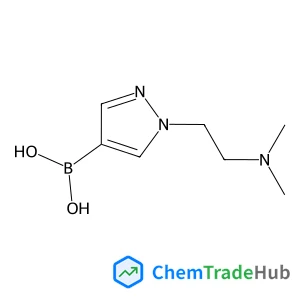
(1-(2-(Dimethylamino)ethyl)-1H-pyrazol-4-yl)boronic acid
CAS Number:
1086063-73-1
Molecular Formula:
C7H14BN3O2
Siwar Chibani, Mouheb Chebbi, Sébastien Lebègue, Laurent Cantrel, Michael Badawi
Silver modified zeolites with a mordenite structure can capture volatile iodine compounds (I2 and ICH3) which can be released during a severe nuclear accident. However under these particular conditions, molecules such as CO and H2O present in the containment atmosphere are expected to inhibit the adsorption of iodine compounds. In the present work, periodic density functional theory calculations have been carried out to investigate the interaction of I2, ICH3, H2O and CO molecules in silver-exchanged mordenite with various Si/Al ratios with the aim of finding values that favor a selective adsorption of I2 and ICH3. Computational results show that the interaction energies of CO and H2O remain of the same order of magnitude (from −120 to −140 kJ mol−1 for CO and from −90 to −120 kJ mol−1 for H2O) for all the investigated Si/Al ratios. In contrast, ICH3 is increasingly strongly adsorbed as the Si/Al ratio decreases, from around −145 kJ mol−1 when Si/Al = 47 to −190 kJ mol−1 for Si/Al = 5. The same trend is observed for I2 with a larger amplitude: from −135 kJ mol−1 for Si/Al = 47 to −300 kJ mol−1 for Si/Al = 5. Therefore, the use of silver-exchanged mordenite with Si/Al ratios of 5 or 11 would drastically limit the inhibiting effect of contaminants on the adsorption of volatile iodine species. Also for the same ratios, a spontaneous dissociation of I2 during its adsorption is observed, leading to the formation of AgI complexes which are prerequisite for the immobilization of iodine in the long term.
Akiho Horibe, Tomoko Murayama, Tsuyoshi Kawai, Yoshiyuki Nonoguchi
DOI: 10.1039/D3LF00119A
DOI: 10.1039/D3SU00247K
Bareera Siddiqui, Alisha Ahmad, Owais Yousuf, Kaiser Younis
DOI: 10.1039/D3FB00111C
K. Sandeep Raju, Gouri Sankar Das, Kumud Malika Tripathi
DOI: 10.1039/D3SU00343D
DOI: 10.1039/D3SU90059B
Anna Hu, Yujie Zhang, Jinchuang Zhang, Tongqing Li, Zhaojun Wang, Qiang Wang
DOI: 10.1039/D3FB00171G
Ali Asad Yousaf, Kashif Sarfraz Abbasi, Muhammad Suhail Ibrahim, Asma Sohail, Mamoona Faiz, Mehwish Khadim
DOI: 10.1039/D3FB00113J
Ram Asrey, Swati Sharma, Kalyan Barman, Uma Prajapati, Narender Negi
DOI: 10.1039/D3FB00037K
Sumit Kumar Verma, Remya Sasikala, Pankaj Kishore, C. O. Mohan, P. Ganesan, Pandurengan Padmavathy, Nagarajan Muralidharan, Bindu Jaganath, Soottawat Benjakul
DOI: 10.1039/D3FB00144J
2-(2-Chloroacetamido)-3-phenylpropanoic acid (CAS: 7765-11-9) is generally consi...
2-(Benzyloxy)-5-bromobenzoic acid can be handled safely if appropriate precautio...
(4-Methyl-1,2,5-oxadiazol-3-yl)methanamine hydrochloride is a chemical compound ...
2-(5-Hexylthiophen-2-yl)-4,4,5,5-tetramethyl-1,3,2-dioxaborolane (CAS: 917985-54...
While 4-(8-Methyl-9H-1,3-dioxolo[4,5-h][2,3]benzodiazepin-5-yl)benzenamine (CAS:...
The market for tert-butyl 3-hydroxy-4,5,7,8-tetrahydro-2H-pyrazolo[3,4-d]azepine...
Waste containing 3,5-Diamino-1H-pyrazole-4-carbonitrile (CAS: 6844-58-2) should ...
(6-Fluoro-3-pyridinyl)boronic acid can be synthesized through the reaction of 6-...
Dibenzyl carbonimidoylbiscarbamate (CAS: 10065-79-9) finds applications in vario...
The market for (beta,beta,2,3,4,5,6-~2~H_7_)Phenylalanine (CAS: 74228-83-4) is g...

Physical Chemistry Chemical Physics (PCCP) is an international journal co-owned by 19 physical chemistry and physics societies from around the world. This journal publishes original, cutting-edge research in physical chemistry, chemical physics and biophysical chemistry. To be suitable for publication in PCCP, articles must include significant innovation and/or insight into physical chemistry; this is the most important criterion that reviewers and Editors will judge against when evaluating submissions. The journal has a broad scope and welcomes contributions spanning experiment, theory, computation and data science. Topical coverage includes spectroscopy, dynamics, kinetics, statistical mechanics, thermodynamics, electrochemistry, catalysis, surface science, quantum mechanics, quantum computing and machine learning. Interdisciplinary research areas such as polymers and soft matter, materials, nanoscience, energy, surfaces/interfaces, and biophysical chemistry are welcomed if they demonstrate significant innovation and/or insight into physical chemistry. Joined experimental/theoretical studies are particularly appreciated when complementary and based on up-to-date approaches.
![Ethyl ({[(2-methyl-2-propanyl)oxy]carbonyl}amino)(2-pyridinyl)acetate structure](https://static.chemtradehub.com/structs/313/313490-90-3-dd15.webp "Ethyl ({[(2-methyl-2-propanyl)oxy]carbonyl}amino)(2-pyridinyl)acetate structure")



