













Dye adsorption-assisted colloidal dispersion of single-walled carbon nanotubes in polar solvents
Literature Information
Publication Date
2023-09-18
DOI
10.1039/D3LF00119A
Impact Factor
0
Authors
Akiho Horibe, Tomoko Murayama, Tsuyoshi Kawai, Yoshiyuki Nonoguchi
View Original
Abstract
Micellar surfactants with amphiphilic chemical structures are mostly used to disperse single-walled carbon nanotubes (SWCNTs) in water. However, there is little systematic knowledge regarding the use of low-molecular-weight nonmicellar adsorbates as efficient surfactants for colloidal SWCNT dispersions, which limits the number of available solvents. In this article, we present an empirical rule for adsorbate-based dispersants required for SWCNT dispersion in polar organic solvents and water. First, we demonstrate that SWCNTs can be dispersed in aqueous media with the aid of the non-aqueous stilbene backbone compound amsonic acid. The impact of nonmicellar physical adsorption on dispersion was systematically examined using low-molecular-weight compounds, including Fluorescent Brighteners 28 and 220. This discovery has increased the availability of solvents such as water, polar organic solvents such as alcohols, and surfactants such as widely used organic dyes. The results of our study indicate that effective nonmicellar dispersants should include acid–base-carrying structures. The present findings have elucidated the colloidal chemistry of nanocarbon materials with significant potential for application as low-molecular-weight adsorbate-enhanced multifunctional inks.
Related Literature
In situ magnetic resonance imaging of electrically-induced water diffusion in a Nafion ionic polymer film
Richard T. Baker, Leila Naji, Karen Lochhead, John A. Chudek
2003-03-18
Communication
DOI: 10.1039/B301039B
The role of isomorphism in synthetic analysis. Pruning the search tree by finding disjoint isomorphic substructures
Steven H. Bertz, Toby J. Sommer
2003-03-25
Communication
DOI: 10.1039/B300935A
Controlled assembly of luminescent racks based on heteroleptic dinuclear lanthanide complexes
M. Margarita Castaño-Briones, Andrew P. Bassett, Linette L. Meason, Peter R. Ashton, Zoe Pikramenou
2004-10-26
Communication
DOI: 10.1039/B412999G
Gold and silver nanoparticles functionalized with known numbers of oligonucleotides per particle for DNA detection
Yang Chen, Jenny Aveyard, Robert Wilson
2004-11-18
Communication
DOI: 10.1039/B411181H
Capturing a metastable chiral polymorph of an achiral molecule—hexa-O-benzoyl-myo-inositol
Rajesh G. Gonnade, Mohan M. Bhadbhade, Mysore S. Shashidhar
2004-09-27
Communication
DOI: 10.1039/B410051D
Photoactive dimesogen having different pathways of light driven phase transitions at different temperatures
V. Ajay Mallia, Nobuyuki Tamaoki
2004-10-01
Communication
DOI: 10.1039/B410902C
Influence of substrate on self-assembled photonic crystal
Sachiko I. Matsushita
2004-02-09
Communication
DOI: 10.1039/B313410E
Monitoring the formation of biosilica catalysed by histidine-tagged silicatein
Muhammad Nawaz Tahir, Patrick Théato, Werner E. G. Müller, Heinz C. Schröder, Andreas Janshoff, Jian Zhang, Joachim Huth, Wolfgang Tremel
2004-10-27
Communication
DOI: 10.1039/B410283E
Highly substituted pyridinesvia tethered imine–enamine (TIE) methodology
Steven A. Raw, Richard J. K. Taylor
2004-01-27
Communication
DOI: 10.1039/B316107B
A novel migrative addition reaction of hydrazines to the diketone derivative of C60
Sho-ichi Iwamatsu, Fumiaki Ono
2003-05-02
Communication
DOI: 10.1039/B302080K
You might also like
Compound Q&A
What industries use (1R,3S)-1,3-Cyclopentanediol (CAS: 16326-97-9)?
(1R,3S)-1,3-Cyclopentanediol finds applications in various industries. In the ph...
16326-97-9(1R,3S)-1,3-Cyclopen...
Compound Q&A
What precautions should be taken when handling N'-[4-(Dimethylamino)phenyl]-N,N-dimethyl-1,4-benzenediamine (CAS: 637-31-0)?
When handling N'-[4-(Dimethylamino)phenyl]-N,N-dimethyl-1,4-benzenediamine, it i...
637-31-0N'-[4-(Dimethylamino...
Compound Q&A
Are there alternatives to 5-(2,4-Difluorophenyl)-2-methoxypyrimidine (CAS: 1352318-16-1) in synthesis?
There are several alternatives to 5-(2,4-Difluorophenyl)-2-methoxypyrimidine in ...
1352318-16-15-(2,4-Difluoropheny...
Compound Q&A
What regulatory guidelines apply to 1-(3-Methoxyphenoxy)propan-2-ol (CAS: 382141-68-6)?
1-(3-Methoxyphenoxy)propan-2-ol (CAS: 382141-68-6) must comply with the Globally...
382141-68-61-(3-Methoxyphenoxy)...
Compound Q&A
Is Tetrodotoxin Citrate (CAS: 18660-81-6) safe?
Tetrodotoxin Citrate is extremely dangerous and should be handled with extreme c...
18660-81-6Tetrodotoxin Citrate
Compound Q&A
What are the main uses of 2-Methyl-2-propanyl [(1R,3S)-3-hydroxycyclopentyl]carbamate (CAS: 225641-84-9)?
2-Methyl-2-propanyl [(1R,3S)-3-hydroxycyclopentyl]carbamate (CAS: 225641-84-9) i...
225641-84-92-Methyl-2-propanyl ...
Compound Q&A
How should waste containing 4-(2-Hydroxyhexafluoroisopropyl)Benzoic Acid (CAS: 16261-80-6) be handled?
Waste containing 4-(2-Hydroxyhexafluoroisopropyl)Benzoic Acid (CAS: 16261-80-6) ...
16261-80-64-(2-Hydroxyhexafluo...
Compound Q&A
How is 2-Methyl-2-proanyl {(2S)-1-[(benzyloxy)amino]-3-hydroxy-3-methyl-1-oxo-2-butanyl}carbamate (CAS: 102507-19-7) typically synthesized?
2-Methyl-2-proanyl {(2S)-1-[(benzyloxy)amino]-3-hydroxy-3-methyl-1-oxo-2-butanyl...
102507-19-72-Methyl-2-propanyl ...
Compound Q&A
What is Benzeneethanamine, α-ethyl-, hydrochloride (1:1) (CAS: 20735-15-3)?
Benzeneethanamine, α-ethyl-, hydrochloride (1:1) is an organic compound with the...
20735-15-3Benzeneethanamine, α...
Compound Q&A
Are there alternatives to 3-{(E)-[4-(Dimethylamino)phenyl]diazenyl}benzoic acid (CAS: 20691-84-3) in synthesis?
In the synthesis of compounds similar to 3-{(E)-[4-(Dimethylamino)phenyl]diazeny...
20691-84-33-{(E)-[4-(Dimethyla...
Source Journal
Recommended Compounds
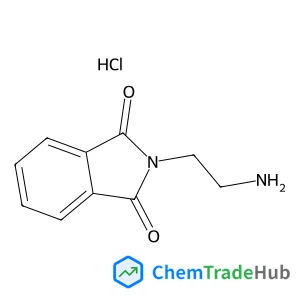
2-(2-Aminoethyl)-1H-isoindole-1,3(2H)-dione hydrochloride (1:1)
CAS Number:
30250-67-0
Molecular Formula:
C10H11ClN2O2


Recommended Suppliers






Disclaimer
This page provides academic journal information for reference and research purposes only. We are not affiliated with any journal publishers and do not handle publication submissions. For publication-related inquiries, please contact the respective journal publishers directly.
If you notice any inaccuracies in the information displayed, please contact us at support@chemtradehub.com. We will promptly review and address your concerns.