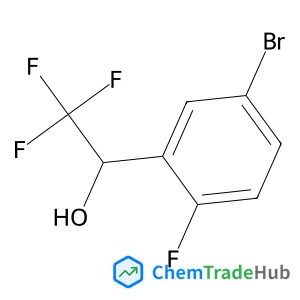
1-(5-Bromo-2-fluorophenyl)-2,2,2-trifluoroethanol
CAS Number:
1039827-16-1
Molecular Formula:
C8H5BrF4O
Xiaofang Li, Changqian Wang, Bo Li, Yu Shao, Danzhen Li
Efficient light harvesting was observed over CdS photodeposited on In2O3 photonic crystals during the photocatalytic hydrogenation of 4-nitroaniline to p-phenylenediamine. The highest conversion of 4-nitroaniline and selectivity of p-phenylenediamine over the In2O3 photonic crystal supported CdS were ∼93% and ∼99%, respectively, which were better than that achieved for commercial hexagonal CdS. The existence of the photonic crystal structure was responsible for the higher efficiency of In2O3 photonic crystal supported CdS. The ordered structure facilitated the mass transport. The elaborate tuning of the photonic band gap activated the slow photon enhancement effect on the blue edge for intensifying the light harvesting efficiency of CdS. Moreover, CdS supported on In2O3 photonic crystals exhibited higher photocatalytic stability than that on the In2O3 nanocrystals. The mechanism of photocatalytic hydrogenation over In2O3 photonic crystal supported CdS was discussed. Our results provided guidance for efficiently utilizing light for photocatalysis by applying photonic crystals as support.
Sebastian Zuluaga, Li-Hong Liu, Natis Shafiq, Sara M. Rupich, Jean-François Veyan, Yves J. Chabal, Timo Thonhauser
DOI: 10.1039/C4CP05164E
Alessandro Erba, Roberto Dovesi
DOI: 10.1039/C4CP01597E
Jiang Pu, Lain-Jong Li
DOI: 10.1039/C3CP55270E
Mrinmoy Biswas, Madhab Dule, Pabitra N. Samanta, Sharmistha Ghosh, Tarun K. Mandal
DOI: 10.1039/C4CP01324G
L. L. Zou, M. Nadeem, S. C. Su, Z. L. Wang, W. Anwand, A. Wagner, J. H. Hao, C. W. Leung, R. Lortz, F. C. C. Ling
DOI: 10.1039/C4CP00951G
K. Zberecki, R. Swirkowicz, M. Wierzbicki
DOI: 10.1039/C4CP04884A
Elisa Frezza, Alberta Ferrarini, Hima Bindu Kolli, Achille Giacometti, Giorgio Cinacchi
DOI: 10.1039/C4CP01816H
K. A. Eslahian, D. Docter, T. Lang, R. Zellner, K. Nienhaus, R. H. Stauber, M. Maskos
DOI: 10.1039/C4CP00058G
Pilar Redondo, Antonio Largo, Víctor Manuel Rayón, Germán Molpeceres, José Ángel Sordo, Carmen Barrientos
DOI: 10.1039/C4CP02094D
Jonas Warneke, Willem F. Van Dorp, Petra Rudolf, Michal Stano, Peter Papp, Štefan Matejčík, Tobias Borrmann, Petra Swiderek
DOI: 10.1039/C4CP04239E
2-(2-Chloroacetamido)-3-phenylpropanoic acid (CAS: 7765-11-9) is generally consi...
2-(Benzyloxy)-5-bromobenzoic acid can be handled safely if appropriate precautio...
(4-Methyl-1,2,5-oxadiazol-3-yl)methanamine hydrochloride is a chemical compound ...
2-(5-Hexylthiophen-2-yl)-4,4,5,5-tetramethyl-1,3,2-dioxaborolane (CAS: 917985-54...
While 4-(8-Methyl-9H-1,3-dioxolo[4,5-h][2,3]benzodiazepin-5-yl)benzenamine (CAS:...
The market for tert-butyl 3-hydroxy-4,5,7,8-tetrahydro-2H-pyrazolo[3,4-d]azepine...
Waste containing 3,5-Diamino-1H-pyrazole-4-carbonitrile (CAS: 6844-58-2) should ...
(6-Fluoro-3-pyridinyl)boronic acid can be synthesized through the reaction of 6-...
Dibenzyl carbonimidoylbiscarbamate (CAS: 10065-79-9) finds applications in vario...
The market for (beta,beta,2,3,4,5,6-~2~H_7_)Phenylalanine (CAS: 74228-83-4) is g...

Physical Chemistry Chemical Physics (PCCP) is an international journal co-owned by 19 physical chemistry and physics societies from around the world. This journal publishes original, cutting-edge research in physical chemistry, chemical physics and biophysical chemistry. To be suitable for publication in PCCP, articles must include significant innovation and/or insight into physical chemistry; this is the most important criterion that reviewers and Editors will judge against when evaluating submissions. The journal has a broad scope and welcomes contributions spanning experiment, theory, computation and data science. Topical coverage includes spectroscopy, dynamics, kinetics, statistical mechanics, thermodynamics, electrochemistry, catalysis, surface science, quantum mechanics, quantum computing and machine learning. Interdisciplinary research areas such as polymers and soft matter, materials, nanoscience, energy, surfaces/interfaces, and biophysical chemistry are welcomed if they demonstrate significant innovation and/or insight into physical chemistry. Joined experimental/theoretical studies are particularly appreciated when complementary and based on up-to-date approaches.