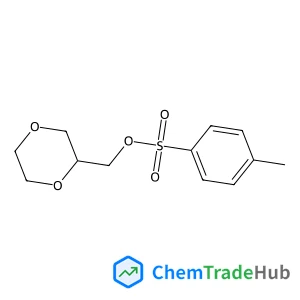
(S)-(1,4-Dioxan-2-yl)methyl 4-methylbenzenesulfonate
CAS Number:
917882-64-5
Molecular Formula:
C12H16O5S
B. X. Wang, T. F. Liu, Y. B. Zhou, X. Chen, X. B. Yuan, Y. Y. Yang, W. P. Liu, J. M. Wang, H. W. Han, Y. W. Tang
A one dimensional nanostructure array has been considered as a successful charge transport material for perovskite solar cells (PSCs), because of its large internal surface area, superior charge collection efficiency and fast charge transport. Herein we demonstrate a ZnO nanorod (NR) array as the electron collector in a hole-conductor-free PSC with a carbon counter electrode (CE). A relatively low initial power conversion efficiency (PCE) of 5.6% was achieved using a 1 μm long ZnO NR array as an electron collector. However, by introduction of a thin TiO2 coating layer on the surface of ZnO via TiCl4 treatment, the PCE of the cell has been improved to the highest value of 8.24%. It is revealed that the performance enhancement of the ZnO/TiO2 NR based PSCs is largely attributed to the larger surface area, reduced electron combination, and superior electron transport properties.

Russian Journal of Coordination Chemistry

Current Opinion in Colloid & Interface Science

Nature Medicine

Russian Journal of Bioorganic Chemistry

New Journal of Chemistry

Chemical Communications

Organic Process Research & Development

Current Opinion in Solid State & Materials Science

Drug Discovery Today

Russian Chemical Bulletin
L. L. Zou, M. Nadeem, S. C. Su, Z. L. Wang, W. Anwand, A. Wagner, J. H. Hao, C. W. Leung, R. Lortz, F. C. C. Ling
DOI: 10.1039/C4CP00951G
R. F. Jin, Y. F. Chang
DOI: 10.1039/C4CP04394D
Pei-Hsing Huang, Shang-Chao Hung, Ming-Yueh Huang
DOI: 10.1039/C4CP01922A
Xiuzhen Zheng, Danzhen Li, Xiaofang Li, Linhui Yu, Peng Wang, Xiaoyun Zhang, Jialin Fang, Yu Shao, Yi Zheng
DOI: 10.1039/C4CP01888E
Christian Reece, David J. Willock, Abbie Trewin
DOI: 10.1039/C4CP04046E
S. Nedd
DOI: 10.1039/C4CP03418J
Aihua Wu
DOI: 10.1039/C4CP01858C
Sebastian Zuluaga, Li-Hong Liu, Natis Shafiq, Sara M. Rupich, Jean-François Veyan, Yves J. Chabal, Timo Thonhauser
DOI: 10.1039/C4CP05164E
Björn Arnold, Matt Bumstead, Ayse Turak
DOI: 10.1039/C4CP02331E
2-(2-Chloroacetamido)-3-phenylpropanoic acid (CAS: 7765-11-9) is generally consi...
2-(Benzyloxy)-5-bromobenzoic acid can be handled safely if appropriate precautio...
(4-Methyl-1,2,5-oxadiazol-3-yl)methanamine hydrochloride is a chemical compound ...
2-(5-Hexylthiophen-2-yl)-4,4,5,5-tetramethyl-1,3,2-dioxaborolane (CAS: 917985-54...
While 4-(8-Methyl-9H-1,3-dioxolo[4,5-h][2,3]benzodiazepin-5-yl)benzenamine (CAS:...
The market for tert-butyl 3-hydroxy-4,5,7,8-tetrahydro-2H-pyrazolo[3,4-d]azepine...
Waste containing 3,5-Diamino-1H-pyrazole-4-carbonitrile (CAS: 6844-58-2) should ...
(6-Fluoro-3-pyridinyl)boronic acid can be synthesized through the reaction of 6-...
Dibenzyl carbonimidoylbiscarbamate (CAS: 10065-79-9) finds applications in vario...
The market for (beta,beta,2,3,4,5,6-~2~H_7_)Phenylalanine (CAS: 74228-83-4) is g...

Physical Chemistry Chemical Physics (PCCP) is an international journal co-owned by 19 physical chemistry and physics societies from around the world. This journal publishes original, cutting-edge research in physical chemistry, chemical physics and biophysical chemistry. To be suitable for publication in PCCP, articles must include significant innovation and/or insight into physical chemistry; this is the most important criterion that reviewers and Editors will judge against when evaluating submissions. The journal has a broad scope and welcomes contributions spanning experiment, theory, computation and data science. Topical coverage includes spectroscopy, dynamics, kinetics, statistical mechanics, thermodynamics, electrochemistry, catalysis, surface science, quantum mechanics, quantum computing and machine learning. Interdisciplinary research areas such as polymers and soft matter, materials, nanoscience, energy, surfaces/interfaces, and biophysical chemistry are welcomed if they demonstrate significant innovation and/or insight into physical chemistry. Joined experimental/theoretical studies are particularly appreciated when complementary and based on up-to-date approaches.

![(1S)-1,5-Anhydro-2-O-alpha-L-arabinopyranosyl-1-[5-hydroxy-7-({6-O-[3-(4-hydroxy-3-methoxyphenyl)propanoyl]-beta-D-glucopyranosyl}oxy)-2-(4-hydroxyphenyl)-4-oxo-4H-chromen-6-yl]-D-glucitol structure](https://static.chemtradehub.com/structs/225/2252345-81-4-bcff.webp "(1S)-1,5-Anhydro-2-O-alpha-L-arabinopyranosyl-1-[5-hydroxy-7-({6-O-[3-(4-hydroxy-3-methoxyphenyl)propanoyl]-beta-D-glucopyranosyl}oxy)-2-(4-hydroxyphenyl)-4-oxo-4H-chromen-6-yl]-D-glucitol structure")