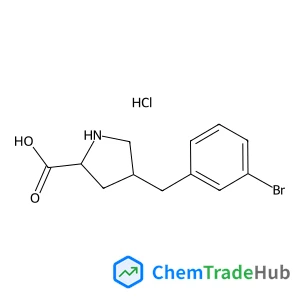
(2S,4R)-4-(3-Bromobenzyl)pyrrolidine-2-carboxylic acid hydrochloride
CAS Number:
1049734-10-2
Molecular Formula:
C12H15BrClNO2
A. V. Gorbunov, T. Putzeys, I. Urbanavičiūtė, R. A. J. Janssen, M. Wübbenhorst, R. P. Sijbesma
We have investigated the ferroelectric polarization switching properties of trialkylbenzene-1,3,5-tricarboxamide (BTA), which is a model system for a large class of novel organic ferroelectric materials. In the solid state BTAs form a liquid crystalline columnar hexagonal phase that provides long range order that was previously shown to give rise to hysteretic dipolar switching. In this work the nature of the polar switching process is investigated by a combination of dielectric relaxation spectroscopy, depth-resolved pyroelectric response measurements, and classical frequency- and time-dependent electrical switching. We show that BTAs, when brought in a homeotropically aligned hexagonal liquid crystalline phase, are truly ferroelectric. Analysis of the transient switching behavior suggests that the ferroelectric switching is limited by a highly dispersive nucleation process, giving rise to a wide distribution of switching times.
Reshab Majumder, Saptadip Miatur, Akash Saha, Shamim Hossain
DOI: 10.1039/D3FB00169E
DOI: 10.1039/D3FB00108C
Ravindra Prajapati, Raj Shah, Mrinaleni Das, Brajendra K. Sharma
DOI: 10.1039/D3FB00141E
Satish Bolloju, Eleni Fiamegkou, Nickil Shah, Mateusz Jan Zuba, Tien-Lin Lee, Pardeep K. Thakur, Melanie J. Loveridge
DOI: 10.1039/D3LF00093A
Xinyang Sun, Alex Durkin, Miao Guo
DOI: 10.1039/D3SU00251A
Fumihiko Ogata, Kazuki Sugimura, Noriaki Nagai, Keiji Nishiwaki
DOI: 10.1039/D3SU00342F
Akiho Horibe, Tomoko Murayama, Tsuyoshi Kawai, Yoshiyuki Nonoguchi
DOI: 10.1039/D3LF00119A
Luciane Maria Colla, Christian Oliveira Reinehr, Paola Gouvêa Manfredini, Vítor Augusto Farina Cavanhi, Jorge Alberto Vieira Costa
DOI: 10.1039/D3FB00077J
2-(2-Chloroacetamido)-3-phenylpropanoic acid (CAS: 7765-11-9) is generally consi...
2-(Benzyloxy)-5-bromobenzoic acid can be handled safely if appropriate precautio...
(4-Methyl-1,2,5-oxadiazol-3-yl)methanamine hydrochloride is a chemical compound ...
2-(5-Hexylthiophen-2-yl)-4,4,5,5-tetramethyl-1,3,2-dioxaborolane (CAS: 917985-54...
While 4-(8-Methyl-9H-1,3-dioxolo[4,5-h][2,3]benzodiazepin-5-yl)benzenamine (CAS:...
The market for tert-butyl 3-hydroxy-4,5,7,8-tetrahydro-2H-pyrazolo[3,4-d]azepine...
Waste containing 3,5-Diamino-1H-pyrazole-4-carbonitrile (CAS: 6844-58-2) should ...
(6-Fluoro-3-pyridinyl)boronic acid can be synthesized through the reaction of 6-...
Dibenzyl carbonimidoylbiscarbamate (CAS: 10065-79-9) finds applications in vario...
The market for (beta,beta,2,3,4,5,6-~2~H_7_)Phenylalanine (CAS: 74228-83-4) is g...

Physical Chemistry Chemical Physics (PCCP) is an international journal co-owned by 19 physical chemistry and physics societies from around the world. This journal publishes original, cutting-edge research in physical chemistry, chemical physics and biophysical chemistry. To be suitable for publication in PCCP, articles must include significant innovation and/or insight into physical chemistry; this is the most important criterion that reviewers and Editors will judge against when evaluating submissions. The journal has a broad scope and welcomes contributions spanning experiment, theory, computation and data science. Topical coverage includes spectroscopy, dynamics, kinetics, statistical mechanics, thermodynamics, electrochemistry, catalysis, surface science, quantum mechanics, quantum computing and machine learning. Interdisciplinary research areas such as polymers and soft matter, materials, nanoscience, energy, surfaces/interfaces, and biophysical chemistry are welcomed if they demonstrate significant innovation and/or insight into physical chemistry. Joined experimental/theoretical studies are particularly appreciated when complementary and based on up-to-date approaches.