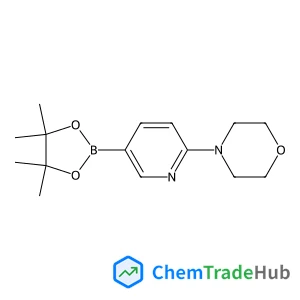
4-(5-(4,4,5,5-tetramethyl-1,3,2-dioxaborolan-2-yl)pyridin-2-yl)morpholine
CAS Number:
485799-04-0
Molecular Formula:
C15H23BN2O3
Luciane Maria Colla, Christian Oliveira Reinehr, Paola Gouvêa Manfredini, Vítor Augusto Farina Cavanhi, Jorge Alberto Vieira Costa
Usually, biopeptides and proteases are bioproducts produced in separate processes. However, through solid-state fermentation, they can be produced simultaneously, using agroindustrial by-products as substrates, reducing the environmental pollution and contributing to a circular bioeconomy. We aimed at the simultaneous production of proteases and biopeptides, using Aspergillus niger grown in soy bran and soy husk (70 : 30). The variables pH, moisture and nitrogen concentration were studied using Full Factorial Design 23. The best and simultaneous production of the biocompounds was obtained at pH 7, 50% moisture and 0.5% sodium nitrate as a nitrogen source, with 677 U g−1 proteases and 4154 μg mL−1 soluble proteins in 48 h, and an antioxidant activity of 2875.6 (mg mL−1 of Trolox equivalents) in 96 h of fermentation, with productivity confirmed in a double production scale. The production of these two biocompounds simultaneously in SSF has never been reported in the literature, thus highlighting the novelty and importance of this work.
Xian-Zheng Zhang, Chih-Chang Chu
DOI: 10.1039/B301423A
Masaharu Ueno, Hideaki Hisamoto, Takehiko Kitamori, Shū Kobayashi
DOI: 10.1039/B301638B
Kenji Wada, Naoki Watanabe, Koichi Yamada, Teruyuki Kondo, Take-aki Mitsudo
DOI: 10.1039/B413921F
Neil D. J. Branscombe, Andrew J. Atkins, Armando Marin-Becerra, Eric J. L. McInnes, Frank E. Mabbs, Jonathan McMaster, Martin Schröder
DOI: 10.1039/B300245D
Yahong Zhang, Xijuan Yu, Xiaoyan Wang, Wei Shan, Pengyuan Yang, Yi Tang
DOI: 10.1039/B411336E
Svetlana L. Kachkarova-Sorokina, Pierre Gallezot, Alexander B. Sorokin
DOI: 10.1039/B411694A
Ping Yin, Song Gao, Li-Min Zheng, Zheming Wang, Xin-Quan Xin
DOI: 10.1039/B212674E
Varinder K. Aggarwal, Mike Butters, Paul W. Davies
DOI: 10.1039/B300719G
Gabriela A. Grasa, Rohit Singh, Natalie M. Scott, Edwin D. Stevens, Steven P. Nolan
DOI: 10.1039/B410986D
Hai-Feng Ji, Yu Feng, Xiaohe Xu, Vemana Purushotham, Thomas Thundat, Gilbert M. Brown
DOI: 10.1039/B408997A
(1R,3S)-1,3-Cyclopentanediol finds applications in various industries. In the ph...
When handling N'-[4-(Dimethylamino)phenyl]-N,N-dimethyl-1,4-benzenediamine, it i...
There are several alternatives to 5-(2,4-Difluorophenyl)-2-methoxypyrimidine in ...
1-(3-Methoxyphenoxy)propan-2-ol (CAS: 382141-68-6) must comply with the Globally...
Tetrodotoxin Citrate is extremely dangerous and should be handled with extreme c...
2-Methyl-2-propanyl [(1R,3S)-3-hydroxycyclopentyl]carbamate (CAS: 225641-84-9) i...
Waste containing 4-(2-Hydroxyhexafluoroisopropyl)Benzoic Acid (CAS: 16261-80-6) ...
2-Methyl-2-proanyl {(2S)-1-[(benzyloxy)amino]-3-hydroxy-3-methyl-1-oxo-2-butanyl...
Benzeneethanamine, α-ethyl-, hydrochloride (1:1) is an organic compound with the...
In the synthesis of compounds similar to 3-{(E)-[4-(Dimethylamino)phenyl]diazeny...
![N,N'-1,2-Ethanediylbis[2-(vinylsulfonyl)acetamide] structure](https://static.chemtradehub.com/structs/667/66710-66-5-b556.webp "N,N'-1,2-Ethanediylbis[2-(vinylsulfonyl)acetamide] structure")