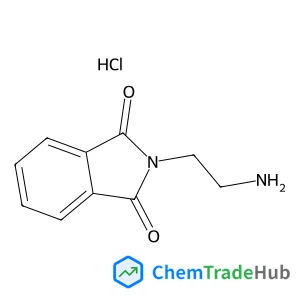
2-(2-Aminoethyl)-1H-isoindole-1,3(2H)-dione hydrochloride (1:1)
CAS Number:
30250-67-0
Molecular Formula:
C10H11ClN2O2
Ravindra Prajapati, Raj Shah, Mrinaleni Das, Brajendra K. Sharma
Food waste-induced environmental damage has been a primary concern for environmentalists for decades. Several studies have proven that greenhouse gases emitted by food waste worldwide are causing more damage than coal power plants in some cases. Over the years, many solutions have been proposed, but the problem is yet to be resolved. This mini-review aims to discuss some of the recent solutions proposed by researchers around the world. A discussion about the effective campaigns intended to target specific demographics to encourage sustainable consumer behavior, successful models designed to implement a systemic production process, and sustainable waste management programs is presented. This study emphasizes taking successful small-scale campaigns and models and utilizing them on a larger scale. It will help reduce food waste by consumers and producers in the long term. Biohydrogen and biogas production through anaerobic digestion (AD) of organic food waste sounds very sustainable and interesting. However, the supply chain optimization, economics involved and land for installing AD, and low-value of the end-products are the challenges that need to be addressed.
Giovanni Bottari, Tomás Torres
DOI: 10.1039/B411960F
Simon M. Langenegger, Robert Häner
DOI: 10.1039/B412831A
Elizabeth A. Whitsitt, Andrew R. Barron
DOI: 10.1039/B212808J
Feihe Huang, Liang Zhou, Jason W. Jones, Harry W. Gibson, Mehdi Ashraf-Khorassani
DOI: 10.1039/B411234B
Svetlana L. Kachkarova-Sorokina, Pierre Gallezot, Alexander B. Sorokin
DOI: 10.1039/B411694A
Yu Wang, William B. Euler, Brett L. Lucht
DOI: 10.1039/B312537H
François Stoffelbach, Rinaldo Poli
DOI: 10.1039/B409992C
Richard T. Baker, Leila Naji, Karen Lochhead, John A. Chudek
DOI: 10.1039/B301039B
Hao Chen, Xubin Zheng, Pengxiang Yang, R. Graham Cooks
DOI: 10.1039/B314713D
Leilani L. Welbes, Robert C. Scarrow, A. S. Borovik
DOI: 10.1039/B408553A
(1R,3S)-1,3-Cyclopentanediol finds applications in various industries. In the ph...
When handling N'-[4-(Dimethylamino)phenyl]-N,N-dimethyl-1,4-benzenediamine, it i...
There are several alternatives to 5-(2,4-Difluorophenyl)-2-methoxypyrimidine in ...
1-(3-Methoxyphenoxy)propan-2-ol (CAS: 382141-68-6) must comply with the Globally...
Tetrodotoxin Citrate is extremely dangerous and should be handled with extreme c...
2-Methyl-2-propanyl [(1R,3S)-3-hydroxycyclopentyl]carbamate (CAS: 225641-84-9) i...
Waste containing 4-(2-Hydroxyhexafluoroisopropyl)Benzoic Acid (CAS: 16261-80-6) ...
2-Methyl-2-proanyl {(2S)-1-[(benzyloxy)amino]-3-hydroxy-3-methyl-1-oxo-2-butanyl...
Benzeneethanamine, α-ethyl-, hydrochloride (1:1) is an organic compound with the...
In the synthesis of compounds similar to 3-{(E)-[4-(Dimethylamino)phenyl]diazeny...
![N,N'-1,2-Ethanediylbis[2-(vinylsulfonyl)acetamide] structure](https://static.chemtradehub.com/structs/667/66710-66-5-b556.webp "N,N'-1,2-Ethanediylbis[2-(vinylsulfonyl)acetamide] structure")