












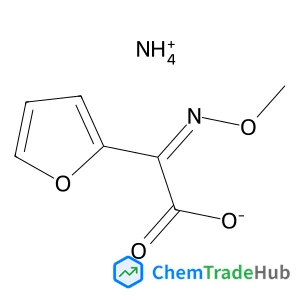
Ammonium (Z)-2-(furan-2-yl)-2-(methoxyimino)acetate
CAS Number:
97148-39-5
Molecular Formula:
C7H10N2O4
Mario R. S. Soares, Ricardo H. Gonçalves, Içamira C. Nogueira, Jefferson Bettini, Adenilson J. Chiquito, Edson R. Leite
Hematite is considered to be the most promising material used as a photoanode for water splitting and here we utilized a sintered hematite photoanode to address the fundamental electrical, electrochemical and photoelectrochemical behavior of this semiconductor oxide. The results presented here allowed us to conclude that the addition of Sn4+ decreases the grain boundary resistance of the hematite polycrystalline electrode. Heat treatment in a nitrogen (N2) atmosphere also contributes to a decrease of the grain boundary resistance, supporting the evidence that the presence of oxygen is fundamental for the formation of a voltage barrier at the hematite grain boundary. The N2 atmosphere affected both doped and undoped sintered electrodes. We also observed that the heat treatment atmosphere modifies the surface states of the solid–liquid interface, changing the charge-transfer resistance. A two-step treatment, with the second being performed at a low temperature in an oxygen (O2) atmosphere, resulted in a better solid–liquid interface.
Li-Yong Gan, Li-Hong Zhang, Qingyun Zhang, Chun-Sheng Guo, Udo Schwingenschlögl
DOI: 10.1039/C5CP05695K
Yonggang Yang, Yufang Liu, Dapeng Yang, Hui Li, Kai Jiang, Jinfeng Sun
DOI: 10.1039/C5CP02530C
Chi Chen, Zarah Medina Baiyee, Xin Chen, Chunming Niu
DOI: 10.1039/C5CP05722A
J. Karel, F. Bernardi, C. Wang, R. Stinshoff, N.-O. Born, S. Ouardi, U. Burkhardt, G. H. Fecher, C. Felser
DOI: 10.1039/C5CP04944J
Robert Pendrill, Olof Engström, Andrea Volpato, Mirco Zerbetto, Antonino Polimeno, Göran Widmalm
DOI: 10.1039/C5CP06288H
Xueli Guo, Yiwei Tan
DOI: 10.1039/C5CP05531H
Nada Mehio, J. Casey Johnson, Vyacheslav S. Bryantsev
DOI: 10.1039/C5CP06165B
Mohammed Ahmed, Ajay K. Singh, Jahur A. Mondal
DOI: 10.1039/C5CP07014G
Harald Ceymann, Moritz Balkenhohl, Alexander Schmiedel, Marco Holzapfel, Christoph Lambert
DOI: 10.1039/C5CP06917C
Waste containing (6-Bromo-2-naphthyl)oxy](dimethyl)(2-methyl-2-propanyl)silane (...
7-Fluoro-4-isoquinolinecarboxylic acid can be synthesized via a multi-step proce...
2,3,5,6-Tetrabromothieno[3,2-b]thiophene is a crystalline compound with a high m...
1-[4-(Benzylamino)-7,8-dihydro-5H-pyrano[4,3-d]pyrimidin-2-yl]-2-methyl-1H-indol...
The market for imidazo[5,1-d]-1,2,3,5-tetrazine-8-carboxylic acid, 3,4-dihydro-3...
3-(Triisopropylsilyl)propiolaldehyde is a synthetic organic compound with the CA...
6-Nitro-2H-1,4-benzoxazin-3(4H)-one (CAS: 81721-87-1) is subject to various regu...
Waste containing (3-Fluorophenyl)(4-{[(2-methyl-2-propanyl)oxy]carbonyl}-1-piper...
N,N'-4,4'-Biphenyldiyldiisonicotinamide is a white crystalline solid with a mole...
6-Bromo-8-fluoro-2-quinazolinol is primarily used in the pharmaceutical industry...

Physical Chemistry Chemical Physics (PCCP) is an international journal co-owned by 19 physical chemistry and physics societies from around the world. This journal publishes original, cutting-edge research in physical chemistry, chemical physics and biophysical chemistry. To be suitable for publication in PCCP, articles must include significant innovation and/or insight into physical chemistry; this is the most important criterion that reviewers and Editors will judge against when evaluating submissions. The journal has a broad scope and welcomes contributions spanning experiment, theory, computation and data science. Topical coverage includes spectroscopy, dynamics, kinetics, statistical mechanics, thermodynamics, electrochemistry, catalysis, surface science, quantum mechanics, quantum computing and machine learning. Interdisciplinary research areas such as polymers and soft matter, materials, nanoscience, energy, surfaces/interfaces, and biophysical chemistry are welcomed if they demonstrate significant innovation and/or insight into physical chemistry. Joined experimental/theoretical studies are particularly appreciated when complementary and based on up-to-date approaches.
![(1S)-1,5-Anhydro-1-[3-(1-benzothiophen-2-ylmethyl)-4-fluorophenyl]-D-glucitol structure](https://static.chemtradehub.com/structs/761/761423-87-4-dbeb.webp "(1S)-1,5-Anhydro-1-[3-(1-benzothiophen-2-ylmethyl)-4-fluorophenyl]-D-glucitol structure")




