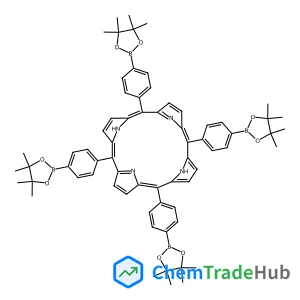
5,10,15,20-tetrakis(4-boronic acid pinacol ester phenyl) porphyrin
CAS Number:
1332748-00-1
Molecular Formula:
C68H74B4N4O8
Jan Chalabala, Petr Slavíček
In the case of the ammonia dimer, we address the following questions: how ultrafast ionization dynamics is controlled by hydrogen bonding and whether we can control the products via selective ionization of a specific electron. We use quantum chemical calculations and ab initio non-adiabatic molecular dynamics simulations to model the femtosecond dynamics of the ammonia dimer upon ionization. The role of nuclear quantum effects and thermal fluctuations in predicting the structure of the dimer is emphasized; it is shown that the minimum energy and vibrationally averaged structures are rather different. The ground state structure subsequently controls the ionization dynamics. We describe reaction pathways, electronic population transfers and reaction yields with respect to ionization from different molecular orbitals. The simulations showed that the ionized ammonia dimer is highly unstable and its decay rate is primarily driven by the position of the electron hole. In the case of ground state ionization (i.e. the HOMO electron is ionized), the decay is likely to be preceded by a proton transfer (PT) channel yielding NH4+ and NH2˙ fragments. The PT is less intense and slower compared with the ionized water dimer. After ionizing deeper lying electrons, mainly NH3+˙ and NH3 fragments are formed. Overall, our results show that the ionization dynamics of the ammonia and water dimers differ due to the nature of the hydrogen bond in these systems.
Christoph Kerzig, Martin Goez
DOI: 10.1039/C6CP03742A
Yasuaki Masumoto, Hikaru Umino, Jianhui Sun, Eri Suzumura
DOI: 10.1039/C5CP04256A
Chiu Tung Cheng, Kevin R. Wilson
DOI: 10.1039/C5CP03791C
L. Vereecken, W. J. Bloss
DOI: 10.1039/C5CP03862F
Edward M. Kosower, Galina Borz
DOI: 10.1039/C5CP04439A
M. T. Greiner, T. E. Jones, B. E. Johnson, T. C. R. Rocha, Z. J. Wang, M. Armbrüster, M. Willinger, A. Knop-Gericke, R. Schlögl
DOI: 10.1039/C5CP03722K
Djemel Hamdane, Christophe Velours, David Cornu, Magali Nicaise, Murielle Lombard, Marc Fontecave
DOI: 10.1039/C6CP03635J
Camila S. Monteiro, Daniele C. Ferreira, Gustavo A. M. Sáfar, Rafael N. Gontijo, Cristiano Fantini, Dayse C. S. Martins, Ynara M. Idemori, Maurício V. B. Pinheiro, Klaus Krambrock
DOI: 10.1039/C6CP03366K
David Eisenberg, Wowa Stroek, Norbert J. Geels, Stefania Tanase, Marilena Ferbinteanu, Simon J. Teat, Pierre Mettraux, Ning Yan, Gadi Rothenberg
DOI: 10.1039/C6CP04132A
Miao Miao, Gangling Wang, Shaomei Cao, Xin Feng, Jianhui Fang, Liyi Shi
DOI: 10.1039/C5CP04679C
When handling 4-Methyl-6-(trifluoromethyl)quinoline (CAS: 40716-16-3), safety go...
4-(3,5-Difluorophenyl)aniline is an aromatic organic compound with the CAS numbe...
5-{[4-(Trifluoromethyl)phenyl]sulfanyl}-1,2,3-thiadiazole-4-carboxylic acid can ...
The market for 4-Benzylaniline hydrochloride (CAS: 6317-57-3) is steadily growin...
[3-(Diethylsulfamoyl)phenyl]boronic acid is generally considered safe when handl...
3-Bromo-2,5-dimethoxyaniline is mainly used in the pharmaceutical and chemical i...
N-Methyl-1-(5-methyl-1H-indol-3-yl)methanamine (CAS: 915922-67-7) is subject to ...
This compound is primarily used in the pharmaceutical industry for the synthesis...
2-Methyl-2-propanyl [(1S,3R)-3-aminocyclohexyl]carbamate (CAS: 1298101-47-9) sho...
Ethyl 2-bromo-4,4,4-trifluorobutanoate (CAS: 367-33-9) is utilized in the pharma...

Physical Chemistry Chemical Physics (PCCP) is an international journal co-owned by 19 physical chemistry and physics societies from around the world. This journal publishes original, cutting-edge research in physical chemistry, chemical physics and biophysical chemistry. To be suitable for publication in PCCP, articles must include significant innovation and/or insight into physical chemistry; this is the most important criterion that reviewers and Editors will judge against when evaluating submissions. The journal has a broad scope and welcomes contributions spanning experiment, theory, computation and data science. Topical coverage includes spectroscopy, dynamics, kinetics, statistical mechanics, thermodynamics, electrochemistry, catalysis, surface science, quantum mechanics, quantum computing and machine learning. Interdisciplinary research areas such as polymers and soft matter, materials, nanoscience, energy, surfaces/interfaces, and biophysical chemistry are welcomed if they demonstrate significant innovation and/or insight into physical chemistry. Joined experimental/theoretical studies are particularly appreciated when complementary and based on up-to-date approaches.