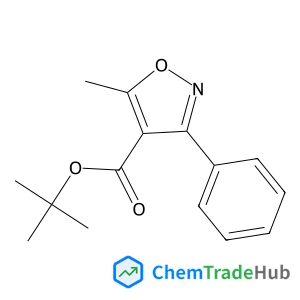
2-Methyl-2-propanyl 5-methyl-3-phenyl-1,2-oxazole-4-carboxylate
CAS Number:
211429-79-7
Molecular Formula:
C15H17NO3
Yasuaki Masumoto, Hikaru Umino, Jianhui Sun, Eri Suzumura
We studied the spin rotation of electrons in CdS quantum dots (QDs) and CdS QDs with charge acceptors by means of time-resolved Faraday rotation (TRFR) at room temperature. The electron spin rotation had an oscillatory component in the TRFR signal and the oscillation frequency proportional to the magnetic field gave a g-factor of the electrons of 1.965 ± 0.006. The non-oscillatory component came from the population of excitons and showed an additional decay in CdS QDs with hole acceptors. The electron spin rotation signal was largely enhanced and lasted for a spin coherence time of T2* = 450 ps in CdS QDs tethered to TiO2 electron acceptors, where the spin initialization was triggered by the positive trion transition. These results give clear evidence that the electron spin rotation signal in QDs can be enhanced by transient p-doping.
Viktoriya Poterya, Dana Nachtigallová, Jozef Lengyel, Michal Fárník
DOI: 10.1039/C5CP04485E
Marnik Bercx, Nasrin Sarmadian, Rolando Saniz, Bart Partoens, Dirk Lamoen
DOI: 10.1039/C6CP03468C
Ross H. McKenzie
DOI: 10.1039/C5CP02239H
Debmalya Bhunia, Rajdeep Chowdhury, Kankan Bhattacharyya
DOI: 10.1039/C5CP04908C
Masaya Nakamura, Takayuki Hirai
DOI: 10.1039/C5CP03877D
Yafei Jiang, Hongwei Tan, Jimin Zheng, Xichen Li, Guangju Chen, Zongchao Jia
DOI: 10.1039/C5CP03342J
Sudip Kumar Mondal, Ken-ichi Inoue, Shoichi Yamaguchi
DOI: 10.1039/C5CP04264J
Miriam Marqués, Angel Morales-García, José Manuel Menéndez, Valentín G. Baonza, José Manuel Recio
DOI: 10.1039/C5CP03673A
Chaitanya V. Mungi, Sachin Kumar Singh, Sudha Rajamani
DOI: 10.1039/C6CP00686H
Sherdil Khan, Maximiliano J. M. Zapata, Marcelo B. Pereira, Renato V. Gonçalves, Lukas Strizik, Jairton Dupont, Marcos J. L. Santos, Sérgio R. Teixeira
DOI: 10.1039/C5CP03645C
When handling 4-Methyl-6-(trifluoromethyl)quinoline (CAS: 40716-16-3), safety go...
4-(3,5-Difluorophenyl)aniline is an aromatic organic compound with the CAS numbe...
5-{[4-(Trifluoromethyl)phenyl]sulfanyl}-1,2,3-thiadiazole-4-carboxylic acid can ...
The market for 4-Benzylaniline hydrochloride (CAS: 6317-57-3) is steadily growin...
[3-(Diethylsulfamoyl)phenyl]boronic acid is generally considered safe when handl...
3-Bromo-2,5-dimethoxyaniline is mainly used in the pharmaceutical and chemical i...
N-Methyl-1-(5-methyl-1H-indol-3-yl)methanamine (CAS: 915922-67-7) is subject to ...
This compound is primarily used in the pharmaceutical industry for the synthesis...
2-Methyl-2-propanyl [(1S,3R)-3-aminocyclohexyl]carbamate (CAS: 1298101-47-9) sho...
Ethyl 2-bromo-4,4,4-trifluorobutanoate (CAS: 367-33-9) is utilized in the pharma...

Physical Chemistry Chemical Physics (PCCP) is an international journal co-owned by 19 physical chemistry and physics societies from around the world. This journal publishes original, cutting-edge research in physical chemistry, chemical physics and biophysical chemistry. To be suitable for publication in PCCP, articles must include significant innovation and/or insight into physical chemistry; this is the most important criterion that reviewers and Editors will judge against when evaluating submissions. The journal has a broad scope and welcomes contributions spanning experiment, theory, computation and data science. Topical coverage includes spectroscopy, dynamics, kinetics, statistical mechanics, thermodynamics, electrochemistry, catalysis, surface science, quantum mechanics, quantum computing and machine learning. Interdisciplinary research areas such as polymers and soft matter, materials, nanoscience, energy, surfaces/interfaces, and biophysical chemistry are welcomed if they demonstrate significant innovation and/or insight into physical chemistry. Joined experimental/theoretical studies are particularly appreciated when complementary and based on up-to-date approaches.