












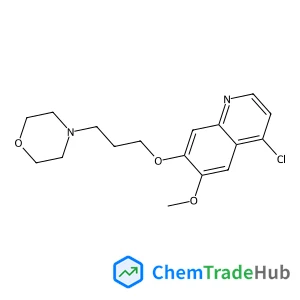
4-(3-((4-Chloro-6-methoxyquinolin-7-yl)oxy)propyl)morpholine
CAS Number:
205448-32-4
Molecular Formula:
C17H21ClN2O3
Alexander Teplukhin, Dmitri Babikov
Rigorous calculations of scattering resonances in ozone are carried out for a broad range of rotational excitations. The accurate potential energy surface of Dawes is adopted, and a new efficient method for calculations of ro–vibrational energies, wave functions and resonance lifetimes is employed (which uses hyper-spherical coordinates, the sequential diagonalization/truncation approach, grid optimization and complex absorbing potential). A detailed analysis is carried out to characterize distributions of resonance energies and lifetimes, their rotational/vibrational content and their positions with respect to the centrifugal barrier. Emphasis is on the contribution of these resonances to the recombination process that forms ozone. It is found that major contributions come from localized resonances at energies near the top of the barrier. Delocalized resonances at higher energies should also be taken into account, while very narrow resonances at low energies (trapped far behind the centrifugal barrier) should be treated as bound states. The absolute value of the recombination rate coefficient, its pressure and temperature dependencies are obtained using the energy-transfer model developed in the earlier work. Good agreement with experimental data is obtained if one follows the suggestion of Troe, who argued that the energy transfer mechanism of recombination is responsible only for 55% of the recombination rate (with the remaining 45% coming from the competing chaperon mechanism).
Dong-Chan Lee, Lacie V. Brownell, Kyoungmi Jang, Seung Ju Han, Kathleen A. Robins
DOI: 10.1039/C4CP05090H
Sana Labidi, Zixian Jia, Mounir Ben Amar, Khay Chhor, Andrei Kanaev
DOI: 10.1039/C4CP05149A
Ranjita K. Bose, Nico Hohlbein, Santiago J. Garcia, Annette M. Schmidt, Sybrand van der Zwaag
DOI: 10.1039/C4CP04015E
Erin M. Adkins, J. Houston Miller
DOI: 10.1039/C4CP04452E
Cláudio M. Lousada, Pavel A. Korzhavyi
DOI: 10.1039/C4CP04277H
Joseph H. Montoya, Monica Garcia-Mota
DOI: 10.1039/C4CP05259E
Hammad Cheema, Robert Younts, Louis Ogbose, Bhoj Gautam, Kenan Gundogdu, Ahmed El-Shafei
DOI: 10.1039/C4CP04741A
Rodrigo B. Kato, Frederico T. Silva, Gisele L. Pappa, Jadson C. Belchior
DOI: 10.1039/C4CP03779K
L. Wang, I.-S. Tamgho, L. A. Crandall, J. J. Rack, C. J. Ziegler
DOI: 10.1039/C4CP04737K
Alexandra Lambrou, Eftychia Pinakoulaki
DOI: 10.1039/C4CP04352A
(5-Sulfamoyl-3-pyridinyl)boronic acid is primarily used in chemical synthesis, p...
Benzyl 2-methyl-2-(methylsulfonyl)-4-pentenoate is typically synthesized via est...
When handling 8-Fluoroquinolin-6-ol (CAS: 209353-22-0), it is important to use p...
1,3-Dibromo-5-(2-methyl-2-propanyl)benzene (CAS: 129316-09-2) is a crystalline c...
Ethyl 7-chloro-4-oxo-1-(1,3-thiazol-2-yl)-1,4-dihydro-1,8-naphthyridine-3-carbox...
When handling Delta-7-Avenasterol (CAS: 23290-26-8), it is important to wear app...
Proper handling involves the use of personal protective equipment such as gloves...
When handling 2-Methyl-2-proanyl 4-[(2-aminophenyl)amino]-1-piperidinecarboxylat...
N-Methyl-4-chlorobenzylamine hydrochloride (CAS: 65542-24-7) is a organic compou...
[2-(Dodecyloxy)ethoxy]acetic acid (CAS: 27306-90-7) is generally considered safe...

Physical Chemistry Chemical Physics (PCCP) is an international journal co-owned by 19 physical chemistry and physics societies from around the world. This journal publishes original, cutting-edge research in physical chemistry, chemical physics and biophysical chemistry. To be suitable for publication in PCCP, articles must include significant innovation and/or insight into physical chemistry; this is the most important criterion that reviewers and Editors will judge against when evaluating submissions. The journal has a broad scope and welcomes contributions spanning experiment, theory, computation and data science. Topical coverage includes spectroscopy, dynamics, kinetics, statistical mechanics, thermodynamics, electrochemistry, catalysis, surface science, quantum mechanics, quantum computing and machine learning. Interdisciplinary research areas such as polymers and soft matter, materials, nanoscience, energy, surfaces/interfaces, and biophysical chemistry are welcomed if they demonstrate significant innovation and/or insight into physical chemistry. Joined experimental/theoretical studies are particularly appreciated when complementary and based on up-to-date approaches.
![2-(5-Bromo-1H-pyrrolo[2,3-B]pyridin-3-YL)acetic acid structure](https://static.chemtradehub.com/structs/106/1060795-03-0-0589.webp "2-(5-Bromo-1H-pyrrolo[2,3-B]pyridin-3-YL)acetic acid structure")
![4-Fluoro-2-(4-{[(3S,4R)-4-(2-hydroxy-2-propanyl)-3-pyrrolidinyl]amino}-6,7-dimethoxy-2-quinazolinyl)phenol hydrochloride (1:1) structure](https://static.chemtradehub.com/structs/143/1431697-96-9-619c.webp "4-Fluoro-2-(4-{[(3S,4R)-4-(2-hydroxy-2-propanyl)-3-pyrrolidinyl]amino}-6,7-dimethoxy-2-quinazolinyl)phenol hydrochloride (1:1) structure")
![N-[2,6-Di(9-anthryl)-4-oxido-8,9,10,11,12,13,14,15-octahydrodinaphtho[2,1-d:1',2'-f][1,3,2]dioxaphosphepin-4-yl]-1,1,1-trifluoromethanesulfonamide structure](https://static.chemtradehub.com/structs/122/1227374-64-2-cdb5.webp "N-[2,6-Di(9-anthryl)-4-oxido-8,9,10,11,12,13,14,15-octahydrodinaphtho[2,1-d:1',2'-f][1,3,2]dioxaphosphepin-4-yl]-1,1,1-trifluoromethanesulfonamide structure")




