












Extinction measurements for optical band gap determination of soot in a series of nitrogen-diluted ethylene/air non-premixed flames
Literature Information
Publication Date
2014-12-05
DOI
10.1039/C4CP04452E
Impact Factor
3.676
Authors
Erin M. Adkins, J. Houston Miller
View Original
Abstract
Visible light extinction was measured in a series of nitrogen-diluted, ethylene/air, non-premixed flames and this data was used to determine the optical band gap, OBG, as a function of flame position. Collimated light from a supercontinuum source is telescopically expanded and refocused to match the f – number of a dispersing monochromator. The dispersed light is split into a power metering channel and a channel that is periscoped and focused into the flame. The transmitted light is then recollimated and focussed onto a silicon photodiode detector. After tomographic reconstruction of the radial extinction field, the OBG was derived from the near-edge absorption feature using Tauc/Davis–Mott analysis. A slight evolution in OBG was observed throughout all flame systems with a consistent range of OBG observed between approximately 1.85 eV and 2.35 eV. Averaging over all positions the mean OBG was approximately 2.09 eV for all flame systems. Comparing these results to previously published computational results relating calculated HOMO–LUMO gaps for a variety of D2h PAH molecules to the number of aromatic rings in the structure, showed that the observed optical band gap is consistent with a PAH of about 14 rings or a conjugation length of 0.97 nm. This work provides experimental support to the model of soot formation where the transition from chemical to physical growth starts at a modest molecular size; about the size of circumpyrene.
Related Literature
Non-classical logic inverter coupling a ZnO nanowire-based Schottky barrier transistor and adjacent Schottky diode
Seyed Hossein Hosseini Shokouh, Syed Raza Ali Raza, Hee Sung Lee, Seongil Im
2014-05-30
Communication
DOI: 10.1039/C4CP01266F
An intriguing pH-triggered FRET-based biosensor emission of a pyrazoline–doxorubicin couple and its application in living cells
Sayaree Dhar, Subhash Chandra Bhattacharya
2014-01-06
Communication
DOI: 10.1039/C3CP54527J
Experimental and simulation studies of unusual current blockade induced by translocation of small oxidized PEG through a single nanopore
S. Cabello-Aguilar, A. Abou Chaaya, F. Picaud, M. Bechelany, C. Pochat-Bohatier, S. Yesylevskyy, S. Kraszewski, M. C. Bechelany, F. Rossignol, E. Balanzat, J. M. Janot, P. Miele, P. Dejardin, S. Balme
2014-07-08
Paper
DOI: 10.1039/C4CP01954G
The interaction of gold and silver nanoparticles with a range of anionic and cationic dyes
H. Kitching, A. J. Kenyon, I. P. Parkin
2014-02-10
Paper
DOI: 10.1039/C3CP55366C
Photodissociation dynamics of propargylene, HCCCH
Jens Giegerich, Jens Petersen, Roland Mitrić, Ingo Fischer
2014-02-07
Paper
DOI: 10.1039/C3CP53213E
Ionic liquid clusters: structure, formation mechanism, and effect on the behavior of ionic liquids
Shimou Chen, Suojiang Zhang, Xiaomin Liu, Jinquan Wang, Jianji Wang, Kun Dong, Jian Sun, Baohua Xu
2013-10-17
Perspective
DOI: 10.1039/C3CP53116C
Effect of electrolyte bleaching on the stability and performance of dye solar cells
Simone Mastroianni, Imran Asghar, Kati Miettunen, Janne Halme, Alessandro Lanuti, Thomas M. Brown, Peter Lund
2014-02-04
Paper
DOI: 10.1039/C3CP55342F
Reaction mediated artificial cell termination: control of vesicle viability using Rh(i)-catalyzed hydrogenation
Hirokazu Komatsu, Yuki Daimon, Kohsaku Kawakami, Motomu Kanai
2014-06-20
Paper
DOI: 10.1039/C4CP02255F
You might also like
Compound Q&A
What are the main uses of (5-Sulfamoyl-3-pyridinyl)boronic acid (CAS: 951233-61-7)?
(5-Sulfamoyl-3-pyridinyl)boronic acid is primarily used in chemical synthesis, p...
951233-61-7(5-Sulfamoyl-3-pyrid...
Compound Q&A
How is Benzyl 2-methyl-2-(methylsulfonyl)-4-pentenoate (CAS: 1942858-50-5) typically synthesized?
Benzyl 2-methyl-2-(methylsulfonyl)-4-pentenoate is typically synthesized via est...
1942858-50-5Benzyl 2-methyl-2-(m...
Compound Q&A
What precautions should be taken when handling 8-Fluoroquinolin-6-ol (CAS: 209353-22-0)?
When handling 8-Fluoroquinolin-6-ol (CAS: 209353-22-0), it is important to use p...
209353-22-08-Fluoroquinolin-6-o...
Compound Q&A
What are the physical and chemical properties of 1,3-Dibromo-5-(2-methyl-2-propanyl)benzene (CAS: 129316-09-2)?
1,3-Dibromo-5-(2-methyl-2-propanyl)benzene (CAS: 129316-09-2) is a crystalline c...
129316-09-21,3-Dibromo-5-(2-met...
Compound Q&A
What industries use Ethyl 7-chloro-4-oxo-1-(1,3-thiazol-2-yl)-1,4-dihydro-1,8-naphthyridine-3-carboxylate (CAS: 174726-87-5)?
Ethyl 7-chloro-4-oxo-1-(1,3-thiazol-2-yl)-1,4-dihydro-1,8-naphthyridine-3-carbox...
174726-87-5Ethyl 7-chloro-4-oxo...
Compound Q&A
What precautions should be taken when handling Delta-7-Avenasterol (CAS: 23290-26-8)?
When handling Delta-7-Avenasterol (CAS: 23290-26-8), it is important to wear app...
23290-26-8Delta-7-Avenasterol
Compound Q&A
What precautions should be taken when handling N-({(5R)-3-[3-Fluoro-4-(4-morpholinyl)phenyl]-2-oxo-1,3-oxazolidin-5-yl}methyl)acetamide (CAS: 872992-20-6)?
Proper handling involves the use of personal protective equipment such as gloves...
872992-20-6N-({(5R)-3-[3-Fluoro...
Compound Q&A
What precautions should be taken when handling 2-Methyl-2-proanyl 4-[(2-aminophenyl)amino]-1-piperidinecarboxylate (CAS: 79099-00-6)?
When handling 2-Methyl-2-proanyl 4-[(2-aminophenyl)amino]-1-piperidinecarboxylat...
79099-00-62-Methyl-2-propanyl ...
Compound Q&A
What is N-Methyl-4-chlorobenzylamine hydrochloride (CAS: 65542-24-7)?
N-Methyl-4-chlorobenzylamine hydrochloride (CAS: 65542-24-7) is a organic compou...
65542-24-7N-Methyl-4-chloroben...
Compound Q&A
Is [2-(Dodecyloxy)ethoxy]acetic acid (CAS: 27306-90-7) safe?
[2-(Dodecyloxy)ethoxy]acetic acid (CAS: 27306-90-7) is generally considered safe...
27306-90-7[2-(Dodecyloxy)ethox...
Source Journal
Physical Chemistry Chemical Physics

CiteScore:
5.5
Self-citation Rate:
10.3%
Articles per Year:
3036
Physical Chemistry Chemical Physics (PCCP) is an international journal co-owned by 19 physical chemistry and physics societies from around the world. This journal publishes original, cutting-edge research in physical chemistry, chemical physics and biophysical chemistry. To be suitable for publication in PCCP, articles must include significant innovation and/or insight into physical chemistry; this is the most important criterion that reviewers and Editors will judge against when evaluating submissions. The journal has a broad scope and welcomes contributions spanning experiment, theory, computation and data science. Topical coverage includes spectroscopy, dynamics, kinetics, statistical mechanics, thermodynamics, electrochemistry, catalysis, surface science, quantum mechanics, quantum computing and machine learning. Interdisciplinary research areas such as polymers and soft matter, materials, nanoscience, energy, surfaces/interfaces, and biophysical chemistry are welcomed if they demonstrate significant innovation and/or insight into physical chemistry. Joined experimental/theoretical studies are particularly appreciated when complementary and based on up-to-date approaches.
Recommended Compounds
![2-(5-Bromo-1H-pyrrolo[2,3-B]pyridin-3-YL)acetic acid structure](https://static.chemtradehub.com/structs/106/1060795-03-0-0589.webp "2-(5-Bromo-1H-pyrrolo[2,3-B]pyridin-3-YL)acetic acid structure")
2-(5-Bromo-1H-pyrrolo[2,3-B]pyridin-3-YL)acetic acid
CAS Number:
1060795-03-0
Molecular Formula:
C9H7BrN2O2
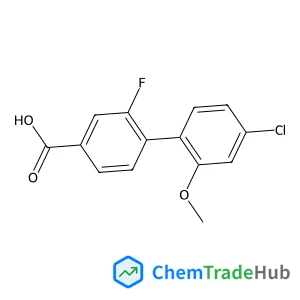
4-(4-Chloro-2-methoxyphenyl)-3-fluorobenzoic acid
CAS Number:
1261970-23-3
Molecular Formula:
C14H10ClFO3
Recommended Suppliers





Disclaimer
This page provides academic journal information for reference and research purposes only. We are not affiliated with any journal publishers and do not handle publication submissions. For publication-related inquiries, please contact the respective journal publishers directly.
If you notice any inaccuracies in the information displayed, please contact us at support@chemtradehub.com. We will promptly review and address your concerns.