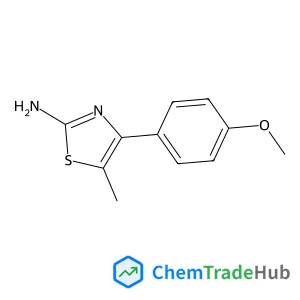
4-(4-Methoxyphenyl)-5-methyl-1,3-thiazol-2-amine
CAS Number:
105512-88-7
Molecular Formula:
C11H12N2OS
Sana Labidi, Zixian Jia, Mounir Ben Amar, Khay Chhor, Andrei Kanaev
Nucleation and growth of zirconium-oxo-alkoxy (ZOA) nanoparticles were studied in a sol–gel process in n-propanol solution at a hydrolysis ratio H between 1.0 and 2.7 and zirconium-n-propoxyde precursor concentrations between 0.10 and 0.15 mol l−1. The chemical transformations were conducted in quasi-perfect micromixing conditions (Damköhler number Da ≤ 1) and the nanoparticle size evolution was monitored in situ with the light scattering method. The size of primary nanoparticles (nuclei) 2R0 = 3.6 nm was found to be almost independent of the preparation conditions. A remarkable similarity with the titanium-oxo-alkoxy (TOA) nanoparticles was observed. In particular, both systems show the induction stage of the sol–gel growth for a hydrolysis ratio H > 2.0 and stable oxometallate units for H ≤ 2.0. However in contrast to TOA, no stable hierarchical ZOA units (clusters) with R0 ≥ R ≥ 1.0 nm were observed, which makes this system less stable against aggregation, leading to polydispersed nanoparticles.
Taeseup Song, P. Lakshmipathiraj, Hyungkyu Han, Volodymyr V. Lysak, C. Terashima, Kazuya Nakata, A. Fujishima, Yong Soo Kang
DOI: 10.1039/C4CP02009J
Rahul P. Hardikar, Deya Das, Sang Soo Han, Kwang-Ryeol Lee, Abhishek K. Singh
DOI: 10.1039/C4CP01412J
S. Cabello-Aguilar, A. Abou Chaaya, F. Picaud, M. Bechelany, C. Pochat-Bohatier, S. Yesylevskyy, S. Kraszewski, M. C. Bechelany, F. Rossignol, E. Balanzat, J. M. Janot, P. Miele, P. Dejardin, S. Balme
DOI: 10.1039/C4CP01954G
Guido Saracco, Svetoslava Vankova, Cristina Pagliano, Barbara Bonelli, Edoardo Garrone
DOI: 10.1039/C3CP54896A
Katia Nchimi Nono, Loïc J. Charbonnière, Hans-Gerd Löhmannsröben
DOI: 10.1039/C3CP54883J
K. S. Deepa, P. Shaiju, M. T. Sebastian, E. Bhoje Gowd, J. James
DOI: 10.1039/C4CP01924E
Marcus Rohnke, Bert M. Weckhuysen
DOI: 10.1039/C3CP54337D
Mustafa Selman Yavuz, Ugur Tamer
DOI: 10.1039/C3CP55087G
Simone Mastroianni, Imran Asghar, Kati Miettunen, Janne Halme, Alessandro Lanuti, Thomas M. Brown, Peter Lund
DOI: 10.1039/C3CP55342F
(5-Sulfamoyl-3-pyridinyl)boronic acid is primarily used in chemical synthesis, p...
Benzyl 2-methyl-2-(methylsulfonyl)-4-pentenoate is typically synthesized via est...
When handling 8-Fluoroquinolin-6-ol (CAS: 209353-22-0), it is important to use p...
1,3-Dibromo-5-(2-methyl-2-propanyl)benzene (CAS: 129316-09-2) is a crystalline c...
Ethyl 7-chloro-4-oxo-1-(1,3-thiazol-2-yl)-1,4-dihydro-1,8-naphthyridine-3-carbox...
When handling Delta-7-Avenasterol (CAS: 23290-26-8), it is important to wear app...
Proper handling involves the use of personal protective equipment such as gloves...
When handling 2-Methyl-2-proanyl 4-[(2-aminophenyl)amino]-1-piperidinecarboxylat...
N-Methyl-4-chlorobenzylamine hydrochloride (CAS: 65542-24-7) is a organic compou...
[2-(Dodecyloxy)ethoxy]acetic acid (CAS: 27306-90-7) is generally considered safe...

Physical Chemistry Chemical Physics (PCCP) is an international journal co-owned by 19 physical chemistry and physics societies from around the world. This journal publishes original, cutting-edge research in physical chemistry, chemical physics and biophysical chemistry. To be suitable for publication in PCCP, articles must include significant innovation and/or insight into physical chemistry; this is the most important criterion that reviewers and Editors will judge against when evaluating submissions. The journal has a broad scope and welcomes contributions spanning experiment, theory, computation and data science. Topical coverage includes spectroscopy, dynamics, kinetics, statistical mechanics, thermodynamics, electrochemistry, catalysis, surface science, quantum mechanics, quantum computing and machine learning. Interdisciplinary research areas such as polymers and soft matter, materials, nanoscience, energy, surfaces/interfaces, and biophysical chemistry are welcomed if they demonstrate significant innovation and/or insight into physical chemistry. Joined experimental/theoretical studies are particularly appreciated when complementary and based on up-to-date approaches.


![(4-Methyl-1H-benzo[d]imidazol-2-yl)methanamine structure](https://static.chemtradehub.com/structs/933/933756-31-1-7b0b.webp "(4-Methyl-1H-benzo[d]imidazol-2-yl)methanamine structure")