












![Ethyl thieno[3,2-f]quinoline-2-carboxylate structure](https://static.chemtradehub.com/structs/299/29948-26-3-f62b.webp "Ethyl thieno[3,2-f]quinoline-2-carboxylate structure")
Vacuum ultraviolet photodissociation of hydrogen bromide
Literature Information
Publication Date
2016-05-06
DOI
10.1039/C6CP01956K
Impact Factor
3.676
Authors
Yvonne Dorenkamp, Shengrui Yu, Alec M. Wodtke, Dongxu Dai, Kaijun Yuan, Xueming Yang
View Original
Abstract
Photodissociation dynamics of HBr at a series of photolysis wavelengths in the range of 123.90–125.90 nm and at around 137.0 nm have been studied using the H atom Rydberg “tagging” time-of-flight technique. The branching fractions between the channels forming ground Br(2P3/2) and spin–orbit excited Br(2P1/2) atoms together with the angular distributions of the products corresponding to these two channels have been measured. The photolysis wavelengths in this work excited the HBr molecule from the ground state X 1Σ+ to various Rydberg states and the V 1Σ+ ion-pair valence state. Predissociation via these states displays rich behavior, indicating the influence of the nature of initially excited states and the coupling to other bound or repulsive states on the predissociation dynamics.
Related Literature
Correction: Hydride transfer enabled switchable dearomatization of indoles in the carbocyclic ring and the pyrrole ring
Kang Duan, Hongjin Shi, Lin-Xuan Wang, Shuai-Shuai Li, Lubin Xu
2020-09-16
Correction
DOI: 10.1039/D0QO90064H
Recent advances in the asymmetric synthesis of pharmacology-relevant nitrogen heterocycles via stereoselective aza-Michael reactions
Maxim G. Vinogradov, Olga V. Turova, Sergei G. Zlotin
2019-02-28
Review Article
DOI: 10.1039/C8OB03034K
Recent progress in the usage of tetrabromo-substituted naphthalenetetracarboxylic dianhydride as a building block to construct organic semiconductors and their applications
Zongrui Wang, Hua Li, Jianmei Lu
2020-07-22
Review Article
DOI: 10.1039/D0QO00637H
Oxidative oxy-cyclization of 2-alkynylbenzamide enabled by TBAB/Oxone: switchable synthesis of isocoumarin-1-imines and isobenzofuran-1-imine
Guanyinsheng Qiu, Hongwei Zhou, Jin-Biao Liu
2019-04-01
Paper
DOI: 10.1039/C9OB00320G
Recent advances in nitro-involved radical reactions
Jiapian Huang, Feng Ding, Pornchai Rojsitthisak, Fu-Sheng He
2020-07-17
Review Article
DOI: 10.1039/D0QO00563K
Iron catalyzed ketoalkylation and ketoalkylation/etherification of styrenes initiated by selective C–C bond cleavage
Meng-Ting Suo, Shuo Yang, Jun-Cheng Yang, Ze-Yu Liu, Jun-Jie Zhang, Li-Na Guo
2020-07-15
Research Article
DOI: 10.1039/D0QO00671H
Recent advances in the synthesis of bridgehead (or ring-junction) nitrogen heterocycles via transition metal-catalyzed C–H bond activation and functionalization
Biao Nie, Wanqing Wu, Yingjun Zhang, Huanfeng Jiang, Ji Zhang
2020-08-05
Review Article
DOI: 10.1039/D0QO00510J
Detection and identification of O-GlcNAc-modified proteins using 6-azido-6-deoxy-N-acetyl-galactosamine
Jianshuang Guo, Guoqiang Zhang, Jing Ma, Caili Zhao, Qingqing Xue, Jiyan Wang, Wenjie Liu, Kaihui Liu, Haifeng Wang, Ning Liu, Qitao Song, Jing Li
2019-04-06
Paper
DOI: 10.1039/C9OB00516A
Ruthenium(ii)-catalyzed acyloxylation of the ortho-C–H bond in 2-aroyl-imidazoles with carboxylic acids‡
Chen-an Wang, Naoto Chatani
2020-08-31
Research Article
DOI: 10.1039/D0QO00920B
You might also like
Compound Q&A
Is 2-(2-chloroacetamido)-3-phenylpropanoic acid (CAS: 7765-11-9) safe?
2-(2-Chloroacetamido)-3-phenylpropanoic acid (CAS: 7765-11-9) is generally consi...
7765-11-92-(2-chloroacetamido...
Compound Q&A
Is 2-(Benzyloxy)-5-bromobenzoic acid (CAS: 62176-31-2) safe?
2-(Benzyloxy)-5-bromobenzoic acid can be handled safely if appropriate precautio...
62176-31-22-(Benzyloxy)-5-brom...
Compound Q&A
What is (4-Methyl-1,2,5-oxadiazol-3-yl)methanamine hydrochloride (CAS: 1159825-48-5)?
(4-Methyl-1,2,5-oxadiazol-3-yl)methanamine hydrochloride is a chemical compound ...
1159825-48-5(4-Methyl-1,2,5-oxad...
Compound Q&A
What is 2-(5-Hexylthiophen-2-yl)-4,4,5,5-tetramethyl-1,3,2-dioxaborolane (CAS: 917985-54-7)?
2-(5-Hexylthiophen-2-yl)-4,4,5,5-tetramethyl-1,3,2-dioxaborolane (CAS: 917985-54...
917985-54-72-(5-Hexylthiophen-2...
Compound Q&A
Are there alternatives to 4-(8-Methyl-9H-1,3-dioxolo[4,5-h][2,3]benzodiazepin-5-yl)benzenamine (CAS: 102771-26-6) in synthesis?
While 4-(8-Methyl-9H-1,3-dioxolo[4,5-h][2,3]benzodiazepin-5-yl)benzenamine (CAS:...
102771-26-64-(8-Methyl-9H-1,3-d...
Compound Q&A
What is the market or research trend for tert-butyl 3-hydroxy-4,5,7,8-tetrahydro-2H-pyrazolo[3,4-d]azepine-6-carboxylate (CAS: 851376-80-2)?
The market for tert-butyl 3-hydroxy-4,5,7,8-tetrahydro-2H-pyrazolo[3,4-d]azepine...
851376-80-2tert-butyl 3-hydroxy...
Compound Q&A
How should waste containing 3,5-Diamino-1H-pyrazole-4-carbonitrile (CAS: 6844-58-2) be handled?
Waste containing 3,5-Diamino-1H-pyrazole-4-carbonitrile (CAS: 6844-58-2) should ...
6844-58-23,5-Diamino-1H-pyraz...
Compound Q&A
How is (6-Fluoro-3-pyridinyl)boronic acid (CAS: 351019-18-6) typically synthesized?
(6-Fluoro-3-pyridinyl)boronic acid can be synthesized through the reaction of 6-...
351019-18-6(6-Fluoro-3-pyridiny...
Compound Q&A
What industries use Dibenzyl carbonimidoylbiscarbamate (CAS: 10065-79-9)?
Dibenzyl carbonimidoylbiscarbamate (CAS: 10065-79-9) finds applications in vario...
10065-79-9Dibenzyl carbonimido...
Compound Q&A
What is the market or research trend for (beta,beta,2,3,4,5,6-~2~H_7_)Phenylalanine (CAS: 74228-83-4)?
The market for (beta,beta,2,3,4,5,6-~2~H_7_)Phenylalanine (CAS: 74228-83-4) is g...
74228-83-4(beta,beta,2,3,4,5,6...
Source Journal
Physical Chemistry Chemical Physics

CiteScore:
5.5
Self-citation Rate:
10.3%
Articles per Year:
3036
Physical Chemistry Chemical Physics (PCCP) is an international journal co-owned by 19 physical chemistry and physics societies from around the world. This journal publishes original, cutting-edge research in physical chemistry, chemical physics and biophysical chemistry. To be suitable for publication in PCCP, articles must include significant innovation and/or insight into physical chemistry; this is the most important criterion that reviewers and Editors will judge against when evaluating submissions. The journal has a broad scope and welcomes contributions spanning experiment, theory, computation and data science. Topical coverage includes spectroscopy, dynamics, kinetics, statistical mechanics, thermodynamics, electrochemistry, catalysis, surface science, quantum mechanics, quantum computing and machine learning. Interdisciplinary research areas such as polymers and soft matter, materials, nanoscience, energy, surfaces/interfaces, and biophysical chemistry are welcomed if they demonstrate significant innovation and/or insight into physical chemistry. Joined experimental/theoretical studies are particularly appreciated when complementary and based on up-to-date approaches.
Recommended Compounds
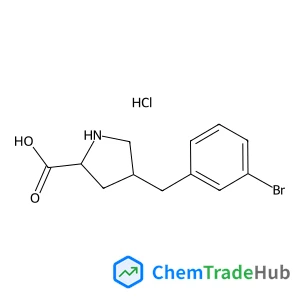
(2S,4R)-4-(3-Bromobenzyl)pyrrolidine-2-carboxylic acid hydrochloride
CAS Number:
1049734-10-2
Molecular Formula:
C12H15BrClNO2
Recommended Suppliers





Disclaimer
This page provides academic journal information for reference and research purposes only. We are not affiliated with any journal publishers and do not handle publication submissions. For publication-related inquiries, please contact the respective journal publishers directly.
If you notice any inaccuracies in the information displayed, please contact us at support@chemtradehub.com. We will promptly review and address your concerns.