


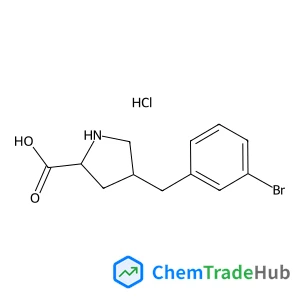
(2S,4R)-4-(3-Bromobenzyl)pyrrolidine-2-carboxylic acid hydrochloride
CAS Number:
1049734-10-2
Molecular Formula:
C12H15BrClNO2
Mohamed Ben Hassine
In the search for new cathode materials for Li-ion batteries, borate (BO33−) based compounds have gained much interest during the last two decades due to the low molecular weight of the borate polyanions which leads to active materials with increased theoretical capacities. In this context we herein report the electrochemical activity versus lithium and the ionic conductivity of a diborate or pyroborate B2O54− based compound, Li6CuB4O10. By combining various electrochemical techniques with in situ X-ray diffraction, we show that this material can reversibly insert/deinsert limited amounts of lithium (∼0.3 Li+) in a potential window ranging from 2.5 to 4.5 V vs. Li+/Li0. We demonstrate, via electron paramagnetic resonance (EPR), that such an electrochemical activity centered near 4.25 V vs. Li+/Li0 is associated with the Cu3+/Cu2+ redox couple, confirmed by density functional theory (DFT) calculations. Another specificity of this compound lies in its different electrochemical behavior when cycled down to 1 V vs. Li+/Li0 which leads to the extrusion of elemental copper via a conversion type reaction as deduced by transmission electron microscopy (TEM). Lastly, we probe the ionic conductivity by means of AC and DC impedance measurements as a function of temperature and show that Li6CuB4O10 undergoes a reversible structural transition around 350 °C, leading to a surprisingly high ionic conductivity of ∼1.4 mS cm−1 at 500 °C.

NDT & E International

Chinese Journal of Chemistry

Journal of the Indian Institute of Science

Bioorganic & Medicinal Chemistry Letters

Polycyclic Aromatic Compounds

Herald of the Russian Academy of Sciences

Medicinal Chemistry Research

Journal of Asian Natural Products Research

Atomization and Sprays

Acta Metallurgica Sinica-English Letters
Li-Wen Jin, Fei Jiang, Ke-Wei Chen, Bai-Xiang Du, Guang-Jian Mei, Feng Shi
DOI: 10.1039/C9OB00432G
Guo-bin Yang, Yong-po Zhang, Dong-dong Guo, Jin-zhong Zhao, Guang-xun Li, Zhuo Tang
DOI: 10.1039/D0QO00722F
Ranjan Kumar Acharyya, Pratik Pal, Shrestha Chatterjee, Samik Nanda
DOI: 10.1039/C9OB00399A
Furen Zhang, Chunmei Li, Chenze Qi
DOI: 10.1039/D0QO00591F
Manickam Bakthadoss, Srinivasan Jayakumar, Selvakumar Raman, Anthonisamy Devaraj, Duddu S. Sharada
DOI: 10.1039/C8OB02970A
Zhijun Zhou, Sheng Xu, Jing Zhang, Wangqing Kong
DOI: 10.1039/D0QO00901F
Noelia Bernardo-García, Pedro A. Sánchez-Murcia, Akbar Espaillat, Siseth Martínez-Caballero, Felipe Cava, Juan A. Hermoso, Federico Gago
DOI: 10.1039/C9OB00223E
Maxim G. Vinogradov, Olga V. Turova, Sergei G. Zlotin
DOI: 10.1039/C8OB03034K
2-(2-Chloroacetamido)-3-phenylpropanoic acid (CAS: 7765-11-9) is generally consi...
2-(Benzyloxy)-5-bromobenzoic acid can be handled safely if appropriate precautio...
(4-Methyl-1,2,5-oxadiazol-3-yl)methanamine hydrochloride is a chemical compound ...
2-(5-Hexylthiophen-2-yl)-4,4,5,5-tetramethyl-1,3,2-dioxaborolane (CAS: 917985-54...
While 4-(8-Methyl-9H-1,3-dioxolo[4,5-h][2,3]benzodiazepin-5-yl)benzenamine (CAS:...
The market for tert-butyl 3-hydroxy-4,5,7,8-tetrahydro-2H-pyrazolo[3,4-d]azepine...
Waste containing 3,5-Diamino-1H-pyrazole-4-carbonitrile (CAS: 6844-58-2) should ...
(6-Fluoro-3-pyridinyl)boronic acid can be synthesized through the reaction of 6-...
Dibenzyl carbonimidoylbiscarbamate (CAS: 10065-79-9) finds applications in vario...
The market for (beta,beta,2,3,4,5,6-~2~H_7_)Phenylalanine (CAS: 74228-83-4) is g...

Physical Chemistry Chemical Physics (PCCP) is an international journal co-owned by 19 physical chemistry and physics societies from around the world. This journal publishes original, cutting-edge research in physical chemistry, chemical physics and biophysical chemistry. To be suitable for publication in PCCP, articles must include significant innovation and/or insight into physical chemistry; this is the most important criterion that reviewers and Editors will judge against when evaluating submissions. The journal has a broad scope and welcomes contributions spanning experiment, theory, computation and data science. Topical coverage includes spectroscopy, dynamics, kinetics, statistical mechanics, thermodynamics, electrochemistry, catalysis, surface science, quantum mechanics, quantum computing and machine learning. Interdisciplinary research areas such as polymers and soft matter, materials, nanoscience, energy, surfaces/interfaces, and biophysical chemistry are welcomed if they demonstrate significant innovation and/or insight into physical chemistry. Joined experimental/theoretical studies are particularly appreciated when complementary and based on up-to-date approaches.
![Ethyl ({[(2-methyl-2-propanyl)oxy]carbonyl}amino)(2-pyridinyl)acetate structure](https://static.chemtradehub.com/structs/313/313490-90-3-dd15.webp "Ethyl ({[(2-methyl-2-propanyl)oxy]carbonyl}amino)(2-pyridinyl)acetate structure")



