












α-TOS-based RAFT block copolymers and their NPs for the treatment of cancer
Literature Information
Publication Date
2015-11-27
DOI
10.1039/C5PY01811K
Impact Factor
5.582
Authors
Francisco J. Parra-Ruiz, Samarendra Maji, Richard Hoogenboom, N. A. Rohner, Susan N. Thomas
View Original
Abstract
α-Tocopheryl succinate (α-TOS) is a well-known mitochondrially targeted anticancer compound. However, a major factor limiting the use of α-TOS is its low solubility in physiological media. To overcome this problem, the aim of this work is the preparation of new polymeric and active α-TOS-based nanovehicle with a precise control over its macromolecular architecture. Reversible addition–fragmentation chain transfer polymerization (RAFT) is used to synthesize an α-TOS amphiphilic block copolymer with highly homogeneous molecular weight and relatively narrow dispersity. Macro-chain transfer agents (macro-CTA) based on poly(ethylene glycol) (PEG) of different molecular weights (MW, ranging from 4.6 to 20 kDa) are used to obtain block copolymers with different hydrophilic/hydrophobic ratios with PEG being the hydrophilic block and a methacrylic derivative of α-tocopheryl succinate (MTOS) being the monomer that formed the hydrophobic block. PEG-b-poly(MTOS) form spherical nanoparticles (NPs) by self-organized precipitation (SORP) or solvent exchange in aqueous media enabling to encapsulate and deliver hydrophobic molecules in their core. The resulting NPs are rapidly endocytosed by cancer cells. The biological activity of the synthesized NPs are found to depend on the MW of PEG, with the NP comprised of the higher MW copolymer resulting in a lower bioactivity due to PEG shielding, inhibiting cellular uptake by endocytosis. Moreover, the biological activity also depends on the MTOS content, as the biological activity increases as a function of MTOS concentration.
Related Literature
Double pH-responsive supramolecular copolymer micelles based on the complementary multiple hydrogen bonds of nucleobases and acetalated dextran for drug delivery
Jizhen Li, Xuesi Chen, Zhigang Xie, Xiabin Jing, Yubin Huang
2015-03-30
Paper
DOI: 10.1039/C5PY00042D
A novel biodegradable polymeric surfactant synthesized from carbon dioxide, maleic anhydride and propylene epoxide
Yulei Liu, Kuirong Deng, Shuanjin Wang, Min Xiao, Dongmei Han, Yuezhong Meng
2015-01-13
Paper
DOI: 10.1039/C4PY01801J
Doubly responsive polymersomes towards monosaccharides and temperature under physiologically relevant conditions
Eun Sun Jeong, Chiyoung Park, Kyoung Taek Kim
2015-03-27
Paper
DOI: 10.1039/C5PY00302D
π-Stacked poly(vinyl ketone)s with accumulated push–pull triphenylamine moieties in the side chain
Heng Wang, Yue Wang, Xichong Ye, Haruka Hayama, Hiroyoshi Sugino, Hideyuki Nakano
2016-11-30
Paper
DOI: 10.1039/C6PY01737A
Enhanced visible radiation photopolymerization of dimethacrylates with the three component thioxanthone (CPTXO)–amine–iodonium salt system
Wayne D. Cook, Fei Chen
2014-11-27
Paper
DOI: 10.1039/C4PY01561D
Synthesis, postmodification and fluorescence properties of reduction-cleavable core-couplable miktoarm stars with a branched core
Cangxia Li, Huanhuan Liu, Dandan Tang, Youliang Zhao
2014-12-15
Paper
DOI: 10.1039/C4PY01495B
Towards being genuinely smart: ‘isothermally-responsive’ polymers as versatile, programmable scaffolds for biologically-adaptable materials
Daniel J. Phillips
2014-12-05
Review Article
DOI: 10.1039/C4PY01539H
Kinetics of the (salen)Cr(iii)- and (salen)Co(iii)-catalyzed copolymerization of epoxides with CO2, and of the accompanying degradation reactions
D. J. Darensbourg, A. D. Yeung
2014-10-27
Paper
DOI: 10.1039/C4PY01322K
Scalable preparation of cyclic polymers by the ring-closure method assisted by the continuous-flow technique
Peng Sun, Jian'an Liu, Zhengbiao Zhang, Ke Zhang
2016-02-23
Paper
DOI: 10.1039/C6PY00165C
You might also like
Compound Q&A
What are the main uses of (5-Sulfamoyl-3-pyridinyl)boronic acid (CAS: 951233-61-7)?
(5-Sulfamoyl-3-pyridinyl)boronic acid is primarily used in chemical synthesis, p...
951233-61-7(5-Sulfamoyl-3-pyrid...
Compound Q&A
How is Benzyl 2-methyl-2-(methylsulfonyl)-4-pentenoate (CAS: 1942858-50-5) typically synthesized?
Benzyl 2-methyl-2-(methylsulfonyl)-4-pentenoate is typically synthesized via est...
1942858-50-5Benzyl 2-methyl-2-(m...
Compound Q&A
What precautions should be taken when handling 8-Fluoroquinolin-6-ol (CAS: 209353-22-0)?
When handling 8-Fluoroquinolin-6-ol (CAS: 209353-22-0), it is important to use p...
209353-22-08-Fluoroquinolin-6-o...
Compound Q&A
What are the physical and chemical properties of 1,3-Dibromo-5-(2-methyl-2-propanyl)benzene (CAS: 129316-09-2)?
1,3-Dibromo-5-(2-methyl-2-propanyl)benzene (CAS: 129316-09-2) is a crystalline c...
129316-09-21,3-Dibromo-5-(2-met...
Compound Q&A
What industries use Ethyl 7-chloro-4-oxo-1-(1,3-thiazol-2-yl)-1,4-dihydro-1,8-naphthyridine-3-carboxylate (CAS: 174726-87-5)?
Ethyl 7-chloro-4-oxo-1-(1,3-thiazol-2-yl)-1,4-dihydro-1,8-naphthyridine-3-carbox...
174726-87-5Ethyl 7-chloro-4-oxo...
Compound Q&A
What precautions should be taken when handling Delta-7-Avenasterol (CAS: 23290-26-8)?
When handling Delta-7-Avenasterol (CAS: 23290-26-8), it is important to wear app...
23290-26-8Delta-7-Avenasterol
Compound Q&A
What precautions should be taken when handling N-({(5R)-3-[3-Fluoro-4-(4-morpholinyl)phenyl]-2-oxo-1,3-oxazolidin-5-yl}methyl)acetamide (CAS: 872992-20-6)?
Proper handling involves the use of personal protective equipment such as gloves...
872992-20-6N-({(5R)-3-[3-Fluoro...
Compound Q&A
What precautions should be taken when handling 2-Methyl-2-proanyl 4-[(2-aminophenyl)amino]-1-piperidinecarboxylate (CAS: 79099-00-6)?
When handling 2-Methyl-2-proanyl 4-[(2-aminophenyl)amino]-1-piperidinecarboxylat...
79099-00-62-Methyl-2-propanyl ...
Compound Q&A
What is N-Methyl-4-chlorobenzylamine hydrochloride (CAS: 65542-24-7)?
N-Methyl-4-chlorobenzylamine hydrochloride (CAS: 65542-24-7) is a organic compou...
65542-24-7N-Methyl-4-chloroben...
Compound Q&A
Is [2-(Dodecyloxy)ethoxy]acetic acid (CAS: 27306-90-7) safe?
[2-(Dodecyloxy)ethoxy]acetic acid (CAS: 27306-90-7) is generally considered safe...
27306-90-7[2-(Dodecyloxy)ethox...
Source Journal
Polymer Chemistry

CiteScore:
8.6
Self-citation Rate:
7.3%
Articles per Year:
457
Polymer Chemistry welcomes submissions in all areas of polymer science that have a strong focus on macromolecular chemistry. Manuscripts may cover a broad range of fields, yet no direct application focus is required.
Recommended Compounds
![5-Chloropyrrolo[2,1-f][1,2,4]triazin-4(3H)-one structure](https://static.chemtradehub.com/structs/888/888720-60-3-4f7c.webp "5-Chloropyrrolo[2,1-f][1,2,4]triazin-4(3H)-one structure")
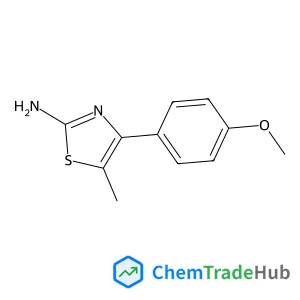
4-(4-Methoxyphenyl)-5-methyl-1,3-thiazol-2-amine
CAS Number:
105512-88-7
Molecular Formula:
C11H12N2OS
Recommended Suppliers








Disclaimer
This page provides academic journal information for reference and research purposes only. We are not affiliated with any journal publishers and do not handle publication submissions. For publication-related inquiries, please contact the respective journal publishers directly.
If you notice any inaccuracies in the information displayed, please contact us at support@chemtradehub.com. We will promptly review and address your concerns.