












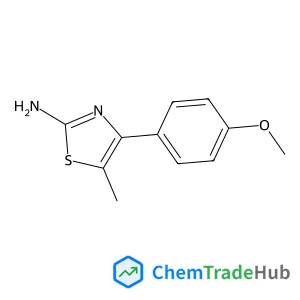
4-(4-Methoxyphenyl)-5-methyl-1,3-thiazol-2-amine
CAS Number:
105512-88-7
Molecular Formula:
C11H12N2OS
Eun Sun Jeong, Chiyoung Park, Kyoung Taek Kim
Organoboronic acid-containing polymers and block copolymers have recently attracted attention because of their ability to recognize important natural diol compounds such as saccharides and nucleotides under physiologically relevant conditions at neutral pH. In particular, polymers and block copolymers that are responsive toward multiple stimuli can be utilized to create smart delivery vehicles for use in applications in a complex environment. Here we report the monosaccharide-responsive polymers and block copolymers comprising styreneboroxole and oligo(ethylene glycol)-functionalized styrenes (OEG-STs) as repeating units. We have shown that homopolymers and copolymers of OEG-STs are thermally responsive by demonstrating that they possess the characteristic of tunable lower critical solution temperature (LCST) in water. When copolymerized with OEG-STs, styreneboroxole units function as a switch to change the solubility of the resulting polymers in aqueous solution by recognizing monosaccharides via the formation of boronate ester. By introducing the minimum number of monosaccharide-responsive styreneboroxole units onto the thermally responsive OEG-ST backbone, we demonstrated the monosaccharide-responsive behavior of the resulting copolymers and their amphiphilic block copolymers in aqueous solution at physiologically relevant pH and temperature. A strategy based on doubly responsive block copolymers reported here could be utilized as new delivery vehicles for cargo molecules such as insulin, due to their ability to function in an in vivo environment.
Amlan J. Kalita, Shahnaz S. Rohman, Chayanika Kashyap, Sabnam S. Ullah, Ankur K. Guha
DOI: 10.1039/D0CP03436C
Małgorzata Jasiurkowska-Delaporte, Maria Massalska-Arodź, Yasuhisa Yamamura, Kazuya Saito
DOI: 10.1039/D0CP04002A
Xiangyue Liu, Gerard Meijer, Jesús Pérez-Ríos
DOI: 10.1039/D0CP03810E
Zi-Chen Lu, Rui Chen, Ju-Guang Han
DOI: 10.1039/C9CP90284H
Joel Y. Y. Loh
DOI: 10.1039/D0CP03217D
Michael Fenech, Sean Lim, Jeffrey Cheung, Neeraj Sharma
DOI: 10.1039/C9CP05718H
Qihao Sun, Wenhui Yang, Yuanbo Cheng, Jiangpeng Dong, Mengqin Zhu, BinBin Zhang, Menghua Zhu, Wanqi Jie
DOI: 10.1039/D0CP04485G
Zhiling Liu, Yan Bai, Ya Li, Jing He, Qingyang Lin, Hua Xie, Zichao Tang
DOI: 10.1039/D0CP03883K
Baili Li, Lixian Tian, Xuehao He, Xuan Ji, Hira Khalid, Chong Yue, Qinggang Liu, Xi Yu, Shengbin Lei, Wenping Hu
DOI: 10.1039/C9CP04695J
Pijush Karak, Swapan Chakrabarti
DOI: 10.1039/D0CP04713A
(5-Sulfamoyl-3-pyridinyl)boronic acid is primarily used in chemical synthesis, p...
Benzyl 2-methyl-2-(methylsulfonyl)-4-pentenoate is typically synthesized via est...
When handling 8-Fluoroquinolin-6-ol (CAS: 209353-22-0), it is important to use p...
1,3-Dibromo-5-(2-methyl-2-propanyl)benzene (CAS: 129316-09-2) is a crystalline c...
Ethyl 7-chloro-4-oxo-1-(1,3-thiazol-2-yl)-1,4-dihydro-1,8-naphthyridine-3-carbox...
When handling Delta-7-Avenasterol (CAS: 23290-26-8), it is important to wear app...
Proper handling involves the use of personal protective equipment such as gloves...
When handling 2-Methyl-2-proanyl 4-[(2-aminophenyl)amino]-1-piperidinecarboxylat...
N-Methyl-4-chlorobenzylamine hydrochloride (CAS: 65542-24-7) is a organic compou...
[2-(Dodecyloxy)ethoxy]acetic acid (CAS: 27306-90-7) is generally considered safe...

Polymer Chemistry welcomes submissions in all areas of polymer science that have a strong focus on macromolecular chemistry. Manuscripts may cover a broad range of fields, yet no direct application focus is required.
![5-Chloropyrrolo[2,1-f][1,2,4]triazin-4(3H)-one structure](https://static.chemtradehub.com/structs/888/888720-60-3-4f7c.webp "5-Chloropyrrolo[2,1-f][1,2,4]triazin-4(3H)-one structure")





