












Synthesis, postmodification and fluorescence properties of reduction-cleavable core-couplable miktoarm stars with a branched core
Literature Information
Publication Date
2014-12-15
DOI
10.1039/C4PY01495B
Impact Factor
5.582
Authors
Cangxia Li, Huanhuan Liu, Dandan Tang, Youliang Zhao
View Original
Abstract
Novel amphiphilic (PEG)m(PCL)n (m ≈ n ≈ 23) miktoarm stars with a disulfide-linked epoxy-functionalized branched core were controllably synthesized via three step reactions comprising self-condensing vinyl polymerization via reversible addition–fragmentation chain transfer, epoxy-carboxyl coupling reaction and ring-opening polymerization. The star copolymers were characterized by 1H NMR spectra, GPC-MALLS, DSC and reduction-triggered degradation. Postpolymerization modification via epoxy-carboxyl/phenol coupling reactions allowed attaching dual-reactive functionalities including coumarin, alkyne and alkyl bromide onto the branched core. In water and THF–water mixtures, a coumarin-modified star copolymer could aggregate into some intriguing morphologies including hyperbranched micelles and large vesicles due to the influence of solvent polarity on aggregation behaviors. Owing to the differences in the isolation of fluorophores from solvents and restricted molecular motion, coumarin-functionalized stars exhibited adjustable fluorescence properties in water and THF–water mixtures, and their aqueous solution had a maximum quantum yield (ΦF = 44.2%). The solutions of star copolymers and their reduction-cleaved copolymers were of different hydrodynamic diameters, and the ΦF(star)/ΦF(cleaved copolymer) values were 1.85 (in THF), 3.00 (in water) and ranged between 1.29 and 2.58 in THF–water mixtures, revealing that the aggregation behaviors and fluorescence properties were strongly dependent on polymeric architecture, location of fluorophores and solvent polarity. Our study affords a versatile method to construct functional miktoarm stars with a multi-reactive branched core, and coumarin-functionalized star copolymers may have a great potential as solvent polarity and reduction dual-sensitive imaging materials in “green” ink, coatings and nanocarriers for biomedical applications.
Related Literature
Transition metal silicide surface grafting by multiple functional groups and green optimization by mechanochemistry
Maxime Godfroy, Mahmoud Khalil, Claude Niebel, Thibaut Jarrosson, Dominique Foix, Valérie Flaud, Françoise Serein-Spirau, Romain Viennois, Michel Granier, Mickaël Beaudhuin
2019-11-01
Paper
DOI: 10.1039/C9CP03864G
Structural and electronic transport properties of a SiC chain encapsulated inside a SiC nanotube: first-principles study
Yi Mu, Cai Cheng, Cui-E Hu, Xiao-Lin Zhou
2019-09-24
Paper
DOI: 10.1039/C9CP03945G
Quantifying reversible nitrogenous ligand binding to Co(ii) porphyrin receptors at the solution/solid interface and in solution
Kristen N. Johnson, K. W. Hipps, Ursula Mazur
2020-10-21
Paper
DOI: 10.1039/D0CP04109B
Can modified DNA base pairs with chalcogen bonding expand the genetic alphabet? A combined quantum chemical and molecular dynamics simulation study
Preetleen Kathuria, Stacey D. Wetmore, Purshotam Sharma
2020-10-05
Paper
DOI: 10.1039/D0CP04921B
One-pot microwave-hydrothermally synthesized carbon nanotube-cerium oxide nanocomposites for enhanced visible photodegradation of acid orange 7
Heyun Jiang, Shengsong Ge, Yu Zhang, Mei Liu, Jing Lin, Junxiang Wang, Zhanhu Guo
2020-08-27
Paper
DOI: 10.1039/D0CP00431F
Non-quenching photoluminescence emission up to at least 865 K upon near-UV excitation in a single crystal of orange-red emitting SmPO4
Jan Beyer, Richard Gloaguen, Johannes Heitmann
2019-11-11
Paper
DOI: 10.1039/C9CP05663G
Fission of charged nano-hydrated ammonia clusters – microscopic insights into the nucleation processes
Bart Oostenrijk, Darío Barreiro, Noelle Walsh, Anna Sankari, Erik P. Månsson, Stacey L. Sorensen, Mathieu Gisselbrecht
2019-10-22
Paper
DOI: 10.1039/C9CP04221K
Addition of carbon-centered radicals to aromatic antioxidants: mechanistic aspects
Janusz M. Gebicki
2020-10-19
Paper
DOI: 10.1039/D0CP04469E
Catalytic mechanism of the PrhA (V150L/A232S) double mutant involved in the fungal meroterpenoid biosynthetic pathway: a QM/MM study
Jie Bai, Lijuan Yan, Yongjun Liu
2019-11-08
Paper
DOI: 10.1039/C9CP03565F
Modulation doping of absorbent cotton derived carbon dots for quantum dot-sensitized solar cells
Shunjian Xu, Meng Zhang, Wei Zhong, Zonghu Xiao, Yongping Luo
2019-11-07
Paper
DOI: 10.1039/C9CP04880D
You might also like
Compound Q&A
What are the main uses of (5-Sulfamoyl-3-pyridinyl)boronic acid (CAS: 951233-61-7)?
(5-Sulfamoyl-3-pyridinyl)boronic acid is primarily used in chemical synthesis, p...
951233-61-7(5-Sulfamoyl-3-pyrid...
Compound Q&A
How is Benzyl 2-methyl-2-(methylsulfonyl)-4-pentenoate (CAS: 1942858-50-5) typically synthesized?
Benzyl 2-methyl-2-(methylsulfonyl)-4-pentenoate is typically synthesized via est...
1942858-50-5Benzyl 2-methyl-2-(m...
Compound Q&A
What precautions should be taken when handling 8-Fluoroquinolin-6-ol (CAS: 209353-22-0)?
When handling 8-Fluoroquinolin-6-ol (CAS: 209353-22-0), it is important to use p...
209353-22-08-Fluoroquinolin-6-o...
Compound Q&A
What are the physical and chemical properties of 1,3-Dibromo-5-(2-methyl-2-propanyl)benzene (CAS: 129316-09-2)?
1,3-Dibromo-5-(2-methyl-2-propanyl)benzene (CAS: 129316-09-2) is a crystalline c...
129316-09-21,3-Dibromo-5-(2-met...
Compound Q&A
What industries use Ethyl 7-chloro-4-oxo-1-(1,3-thiazol-2-yl)-1,4-dihydro-1,8-naphthyridine-3-carboxylate (CAS: 174726-87-5)?
Ethyl 7-chloro-4-oxo-1-(1,3-thiazol-2-yl)-1,4-dihydro-1,8-naphthyridine-3-carbox...
174726-87-5Ethyl 7-chloro-4-oxo...
Compound Q&A
What precautions should be taken when handling Delta-7-Avenasterol (CAS: 23290-26-8)?
When handling Delta-7-Avenasterol (CAS: 23290-26-8), it is important to wear app...
23290-26-8Delta-7-Avenasterol
Compound Q&A
What precautions should be taken when handling N-({(5R)-3-[3-Fluoro-4-(4-morpholinyl)phenyl]-2-oxo-1,3-oxazolidin-5-yl}methyl)acetamide (CAS: 872992-20-6)?
Proper handling involves the use of personal protective equipment such as gloves...
872992-20-6N-({(5R)-3-[3-Fluoro...
Compound Q&A
What precautions should be taken when handling 2-Methyl-2-proanyl 4-[(2-aminophenyl)amino]-1-piperidinecarboxylate (CAS: 79099-00-6)?
When handling 2-Methyl-2-proanyl 4-[(2-aminophenyl)amino]-1-piperidinecarboxylat...
79099-00-62-Methyl-2-propanyl ...
Compound Q&A
What is N-Methyl-4-chlorobenzylamine hydrochloride (CAS: 65542-24-7)?
N-Methyl-4-chlorobenzylamine hydrochloride (CAS: 65542-24-7) is a organic compou...
65542-24-7N-Methyl-4-chloroben...
Compound Q&A
Is [2-(Dodecyloxy)ethoxy]acetic acid (CAS: 27306-90-7) safe?
[2-(Dodecyloxy)ethoxy]acetic acid (CAS: 27306-90-7) is generally considered safe...
27306-90-7[2-(Dodecyloxy)ethox...
Source Journal
Polymer Chemistry

CiteScore:
8.6
Self-citation Rate:
7.3%
Articles per Year:
457
Polymer Chemistry welcomes submissions in all areas of polymer science that have a strong focus on macromolecular chemistry. Manuscripts may cover a broad range of fields, yet no direct application focus is required.
Recommended Compounds
![5-Chloropyrrolo[2,1-f][1,2,4]triazin-4(3H)-one structure](https://static.chemtradehub.com/structs/888/888720-60-3-4f7c.webp "5-Chloropyrrolo[2,1-f][1,2,4]triazin-4(3H)-one structure")
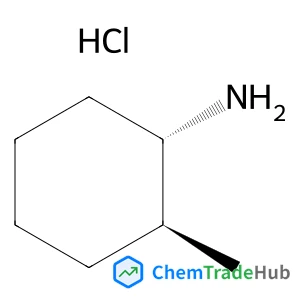
(1R,2R)-2-Methylcyclohexanamine hydrochloride (1:1)
CAS Number:
39558-31-1
Molecular Formula:
C7H16ClN
Recommended Suppliers





Disclaimer
This page provides academic journal information for reference and research purposes only. We are not affiliated with any journal publishers and do not handle publication submissions. For publication-related inquiries, please contact the respective journal publishers directly.
If you notice any inaccuracies in the information displayed, please contact us at support@chemtradehub.com. We will promptly review and address your concerns.