












Electrochemical synthesis of electrochromic polycarbazole films from N-phenyl-3,6-bis(N-carbazolyl)carbazoles
Literature Information
Publication Date
2015-10-22
DOI
10.1039/C5PY01407G
Impact Factor
5.582
Authors
Sheng-Huei Hsiao, Shu-Wei Lin
View Original
Abstract
Two compounds with a tri-carbazole (3Cz) structure, namely 3,6-di(carbazol-9-yl)-N-(4-nitrophenyl)carbazole (NO2-3Cz) and 3,6-di(carbazol-9-yl)-N-(4-aminophenyl)carbazole (NH2-3Cz), were synthesized and electropolymerized into robust polymer films on the electrode surface in an electrolyte solution via the oxidative coupling reactions. The electro-generated polymer films exhibited reversible electrochemical oxidation processes, with significant electrochromic behaviour. The colour of P(NO2-3Cz) films changed from the pale yellow neutral state to yellow-green as a radical cation and then to blue when fully oxidized. Upon oxidation, the colour of P(NH2-3Cz) films changed from colourless to pale green and finally to blue. Furthermore, we also synthesized and characterized some N-phenylcarbazoles with different substituents on the phenyl group. Based on a comparative study, the possible electropolymerization mechanisms of the NO2-3Cz and NH2-3Cz monomers are suggested; that of the former is through carbazole–carbazole coupling, and the latter is through both carbazole–carbazole and NH2–carbazole coupling.
Recommended Journals
Related Literature
Critical assessment of enhancement factor measurements in surface-enhanced Raman scattering on different substrates
Daniel C. Rodrigues, Michele L. de Souza, Klester S. Souza, Diego P. dos Santos, Gustavo F. S. Andrade, Marcia L. A. Temperini
2015-01-26
Paper
DOI: 10.1039/C4CP05080K
A detailed study of cholinium chloride and levulinic acid deep eutectic solvent system for CO2 capture via experimental and molecular simulation approaches
Ruh Ullah, Mert Atilhan, Baraa Anaya, Majeda Khraisheh, Gregorio García, Ahmed ElKhattat, Mohammad Tariq, Santiago Aparicio
2015-06-30
Paper
DOI: 10.1039/C5CP03364K
Probing the mechanism of CO2 capture in diamine-appended metal–organic frameworks using measured and simulated X-ray spectroscopy
Walter S. Drisdell, Roberta Poloni, Thomas M. McDonald, Tod A. Pascal, Liwen F. Wan, C. Das Pemmaraju, Bess Vlaisavljevich, Samuel O. Odoh, Jeffrey B. Neaton, David Prendergast, Jeffrey B. Kortright
2015-07-23
Paper
DOI: 10.1039/C5CP02951A
Theoretical study on interactions of fluorinated organomercurials with arene and gold fragments
Sebastián Miranda-Rojas
2015-09-14
Paper
DOI: 10.1039/C5CP04503G
Surface enhanced Raman scattering of a single molecular junction
Ryuji Matsushita, Manabu Kiguchi
2015-01-15
Paper
DOI: 10.1039/C4CP04906C
Dynamic interface tension of a smectic liquid crystal in anionic surfactant solutions
Kirsten Harth, Larissa M. Shepherd, James Honaker, Ralf Stannarius
2015-09-09
Paper
DOI: 10.1039/C5CP04193G
Electronic structure and conformational flexibility of d-cycloserine
Antonello Filippi, Caterina Fraschetti, Felice Grandinetti, Maurizio Speranza, Aurora Ponzi, Piero Decleva
2015-04-30
Paper
DOI: 10.1039/C5CP01471A
Diverse mixtures of 2,4-dihydroxy tautomers and O4 protonated conformers of uridine and 2′-deoxyuridine coexist in the gas phase
R. R. Wu, Bo Yang, C. E. Frieler, G. Berden, M. T. Rodgers
2015-07-21
Paper
DOI: 10.1039/C5CP02227D
Plasmonic properties of regiospecific core–satellite assemblies of gold nanostars and nanospheres
A. Swarnapali D. S. Indrasekara, Roney Thomas
2014-10-31
Paper
DOI: 10.1039/C4CP04517C
An integrated superhydrophobic-plasmonic biosensor for mid-infrared protein detection at the femtomole level
Adele De Ninno, Gabriele Ciasca, Annamaria Gerardino, Eugenio Calandrini, Massimiliano Papi, Marco De Spirito, Alessandro Nucara, Luca Businaro, Leonetta Baldassarre
2015-02-12
Paper
DOI: 10.1039/C4CP05023A
You might also like
Compound Q&A
Is 2-(2-chloroacetamido)-3-phenylpropanoic acid (CAS: 7765-11-9) safe?
2-(2-Chloroacetamido)-3-phenylpropanoic acid (CAS: 7765-11-9) is generally consi...
7765-11-92-(2-chloroacetamido...
Compound Q&A
Is 2-(Benzyloxy)-5-bromobenzoic acid (CAS: 62176-31-2) safe?
2-(Benzyloxy)-5-bromobenzoic acid can be handled safely if appropriate precautio...
62176-31-22-(Benzyloxy)-5-brom...
Compound Q&A
What is (4-Methyl-1,2,5-oxadiazol-3-yl)methanamine hydrochloride (CAS: 1159825-48-5)?
(4-Methyl-1,2,5-oxadiazol-3-yl)methanamine hydrochloride is a chemical compound ...
1159825-48-5(4-Methyl-1,2,5-oxad...
Compound Q&A
What is 2-(5-Hexylthiophen-2-yl)-4,4,5,5-tetramethyl-1,3,2-dioxaborolane (CAS: 917985-54-7)?
2-(5-Hexylthiophen-2-yl)-4,4,5,5-tetramethyl-1,3,2-dioxaborolane (CAS: 917985-54...
917985-54-72-(5-Hexylthiophen-2...
Compound Q&A
Are there alternatives to 4-(8-Methyl-9H-1,3-dioxolo[4,5-h][2,3]benzodiazepin-5-yl)benzenamine (CAS: 102771-26-6) in synthesis?
While 4-(8-Methyl-9H-1,3-dioxolo[4,5-h][2,3]benzodiazepin-5-yl)benzenamine (CAS:...
102771-26-64-(8-Methyl-9H-1,3-d...
Compound Q&A
What is the market or research trend for tert-butyl 3-hydroxy-4,5,7,8-tetrahydro-2H-pyrazolo[3,4-d]azepine-6-carboxylate (CAS: 851376-80-2)?
The market for tert-butyl 3-hydroxy-4,5,7,8-tetrahydro-2H-pyrazolo[3,4-d]azepine...
851376-80-2tert-butyl 3-hydroxy...
Compound Q&A
How should waste containing 3,5-Diamino-1H-pyrazole-4-carbonitrile (CAS: 6844-58-2) be handled?
Waste containing 3,5-Diamino-1H-pyrazole-4-carbonitrile (CAS: 6844-58-2) should ...
6844-58-23,5-Diamino-1H-pyraz...
Compound Q&A
How is (6-Fluoro-3-pyridinyl)boronic acid (CAS: 351019-18-6) typically synthesized?
(6-Fluoro-3-pyridinyl)boronic acid can be synthesized through the reaction of 6-...
351019-18-6(6-Fluoro-3-pyridiny...
Compound Q&A
What industries use Dibenzyl carbonimidoylbiscarbamate (CAS: 10065-79-9)?
Dibenzyl carbonimidoylbiscarbamate (CAS: 10065-79-9) finds applications in vario...
10065-79-9Dibenzyl carbonimido...
Compound Q&A
What is the market or research trend for (beta,beta,2,3,4,5,6-~2~H_7_)Phenylalanine (CAS: 74228-83-4)?
The market for (beta,beta,2,3,4,5,6-~2~H_7_)Phenylalanine (CAS: 74228-83-4) is g...
74228-83-4(beta,beta,2,3,4,5,6...
Source Journal
Polymer Chemistry

CiteScore:
8.6
Self-citation Rate:
7.3%
Articles per Year:
457
Polymer Chemistry welcomes submissions in all areas of polymer science that have a strong focus on macromolecular chemistry. Manuscripts may cover a broad range of fields, yet no direct application focus is required.
Recommended Compounds
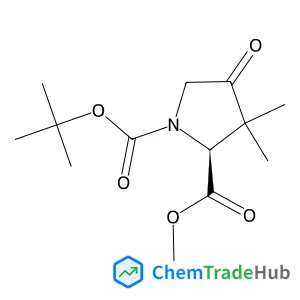
2-Methyl 1-(2-methyl-2-propanyl) (2S)-3,3-dimethyl-4-oxo-1,2-pyrrolidinedicarboxylate
CAS Number:
478698-30-5
Molecular Formula:
C13H21NO5
Recommended Suppliers




Disclaimer
This page provides academic journal information for reference and research purposes only. We are not affiliated with any journal publishers and do not handle publication submissions. For publication-related inquiries, please contact the respective journal publishers directly.
If you notice any inaccuracies in the information displayed, please contact us at support@chemtradehub.com. We will promptly review and address your concerns.