


![5-Bromo-3-isopropyl-1H-pyrrolo[2,3-b]pyridine structure](https://static.chemtradehub.com/structs/125/1256819-54-1-8620.webp "5-Bromo-3-isopropyl-1H-pyrrolo[2,3-b]pyridine structure")
Plasmonic properties of regiospecific core–satellite assemblies of gold nanostars and nanospheres
Literature Information
Publication Date
2014-10-31
DOI
10.1039/C4CP04517C
Impact Factor
3.676
Authors
A. Swarnapali D. S. Indrasekara, Roney Thomas
View Original
Abstract
Solution-based molecularly-mediated bottom-up assembly of gold nanostars and nanospheres in regiospecific core–satellite nanoarchitectures is reported. The controlled assembly is driven by coupling reactions in solution between small, rigid, Raman-active organic molecules bound to the surface of the nanoparticles, and leads to much narrower interparticle gaps than achievable with DNA-based assembly methods. In the described system, gold nanostars with multiple sharp spikes, ideal for electromagnetic field enhancement, are used as the core particle onto which spherical satellites are assembled. Transmission electron micrographs show that the core–satellite structures assemble with <2 nm interparticle gaps and regiospecific binding of only one sphere per spike, and the process can be followed by monitoring changes in the surface enhanced Raman scattering (SERS) spectra of the Raman active linkers. The assembled structures give rise on average to two orders of magnitude SERS signal enhancement per nanoparticle in comparison to their constituents, which can be attributed to the creation of SERS “hot spots” between the nanostar tip and the satellite sphere. Two dimensional finite element electromagnetic models show strongly confined electromagnetic field intensity in the narrow interparticle gaps of core–satellite assemblies, which is significantly enhanced in comparison to the constituent nanoparticles, thus corroborating the experimental findings. Thus, the assemblies reported here can be envisioned as SERS-tags for imaging purposes as well as a model system for SERS-based chemical sensing with improved sensitivity.
Recommended Journals

New Journal of Chemistry

Russian Journal of Organic Chemistry

Current Opinion in Colloid & Interface Science

Saudi Pharmaceutical Journal

Russian Chemical Bulletin

Russian Journal of Coordination Chemistry

Organic Process Research & Development

Russian Journal of Applied Chemistry

Chemical Communications

Russian Journal of Bioorganic Chemistry
Related Literature
Rh-Catalyzed C–C/C–N bond formation via C–H activation: synthesis of 2H-indazol-2-yl-benzo[a]carbazoles
Sundaravel Vivek Kumar, Sonbidya Banerjee, Tharmalingam Punniyamurthy
2019-10-14
Research Article
DOI: 10.1039/C9QO01120J
Photocatalytic decarboxylative [2 + 2 + 1] annulation of 1,6-enynes with N-hydroxyphthalimide esters for the synthesis of indene-containing polycyclic compounds
Meng-Jie Jiao, Dan Liu, Xiu-Qin Hu, Peng-Fei Xu
2019-10-16
Research Article
DOI: 10.1039/C9QO01166H
Regio- and stereo-selective decarbonylative alkylative arylation of terminal alkynes with aliphatic aldehydes and arenes via dual C–H bond functionalization
Yong Peng, Ting-Ting Qin, Cong-Ling Xu, Luo Yang
2019-09-10
Research Article
DOI: 10.1039/C9QO01009B
DMF/NaOH/H2O: a metal-free system for efficient and chemoselective reduction of α-ketoamides
Rongcong Ye, Feiyue Hao, Guyue Liu, Qingsong Zuo, Lijun Deng, Zhengneng Jin, Jiashou Wu
2019-09-04
Research Article
DOI: 10.1039/C9QO00842J
Solvent-controlled chemoselective N-dealkylation-N-nitrosation or C-nitration of N-alkyl anilines with tert-butyl nitrite
Qaiser Mahmood, Guangqiang Xu, Qinggang Wang
2019-08-21
Research Article
DOI: 10.1039/C9QO00965E
A free-radical-promoted stereospecific denitro silylation of β-nitroalkenes with silanes
Xi Zhang, Ming-Xia Liu, Tong-Lin Wang, Yong-Qing Wang, Xi-Cun Wang, Zheng-Jun Quan
2019-08-21
Research Article
DOI: 10.1039/C9QO00819E
Reagent-controlled regiodivergence in the [3,3]-sigmatropic rearrangement of N-(acyloxy)enamides
Norihiko Takeda, Narumi Arisawa, Misaki Miyamoto, Yukiko Kobori, Tetsuro Shinada, Masafumi Ueda
2019-09-27
Research Article
DOI: 10.1039/C9QO01109A
Polyoxygenated meroterpenoids and a bioactive illudalane derivative from a co-culture of Armillaria sp. and Epicoccum sp.
Hong-Tao Li, Linhuan Tang, Tao Liu, Ruining Yang, Yabin Yang, Hao Zhou, Zhong-Tao Ding
2019-10-14
Research Article
DOI: 10.1039/C9QO01087D
You might also like
Compound Q&A
Is 6-(3-Fluorophenyl)picolinic acid (CAS: 887982-40-3) safe?
6-(3-Fluorophenyl)picolinic acid is generally considered safe for laboratory use...
887982-40-36-(3-Fluorophenyl)pi...
Compound Q&A
What industries use (3R)-3-Pyrrolidinol (CAS: 2799-21-5)?
(3R)-3-Pyrrolidinol is used in the pharmaceutical industry as a precursor for dr...
2799-21-5(3R)-3-Pyrrolidinol
Compound Q&A
What precautions should be taken when handling (4R,5R)-4,5-Diethoxycarbonyl-2,2-dimethyldioxolane (CAS: 59779-75-8)?
When handling (4R,5R)-4,5-Diethoxycarbonyl-2,2-dimethyldioxolane (CAS: 59779-75-...
59779-75-8(4R,5R)-4,5-Diethoxy...
Compound Q&A
How is 1-(6-Chloroimidazo[1,2-b]pyridazin-3-yl)ethanone (CAS: 90734-71-7) typically synthesized?
1-(6-Chloroimidazo[1,2-b]pyridazin-3-yl)ethanone is often synthesized via a mult...
90734-71-71-(6-Chloroimidazo[1...
Compound Q&A
What is the market or research trend for N-Ethyl-3,4-dimethylbenzylamine (CAS: 39180-83-1)?
The market for N-Ethyl-3,4-dimethylbenzylamine (CAS: 39180-83-1) remains steady,...
39180-83-1N-Ethyl-3,4-dimethyl...
Compound Q&A
What is Tert-butyl 3-(pyrrolidin-1-yl)azetidine-1-carboxylate (CAS: 1019008-21-9)?
Tert-butyl 3-(pyrrolidin-1-yl)azetidine-1-carboxylate is a chemical compound wit...
1019008-21-9Tert-butyl 3-(pyrrol...
Compound Q&A
What regulatory guidelines apply to 1-Bromo-3-chloro-2,4-dimethoxybenzene (CAS: 1228956-93-1)?
1-Bromo-3-chloro-2,4-dimethoxybenzene (CAS: 1228956-93-1) falls under the classi...
1228956-93-11-Bromo-3-chloro-2,4...
Compound Q&A
Is 8-Bromo-2-methyl-3,4-dihydroisoquinolin-1(2H)-one (CAS: 1368622-07-4) safe?
The safety of 8-Bromo-2-methyl-3,4-dihydroisoquinolin-1(2H)-one (CAS: 1368622-07...
1368622-07-48-Bromo-2-methyl-3,4...
Compound Q&A
Is Benzyl [(3S)-2,6-dioxo-3-piperidinyl]carbamate (CAS: 22785-43-9) safe?
Benzyl [(3S)-2,6-dioxo-3-piperidinyl]carbamate is generally safe when handled wi...
22785-43-9Benzyl [(3S)-2,6-dio...
Compound Q&A
How should 1-{[4-(4,4,5,5-Tetramethyl-1,3,2-dioxaborolan-2-yl)phenyl]sulfonyl}pyrrolidine (CAS: 928657-21-0) be stored?
1-{[4-(4,4,5,5-Tetramethyl-1,3,2-dioxaborolan-2-yl)phenyl]sulfonyl}pyrrolidine s...
928657-21-01-{[4-(4,4,5,5-Tetra...
Source Journal
Physical Chemistry Chemical Physics

CiteScore:
5.5
Self-citation Rate:
10.3%
Articles per Year:
3036
Physical Chemistry Chemical Physics (PCCP) is an international journal co-owned by 19 physical chemistry and physics societies from around the world. This journal publishes original, cutting-edge research in physical chemistry, chemical physics and biophysical chemistry. To be suitable for publication in PCCP, articles must include significant innovation and/or insight into physical chemistry; this is the most important criterion that reviewers and Editors will judge against when evaluating submissions. The journal has a broad scope and welcomes contributions spanning experiment, theory, computation and data science. Topical coverage includes spectroscopy, dynamics, kinetics, statistical mechanics, thermodynamics, electrochemistry, catalysis, surface science, quantum mechanics, quantum computing and machine learning. Interdisciplinary research areas such as polymers and soft matter, materials, nanoscience, energy, surfaces/interfaces, and biophysical chemistry are welcomed if they demonstrate significant innovation and/or insight into physical chemistry. Joined experimental/theoretical studies are particularly appreciated when complementary and based on up-to-date approaches.
Recommended Compounds

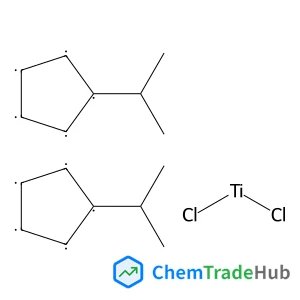
BIS(I-PROPYLCYCLOPENTADIENYL)TITANIUM DICHLORIDE
CAS Number:
12130-65-3
Molecular Formula:
C16H22Cl2Ti
Recommended Suppliers





Disclaimer
This page provides academic journal information for reference and research purposes only. We are not affiliated with any journal publishers and do not handle publication submissions. For publication-related inquiries, please contact the respective journal publishers directly.
If you notice any inaccuracies in the information displayed, please contact us at support@chemtradehub.com. We will promptly review and address your concerns.