












Photocontrollable induction of supramolecular chirality in achiral side chain Azo-containing polymers through preferential chiral solvation‡
Literature Information
Publication Date
2015-04-23
DOI
10.1039/C5PY00496A
Impact Factor
5.582
Authors
Shunqin Jiang, Yin Zhao, Laibing Wang, Lu Yin, Zhengbiao Zhang, Jian Zhu, Wei Zhang, Xiulin Zhu
View Original
Abstract
Here we designed a trans–cis photoisomerizable achiral side chain azobenzene-containing polymer, poly(6-[4-(4-methoxyphenylazo) phenoxy] hexyl methacrylate) (PAzoMA), to investigate the possibility of transferring chirality of chiral solvent molecules to polymers. Preferred chirality in supramolecularly assembled trans-azobenzene units of PAzoMA is successfully induced by limonene chirality. This chiral solvation induced chirality arises from superstructural chirality of well-assembled achiral azobenzene units in polymer side chains. The intense bisignated circular dichroism (CD) signals in the UV-vis region disappeared when trans–cis photoisomerization of PAzoMA occurred with 365 nm light irradiation. The polymer aggregate solution shows the CD-silent state when the cis-PAzoMA solution is subjected to 436 nm light irradiation. The intense CD signals with a ∼40 nm red-shift were recovered by heating the polymer aggregate solution to 60 °C and keeping it at this temperature for 40 min, then cooling it down to room temperature. The successful construction of a reversible chiral–achiral switch based on an achiral azobenzene-containing side chain polymer will open a new approach for production of chiroptical materials.
Related Literature
Asymmetric organocatalytic synthesis of chiral 3,3-disubstituted oxindoles via a 1,6-conjugate addition reaction
Abdul Rahman, Qiaoxia Zhou, Xufeng Lin
2018-06-28
Paper
DOI: 10.1039/C8OB01169A
Regio- and stereoselective cobalt-catalyzed hydrosilylation of 1,3-diynes with primary and secondary silanes
Shaocong Shen, Zhijian Zong, Nan Sun, Baoxiang Hu, Zhenlu Shen, Xinquan Hu
2021-09-15
Research Article
DOI: 10.1039/D1QO00939G
Nα-Amino acid containing privileged structures: design, synthesis and use in solid-phase peptide synthesis
Eva Schütznerová, Adam Přibylka
2018-07-12
Paper
DOI: 10.1039/C8OB01485J
Metal-free electrochemical synthesis of α-ketoamides via decarboxylative coupling of α-keto acids with isocyanides and water
Feng Zhao, Na Meng, Ting Sun, Jiangwei Wen, Xiaohui Zhao
2021-10-26
Research Article
DOI: 10.1039/D1QO01351C
Asymmetric iodine catalysis-mediated enantioselective oxidative transformations
Aurélie Claraz, Géraldine Masson
2018-07-13
Review Article
DOI: 10.1039/C8OB01378K
Synthesis of N-acylbenzimidazoles through [4 + 1] annulation of N-arylpivalimidamides with dioxazolones
Xia Song, Xinyuan Cai, Xinying Zhang, Xuesen Fan
2021-09-14
Research Article
DOI: 10.1039/D1QO01137E
Base controlled diverse reactivity of allyl cyanide for synthesis of multi-substituted benzenes
Pratik Yadav, Ranjay Shaw, Amr Elagamy, Abhinav Kumar, Ramendra Pratap
2018-07-10
Paper
DOI: 10.1039/C8OB01270A
Base-promoted diastereoselective α-alkylation of borane N-((S)-1′-phenylethyl)azetidine-2-carboxylic acid ester complexes
Eiji Tayama, Ryotaro Nishio, Yoshiaki Kobayashi
2018-07-27
Paper
DOI: 10.1039/C8OB01395K
Two bifunctional desferrioxamine chelators for bioorthogonal labeling of biovectors with zirconium-89
F. Gao, C. Ieritano, K.-T. Chen, G. M. Dias, J. Rousseau, Y. Seimbille
2018-07-02
Communication
DOI: 10.1039/C8OB01434E
You might also like
Compound Q&A
What are the main uses of 4-Nitrophenyl phosphate disodium salt hexahydrate (CAS: 333338-18-4)?
4-Nitrophenyl phosphate disodium salt hexahydrate is primarily used as a substra...
333338-18-44-Nitrophenyl phosph...
Compound Q&A
What are the main uses of 2-(Trifluoromethyl)-1,3-oxazole-4-carboxylic Acid (CAS: 1060816-01-4)?
2-(Trifluoromethyl)-1,3-oxazole-4-carboxylic Acid (CAS: 1060816-01-4) is widely ...
1060816-01-42-(Trifluoromethyl)-...
Compound Q&A
How should 2-Fluoro-4-biphenylcarboxylic acid (CAS: 137045-30-8) be stored?
2-Fluoro-4-biphenylcarboxylic acid should be stored in a cool, dry place at room...
137045-30-82-Fluoro-4-biphenylc...
Compound Q&A
What industries use Prednisolone-21-Carboxylic Acid (CAS: 61549-70-0)?
Prednisolone-21-Carboxylic Acid is primarily used in the pharmaceutical industry...
61549-70-0Prednisolone-21-Carb...
Compound Q&A
How should 4-(Hydrazinomethyl)-1,2,3-benzenetriol (CAS: 3614-72-0) be stored?
4-(Hydrazinomethyl)-1,2,3-benzenetriol (CAS: 3614-72-0) should be stored in a co...
3614-72-04-(Hydrazinomethyl)-...
Compound Q&A
What industries use 4-Amino-1-methyl-1H-pyrazole-5-carboxylic acid hydrochloride (CAS: 92534-70-8)?
4-Amino-1-methyl-1H-pyrazole-5-carboxylic acid hydrochloride (CAS: 92534-70-8) i...
92534-70-84-Amino-1-methyl-1H-...
Compound Q&A
What regulatory guidelines apply to dehydropachymic acid (CAS: 77012-31-8)?
Dehydropachymic acid (CAS: 77012-31-8) is regulated by various agencies. It fall...
77012-31-8Dehydropachymic acid
Compound Q&A
What is the market or research trend for 6-[(2,2-Dimethylpropanoyl)amino]nicotinic acid (CAS: 898561-66-5)?
The market and research trends for 6-[(2,2-Dimethylpropanoyl)amino]nicotinic aci...
898561-66-56-[(2,2-Dimethylprop...
Compound Q&A
How should 1,10-Phenanthroline-2,9-dicarbaldehyde (CAS: 57709-62-3) be stored?
1,10-Phenanthroline-2,9-dicarbaldehyde should be stored in a cool, dry place awa...
57709-62-31,10-Phenanthroline-...
Compound Q&A
How is 5-Carbamoyl-11-oxo-10,11-dihydro-5H-dibenzo[b,f]azepin-10-yl acetate (CAS: 113952-21-9) typically synthesized?
5-Carbamoyl-11-oxo-10,11-dihydro-5H-dibenzo[b,f]azepin-10-yl acetate can be synt...
113952-21-95-Carbamoyl-11-oxo-1...
Source Journal
Polymer Chemistry

CiteScore:
8.6
Self-citation Rate:
7.3%
Articles per Year:
457
Polymer Chemistry welcomes submissions in all areas of polymer science that have a strong focus on macromolecular chemistry. Manuscripts may cover a broad range of fields, yet no direct application focus is required.
Recommended Compounds

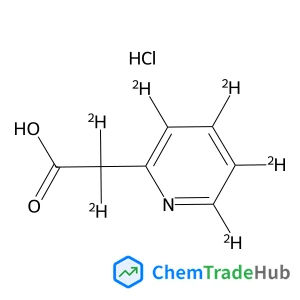
2,2-dideuterio-2-(3,4,5,6-tetradeuterio-2-pyridyl)acetic acid;hydrochloride
CAS Number:
1329799-67-8
Molecular Formula:
C7H2ClD6NO2
Recommended Suppliers




Disclaimer
This page provides academic journal information for reference and research purposes only. We are not affiliated with any journal publishers and do not handle publication submissions. For publication-related inquiries, please contact the respective journal publishers directly.
If you notice any inaccuracies in the information displayed, please contact us at support@chemtradehub.com. We will promptly review and address your concerns.