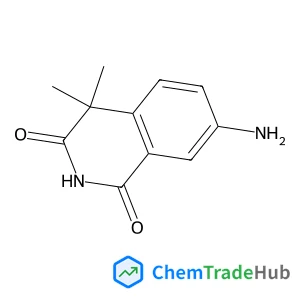
1,3(2H,4H)-Isoquinolinedione, 7-amino-4,4-dimethyl-
CAS Number:
14576-22-8
Molecular Formula:
C11H12N2O2
Aurélie Claraz, Géraldine Masson
The implementation of chiral iodine catalysis has tremendously been developed in the field of asymmetric synthesis over the past decade. It enables the stereoselective creation of C–O as well as C–C, C–N and C–X (X = halogen) bonds through oxidative transformations. Thanks to the low toxicity and ease of handling of iodine compounds, this strategy offers many advantages over classical metal-catalyzed oxidations with chiral ligands. The approaches rely on iodine(I/III) or (−I/+I) catalysis by using a chiral aryliodine or ammonium iodide respectively in combination with a suitable terminal oxidant. As such, the design of iodine compounds with central, axial or even planar chirality has allowed us to achieve high enantioselectivities. The goal of this review is to cover the different chiral iodine compound-catalyzed oxidative transformations including α-functionalization of carbonyl compounds, dearomatization of phenol derivatives and difunctionalization of alkenes which should demonstrate that iodine catalysis has now found its place in the realm of asymmetric organocatalysis.

European Journal of Wood and Wood Products

Journal of Organometallic Chemistry

Proceedings of the National Academy of Sciences of the United States of America

Pure and Applied Chemistry

Planta Medica

Nature

Organic Preparations and Procedures International

Science Progress

Molecular Pharmacology

Russian Chemical Reviews
DOI: 10.1039/C9CP06772H
Jordan Dezalay, Michel Broquier, Satchin Soorkia
DOI: 10.1039/D0CP01127D
Naciye Esma Tirtom, Yang Hsu, Hung-Wen Li
DOI: 10.1039/D0CP01061H
Nur Amirah Jamaluddin, Suriani Abu Bakar, Tretya Ardyani, Masanobu Sagisaka, Shota Suhara, Mohamad Hafiz Mamat, Mohd Khairul Ahmad, Stephen M. King, Sarah E. Rogers, Julian Eastoe
DOI: 10.1039/D0CP01243B
Adriano Santos, Ushula M. Tefashe, Richard L. McCreery, Paulo R. Bueno
DOI: 10.1039/D0CP01621G
Marcos Juanes, Rizalina Tama Saragi, Ruth Pinacho, José E. Rubio, Alberto Lesarri
DOI: 10.1039/D0CP01706J
Chihiro Nanjo, Daisuke Yokogawa, Michio M. Matsushita, Kunio Awaga
DOI: 10.1039/D0CP00423E
A. K. Nair, S. Rani, M. Venkata Kamalakar, S. J. Ray
DOI: 10.1039/D0CP01204A
Karno Schwinn, Nicolas Ferré, Miquel Huix-Rotllant
DOI: 10.1039/D0CP01714K
Jieren Song, Chaocan Cai, Yujiao Bai, Linlin Miao, Rongguo Wang
DOI: 10.1039/D0CP01727B
4-Nitrophenyl phosphate disodium salt hexahydrate is primarily used as a substra...
2-(Trifluoromethyl)-1,3-oxazole-4-carboxylic Acid (CAS: 1060816-01-4) is widely ...
2-Fluoro-4-biphenylcarboxylic acid should be stored in a cool, dry place at room...
Prednisolone-21-Carboxylic Acid is primarily used in the pharmaceutical industry...
4-(Hydrazinomethyl)-1,2,3-benzenetriol (CAS: 3614-72-0) should be stored in a co...
4-Amino-1-methyl-1H-pyrazole-5-carboxylic acid hydrochloride (CAS: 92534-70-8) i...
Dehydropachymic acid (CAS: 77012-31-8) is regulated by various agencies. It fall...
The market and research trends for 6-[(2,2-Dimethylpropanoyl)amino]nicotinic aci...
1,10-Phenanthroline-2,9-dicarbaldehyde should be stored in a cool, dry place awa...
5-Carbamoyl-11-oxo-10,11-dihydro-5H-dibenzo[b,f]azepin-10-yl acetate can be synt...

Organic & Biomolecular Chemistry (OBC) publishes original and high impact research and reviews in organic chemistry. We welcome research that shows new or significantly improved protocols or methodologies in total synthesis, synthetic methodology or physical and theoretical organic chemistry as well as research that shows a significant advance in the organic chemistry or molecular design aspects of chemical biology, catalysis, supramolecular and macromolecular chemistry, theoretical chemistry, mechanism-oriented physical organic chemistry, medicinal chemistry or natural products. Articles published in the journal should report new work which makes a highly-significant impact in the field. Routine and incremental work is generally not suitable for publication in the journal. More details about key areas of our scope are below. In all cases authors should include in their article clear rationale for why their research has been carried out.