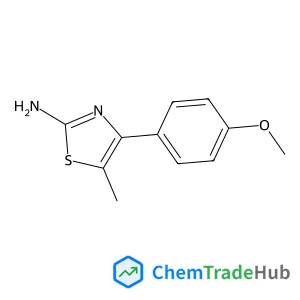
4-(4-Methoxyphenyl)-5-methyl-1,3-thiazol-2-amine
CAS Number:
105512-88-7
Molecular Formula:
C11H12N2OS
Min Chen, Wenping Zou, Zhengguo Cai, Changle Chen
A series of phosphine-sulfonate nickel and palladium complexes [(o-R2-PC6H4SO3)M(allyl)] (1a, R = Ph, M = Ni; 1b, R = o-MeO-C6H4, M = Ni; 1c, R = Cy, M = Ni, 2, R = Cy, M = Pd) were synthesized and characterized. The reaction of B(C6F5)3 with complex 1c led to the isolation of complex [(o-Cy2-PC6H4SO3·B(C6F5)3)Ni(allyl)] (3c). In the X-ray structure of 3c, the binding of B(C6F5)3 to a sulfonate oxygen was observed. The X-ray analysis also suggests a zwitterionic resonance structure of 3c. In norbornene homopolymerization, 1a–1c showed very low activity. The addition of B(C6F5)3 to the system led to an up to 4000 fold increase in the catalytic activity. Under optimized conditions, an activity of up to 1.2 × 10⁷ g mol−1 h−1 was observed for the B(C6F5)3 adduct of 1c. Interestingly, the palladium analogue 2 was not active at all with or without the addition of B(C6F5)3 under the same conditions. In ethylene homopolymerization, the addition of B(C6F5)3 led to an increase in the activity and a decrease in the molecular weight, which is probably due to the reduction of electron density from the nickel center upon B(C6F5)3 binding. In ethylene-norbornene copolymerization, complex 1c showed good activity with up to 10.1% of norbornene incorporation. Interestingly, a decrease in the activity was observed with the addition of B(C6F5)3.
Akira Yamakata, Hirofumi Shimizu, Shigetoshi Oiki
DOI: 10.1039/C5CP02681D
Sergio Romero-Romero, Miguel Costas, Adela Rodríguez-Romero, D. Alejandro Fernández-Velasco
DOI: 10.1039/C5CP01599E
DOI: 10.1039/C5CP03153B
Ning Zhang, Jinwen Shi, Fujun Niu, Jian Wang, Liejin Guo
DOI: 10.1039/C5CP02983J
Chiun-Yan Lin, Jhao-Ying Wu, Yih-Jon Ou, Yu-Huang Chiu, Ming-Fa Lin
DOI: 10.1039/C5CP05013H
Bo Wang, Songmei Li, Xiaoyu Wu, Bin Li, Jianhua Liu, Mei Yu
DOI: 10.1039/C5CP03042K
Bernardo Barbiellini, Hasnain Hafiz, Susmita Basak, Jun Liu, Thomas Richardson, Guojiun Shu, Fangcheng Chou, Tsu-Chien Weng, Dennis Nordlund, Dimosthenis Sokaras, Brian Moritz, Thomas P. Devereaux, Ruimin Qiao, Yi-De Chuang, Arun Bansil, Zahid Hussain, Wanli Yang
DOI: 10.1039/C5CP04739K
Nuno Basílio, Daniel Alfonso Spudeit, Juliana Bastos, Leandro Scorsin, Haidi D. Fiedler, Faruk Nome, Luis García-Río
DOI: 10.1039/C5CP03718B
Saumyakanti Khatua, Haifeng Yuan, Michel Orrit
DOI: 10.1039/C4CP03057E
S. I. Sadovnikov, A. I. Gusev
DOI: 10.1039/C5CP02499D
2-(2-Chloroacetamido)-3-phenylpropanoic acid (CAS: 7765-11-9) is generally consi...
2-(Benzyloxy)-5-bromobenzoic acid can be handled safely if appropriate precautio...
(4-Methyl-1,2,5-oxadiazol-3-yl)methanamine hydrochloride is a chemical compound ...
2-(5-Hexylthiophen-2-yl)-4,4,5,5-tetramethyl-1,3,2-dioxaborolane (CAS: 917985-54...
While 4-(8-Methyl-9H-1,3-dioxolo[4,5-h][2,3]benzodiazepin-5-yl)benzenamine (CAS:...
The market for tert-butyl 3-hydroxy-4,5,7,8-tetrahydro-2H-pyrazolo[3,4-d]azepine...
Waste containing 3,5-Diamino-1H-pyrazole-4-carbonitrile (CAS: 6844-58-2) should ...
(6-Fluoro-3-pyridinyl)boronic acid can be synthesized through the reaction of 6-...
Dibenzyl carbonimidoylbiscarbamate (CAS: 10065-79-9) finds applications in vario...
The market for (beta,beta,2,3,4,5,6-~2~H_7_)Phenylalanine (CAS: 74228-83-4) is g...

Polymer Chemistry welcomes submissions in all areas of polymer science that have a strong focus on macromolecular chemistry. Manuscripts may cover a broad range of fields, yet no direct application focus is required.
![2-Methyl-2-propanyl 4-oxo-3,9-diazabicyclo[4.2.1]nonane-9-carboxylate structure](https://static.chemtradehub.com/structs/131/1312456-05-5-9a15.webp "2-Methyl-2-propanyl 4-oxo-3,9-diazabicyclo[4.2.1]nonane-9-carboxylate structure")