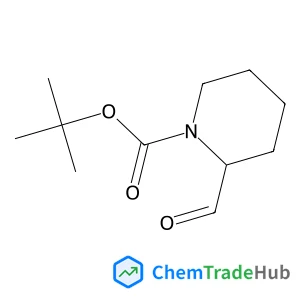
2-Methyl-2-propanyl (2R)-2-formyl-1-piperidinecarboxylate
CAS Number:
134526-69-5
Molecular Formula:
C11H19NO3
Tony Pham, Katherine A. Forrest, Eduardo H. L. Falcão, Juergen Eckert, Brian Space
Experimental sorption measurements, inelastic neutron scattering (INS), and theoretical studies of H2 sorption were performed in α-[Mg3(O2CH)6], a metal–organic framework (MOF) that consists of a network of Mg2+ ions coordinated to formate ligands. The experimental H2 uptake at 77 K and 1.0 atm was observed to be 0.96 wt%, which is quite impressive for a Mg2+-based MOF that has a BET surface area of only 150 m2 g−1. Due to the presence of small pore sizes in the MOF, the isosteric heat of adsorption (Qst) value was observed to be reasonably high for a material with no open-metal sites (ca. 7.0 kJ mol−1). The INS spectra for H2 in α-[Mg3(O2CH)6] is very unusual for a porous material, as there exist several different peaks that occur below 10 meV. Simulations of H2 sorption in α-[Mg3(O2CH)6] revealed that the H2 molecules sorbed at three principal locations within the small pores of the framework. It was discovered through the simulations and two-dimensional quantum rotation calculations that different groups of peaks correspond to particular sorption sites in the material. However, for H2 sorbed at a specific site, it was observed that differences in the positions and angular orientations led to distinctions in the rotational tunnelling transitions; this led to a total of eight identified sites. An extremely high rotational barrier was calculated for H2 sorbed at the most favorable site in α-[Mg3(O2CH)6] (81.59 meV); this value is in close agreement to that determined using an empirical phenomenological model (75.71 meV). This rotational barrier for H2 exceeds those for various MOFs that contain open-metal sites and is currently the highest yet for a neutral MOF. This study highlights the synergy between experiment and theory to extract useful and important atomic level details on the remarkable sorption mechanism for H2 in a MOF with small pore sizes.
Martin G. Banwell, Alison J. Edwards, Jason A. Smith, Ernest Hamel, Pascal Verdier-Pinard
DOI: 10.1039/B209992F
Rhys B. Murphy, Duc-Truc Pham, Jonathan M. White, Stephen F. Lincoln, Martin R. Johnston
DOI: 10.1039/C8OB00944A
Ronghao Xie, Shixiao Chen, Xianping Xiang, Xiangcong Yin, Lubin Xu, Shuai-Shuai Li, Liang Wang, Fengying Dong
DOI: 10.1039/D1QO01530C
Ismail Althagafi, Ranjay Shaw, Rahul Panwar, Shally, Chanda Sinha, Amit Kumar, Yong-Tang Zheng, Ramendra Pratap
DOI: 10.1039/C8OB01733F
Vinni H. Lillelund, Huizhen Liu, Xifu Liang, Helmer Søhoel, Mikael Bols
DOI: 10.1039/B208784G
Gaia Scalabrino, Xiao-Wen Sun, John Mann, Anne Baron
DOI: 10.1039/B207800G
Jennifer Frommer, Beatrice Karg, Klaus Weisz, Sabine Müller
DOI: 10.1039/C8OB02246A
Jing Xu, Da-Jun Zheng, Mi-Mi Su, Yan-Chi Chen, Qing-Cai Jiao
DOI: 10.1039/C8OB01908H
6-(3-Fluorophenyl)picolinic acid is generally considered safe for laboratory use...
(3R)-3-Pyrrolidinol is used in the pharmaceutical industry as a precursor for dr...
When handling (4R,5R)-4,5-Diethoxycarbonyl-2,2-dimethyldioxolane (CAS: 59779-75-...
1-(6-Chloroimidazo[1,2-b]pyridazin-3-yl)ethanone is often synthesized via a mult...
The market for N-Ethyl-3,4-dimethylbenzylamine (CAS: 39180-83-1) remains steady,...
Tert-butyl 3-(pyrrolidin-1-yl)azetidine-1-carboxylate is a chemical compound wit...
1-Bromo-3-chloro-2,4-dimethoxybenzene (CAS: 1228956-93-1) falls under the classi...
The safety of 8-Bromo-2-methyl-3,4-dihydroisoquinolin-1(2H)-one (CAS: 1368622-07...
Benzyl [(3S)-2,6-dioxo-3-piperidinyl]carbamate is generally safe when handled wi...
1-{[4-(4,4,5,5-Tetramethyl-1,3,2-dioxaborolan-2-yl)phenyl]sulfonyl}pyrrolidine s...

Physical Chemistry Chemical Physics (PCCP) is an international journal co-owned by 19 physical chemistry and physics societies from around the world. This journal publishes original, cutting-edge research in physical chemistry, chemical physics and biophysical chemistry. To be suitable for publication in PCCP, articles must include significant innovation and/or insight into physical chemistry; this is the most important criterion that reviewers and Editors will judge against when evaluating submissions. The journal has a broad scope and welcomes contributions spanning experiment, theory, computation and data science. Topical coverage includes spectroscopy, dynamics, kinetics, statistical mechanics, thermodynamics, electrochemistry, catalysis, surface science, quantum mechanics, quantum computing and machine learning. Interdisciplinary research areas such as polymers and soft matter, materials, nanoscience, energy, surfaces/interfaces, and biophysical chemistry are welcomed if they demonstrate significant innovation and/or insight into physical chemistry. Joined experimental/theoretical studies are particularly appreciated when complementary and based on up-to-date approaches.
![[4-Chloro-3-(diethylcarbamoyl)phenyl]boronic acid structure](https://static.chemtradehub.com/structs/871/871332-68-2-0e3b.webp "[4-Chloro-3-(diethylcarbamoyl)phenyl]boronic acid structure")