













A multi-nuclear magnetic resonance and density functional theory investigation of epitaxially grown InGaP2
Literature Information
Publication Date
2016-06-29
DOI
10.1039/C5CP04593B
Impact Factor
3.676
Authors
P. J. Knijn, P. J. M. van Bentum, C. M. Fang, G. J. Bauhuis, G. A. de Wijs, A. P. M. Kentgens
View Original
Abstract
In this paper the short and long range order in In0.483Ga0.517P thin films is investigated by solid-state Nuclear Magnetic Resonance (NMR) spectroscopy. To this end two samples were grown on a GaAs substrate by metal–organic vapor phase epitaxy at two different growth-pressures. From band gap energy measurements, CuPt long range order parameters of SCuPt = 0.22 and 0.39 were deduced, respectively. In the 31P spectrum five resonances are observed corresponding to the five possible P(GanIn4−n), n = 0–4, coordinations whose relative intensities correspond to the order in the material, but the intensity variations for order parameters between 0 and 0.5 are minimal. 69Ga, 71Ga and 115In (MQ)MAS spectra were acquired to analyze the quadrupolar and chemical shift distributions related to the (dis)order in these materials in more detail. All these spectra clearly reflect the disorder in the sample and do not show the presence of highly ordered domains. The difference in the order parameter in the sample is not clearly reflected in the spectra. 31P chemical shifts were calculated using Density Functional Theory. The experimentally observed shifts are well reproduced with a simple random model of the disorder, thus confirming the assignment of the resonances. The 31P chemical shifts are very sensitive to changes in the lattice parameter and chemical surroundings. These effects nearly compensate and explain why the 31P chemical shifts in pure InP and GaP are nearly identical whereas a large difference would be expected based on the observed shift difference for the P[In4] and P[Ga4] coordinations in In0.483Ga0.517P.
Related Literature
Synthesis of hollow cobalt oxide nanopowders by a salt-assisted spray pyrolysis process applying nanoscale Kirkendall diffusion and their electrochemical properties
Hyeon Seok Ju, Jung Sang Cho, Jong Hwa Kim, Yun Ju Choi, Yun Chan Kang
2015-11-05
Paper
DOI: 10.1039/C5CP06206C
Solvent transport through hard–soft segmented polymer nanocomposites
Sangram K. Rath, Saji S. Edatholath, T. Umasankar Patro, Kathi Sudarshan, P. U. Sastry, Pradeep K. Pujari, G. Harikrishnan
2015-12-16
Paper
DOI: 10.1039/C5CP04432D
Singular analysis and coupled cluster theory
Heinz-Jürgen Flad, Gohar Harutyunyan, Bert-Wolfgang Schulze
2015-06-15
Paper
DOI: 10.1039/C5CP01183C
Strain tuning of the charge density wave in monolayer and bilayer 1T-TaS2
Li-Yong Gan, Li-Hong Zhang, Qingyun Zhang, Chun-Sheng Guo, Udo Schwingenschlögl
2015-12-07
Paper
DOI: 10.1039/C5CP05695K
Very fast bulk Li ion diffusivity in crystalline Li1.5Al0.5Ti1.5(PO4)3 as seen using NMR relaxometry
Qianli Ma, Eva-Maria Hammer
2015-11-10
Communication
DOI: 10.1039/C5CP05337D
Transferability of the coarse-grained potentials for trans-1,4-polybutadiene
Hongxia Guo
2015-11-11
Paper
DOI: 10.1039/C5CP05017K
A new look at oxide formation at the copper/electrolyte interface by in situ spectroscopies
Cigdem Toparli, Adnan Sarfraz, Andreas Erbe
2015-11-02
Paper
DOI: 10.1039/C5CP05172J
Deviation of polarity from linearity in liquid mixtures containing an ionic liquid
Vijay Beniwal, Shashi K. Shukla, Anil Kumar
2015-11-04
Communication
DOI: 10.1039/C5CP05921F
Nuclear quantum tunnelling in enzymatic reactions – an enzymologist's perspective
Linus O. Johannissen, Sam Hay, Nigel S. Scrutton
2015-03-27
Perspective
DOI: 10.1039/C5CP00614G
Contrasting ring-opening propensities in UV-excited α-pyrone and coumarin
Daniel Murdock, Rebecca A. Ingle, Igor V. Sazanovich, Ian P. Clark, Yu Harabuchi, Tetsuya Taketsugu, Satoshi Maeda, Andrew J. Orr-Ewing, Michael N. R. Ashfold
2015-12-16
Paper
DOI: 10.1039/C5CP06597F
You might also like
Compound Q&A
How should waste containing (6-Bromo-2-naphthyl)oxy](dimethyl)(2-methyl-2-propanyl)silane be handled?
Waste containing (6-Bromo-2-naphthyl)oxy](dimethyl)(2-methyl-2-propanyl)silane (...
100751-65-3[(6-Bromo-2-naphthyl...
Compound Q&A
How is 7-Fluoro-4-isoquinolinecarboxylic acid (CAS: 1841081-40-0) typically synthesized?
7-Fluoro-4-isoquinolinecarboxylic acid can be synthesized via a multi-step proce...
1841081-40-07-Fluoro-4-isoquinol...
Compound Q&A
What are the physical and chemical properties of 2,3,5,6-Tetrabromothieno[3,2-b]thiophene (CAS: 124638-53-5)?
2,3,5,6-Tetrabromothieno[3,2-b]thiophene is a crystalline compound with a high m...
124638-53-52,3,5,6-Tetrabromoth...
Compound Q&A
Is 1-[4-(Benzylamino)-7,8-dihydro-5H-pyrano[4,3-d]pyrimidin-2-yl]-2-methyl-1H-indole-4-carboxamide (CAS: 1542705-92-9) safe?
1-[4-(Benzylamino)-7,8-dihydro-5H-pyrano[4,3-d]pyrimidin-2-yl]-2-methyl-1H-indol...
1542705-92-91-[4-(Benzylamino)-7...
Compound Q&A
What is the market or research trend for imidazo[5,1-d]-1,2,3,5-tetrazine-8-carboxylic acid, 3,4-dihydro-3-methyl-4-oxo- (CAS: 113942-30-6)?
The market for imidazo[5,1-d]-1,2,3,5-tetrazine-8-carboxylic acid, 3,4-dihydro-3...
113942-30-6Imidazo[5,1-d]-1,2,3...
Compound Q&A
What is 3-(Triisopropylsilyl)propiolaldehyde (CAS: 163271-80-5)?
3-(Triisopropylsilyl)propiolaldehyde is a synthetic organic compound with the CA...
163271-80-53-(Triisopropylsilyl...
Compound Q&A
What regulatory guidelines apply to 6-Nitro-2H-1,4-benzoxazin-3(4H)-one (CAS: 81721-87-1)?
6-Nitro-2H-1,4-benzoxazin-3(4H)-one (CAS: 81721-87-1) is subject to various regu...
81721-87-16-Nitro-2H-1,4-benzo...
Compound Q&A
How should waste containing (3-Fluorophenyl)(4-{[(2-methyl-2-propanyl)oxy]carbonyl}-1-piperazinyl)acetic acid (CAS: 885272-91-3) be handled?
Waste containing (3-Fluorophenyl)(4-{[(2-methyl-2-propanyl)oxy]carbonyl}-1-piper...
885272-91-3(3-Fluorophenyl)(4-{...
Compound Q&A
What are the physical and chemical properties of N,N'-4,4'-Biphenyldiyldiisonicotinamide (CAS: 55119-40-9)?
N,N'-4,4'-Biphenyldiyldiisonicotinamide is a white crystalline solid with a mole...
55119-40-9N,N'-4,4'-Biphenyldi...
Compound Q&A
What industries use 6-Bromo-8-fluoro-2-quinazolinol (CAS: 1036756-15-6)?
6-Bromo-8-fluoro-2-quinazolinol is primarily used in the pharmaceutical industry...
1036756-15-66-Bromo-8-fluoro-2-q...
Source Journal
Physical Chemistry Chemical Physics

CiteScore:
5.5
Self-citation Rate:
10.3%
Articles per Year:
3036
Physical Chemistry Chemical Physics (PCCP) is an international journal co-owned by 19 physical chemistry and physics societies from around the world. This journal publishes original, cutting-edge research in physical chemistry, chemical physics and biophysical chemistry. To be suitable for publication in PCCP, articles must include significant innovation and/or insight into physical chemistry; this is the most important criterion that reviewers and Editors will judge against when evaluating submissions. The journal has a broad scope and welcomes contributions spanning experiment, theory, computation and data science. Topical coverage includes spectroscopy, dynamics, kinetics, statistical mechanics, thermodynamics, electrochemistry, catalysis, surface science, quantum mechanics, quantum computing and machine learning. Interdisciplinary research areas such as polymers and soft matter, materials, nanoscience, energy, surfaces/interfaces, and biophysical chemistry are welcomed if they demonstrate significant innovation and/or insight into physical chemistry. Joined experimental/theoretical studies are particularly appreciated when complementary and based on up-to-date approaches.
Recommended Compounds


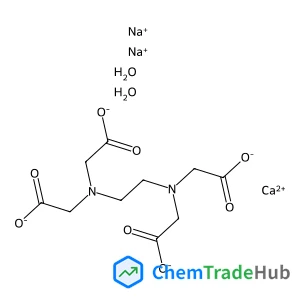
EthylenediaminetetraaceticacidcalciumDisodiumsalthydrate
CAS Number:
23411-34-9
Molecular Formula:
C10H16CaN2Na2O10
Recommended Suppliers






Disclaimer
This page provides academic journal information for reference and research purposes only. We are not affiliated with any journal publishers and do not handle publication submissions. For publication-related inquiries, please contact the respective journal publishers directly.
If you notice any inaccuracies in the information displayed, please contact us at support@chemtradehub.com. We will promptly review and address your concerns.