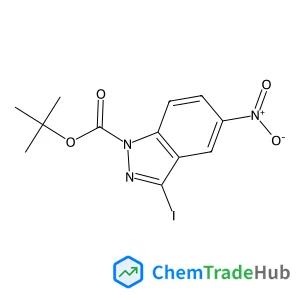
Tert-butyl 3-iodo-5-nitro-1H-indazole-1-carboxylate
CAS Number:
459133-69-8
Molecular Formula:
C12H12IN3O4
M. Mihaylov, S. Andonova, K. Chakarova, A. Vimont, E. Ivanova, N. Drenchev, K. Hadjiivanov
Acidity of solids is decisive for their interaction with guest molecules. One of the most used methods for measuring the acidity of surface hydroxyl groups is the hydrogen bond method based on the spectral shift of the OH stretching modes induced by the adsorption of weak bases. However, many materials of practical interest (e.g. metal organic frameworks, zeolites, etc.) are porous and the OH groups are involved in H-bonding with framework basic sites. Here we show that MIL-53(Al) and NH2-MIL-53(Al) samples are characterized by one type of structural hydroxyl but three IR bands are detected at 100 K with these materials (at 3721, 3711 and 3683 cm−1). These bands are assigned to structural hydroxyls involved in H-bonding with different strengths. There is no correlation between the acidities of the hydroxyls, as measured by low-temperature CO or 15N2 adsorption, and the main reason for this is the pre-existing H-bond. A method for the estimation of the intrinsic frequency of the OH groups (i.e. if not participating in H-bonds), based on the analysis of the spectral data obtained with two molecular probes, is proposed. According to this method, the OH stretching frequency of the structural hydroxyls of MIL-53(Al) samples is determined to be 3727 cm−1. The formation of 1 : 1 adducts between the hydroxyls and strong bases leads to breaking of the pre-existing H-bonds. When the base is weak, bifurcated complexes are formed which slightly affects the spectral shift. The conclusions derived here considerably broaden the applicability of the H-bond method for assessing protonic acidity of materials and systems where the OH groups are preliminarily involved in H-bonding.
Lianyue Wang, Jun Li, Ying Lv, Yi Zhang, Shuang Gao
DOI: 10.1039/C3GC42075B
Shuntaro Tsubaki, Kiriyo Oono, Masanori Hiraoka, Tadaharu Ueda, Ayumu Onda, Kazumichi Yanagisawa, Jun-ichi Azuma
DOI: 10.1039/C3GC42027B
Tomas Trebicky, Patrick Crewdson, Maxim Paliy, Igor Bello, Heng-Yong Nie, Zhi Zheng, Xiaoli Fan, Jun Yang, Changyu Tang, Hao Liu, K. W. Wong
DOI: 10.1039/C3GC41460D
Brandon A. Rodriguez, Chris C. Stowers, Viet Pham, Brad M. Cox
DOI: 10.1039/C3GC42000K
Owen Byrne, Lena Altes, Praveen K. Surolia, Marcel Spulak, Brid Quilty
DOI: 10.1039/C3GC42393J
Mohammad G. Al-Shaal, Adam Dzierbinski, Regina Palkovits
DOI: 10.1039/C3GC41803K
Gregory Chatel, Jorge F. B. Pereira, Varun Debbeti, Hui Wang, Robin D. Rogers
DOI: 10.1039/C3GC41389F
Xiaofu Sun, Zhimin Xue, Tiancheng Mu
DOI: 10.1039/C3GC42166J
DOI: 10.1039/C3GC42124D
DOI: 10.1039/C3GC42044B
When handling 4-Methyl-6-(trifluoromethyl)quinoline (CAS: 40716-16-3), safety go...
4-(3,5-Difluorophenyl)aniline is an aromatic organic compound with the CAS numbe...
5-{[4-(Trifluoromethyl)phenyl]sulfanyl}-1,2,3-thiadiazole-4-carboxylic acid can ...
The market for 4-Benzylaniline hydrochloride (CAS: 6317-57-3) is steadily growin...
[3-(Diethylsulfamoyl)phenyl]boronic acid is generally considered safe when handl...
3-Bromo-2,5-dimethoxyaniline is mainly used in the pharmaceutical and chemical i...
N-Methyl-1-(5-methyl-1H-indol-3-yl)methanamine (CAS: 915922-67-7) is subject to ...
This compound is primarily used in the pharmaceutical industry for the synthesis...
2-Methyl-2-propanyl [(1S,3R)-3-aminocyclohexyl]carbamate (CAS: 1298101-47-9) sho...
Ethyl 2-bromo-4,4,4-trifluorobutanoate (CAS: 367-33-9) is utilized in the pharma...

Physical Chemistry Chemical Physics (PCCP) is an international journal co-owned by 19 physical chemistry and physics societies from around the world. This journal publishes original, cutting-edge research in physical chemistry, chemical physics and biophysical chemistry. To be suitable for publication in PCCP, articles must include significant innovation and/or insight into physical chemistry; this is the most important criterion that reviewers and Editors will judge against when evaluating submissions. The journal has a broad scope and welcomes contributions spanning experiment, theory, computation and data science. Topical coverage includes spectroscopy, dynamics, kinetics, statistical mechanics, thermodynamics, electrochemistry, catalysis, surface science, quantum mechanics, quantum computing and machine learning. Interdisciplinary research areas such as polymers and soft matter, materials, nanoscience, energy, surfaces/interfaces, and biophysical chemistry are welcomed if they demonstrate significant innovation and/or insight into physical chemistry. Joined experimental/theoretical studies are particularly appreciated when complementary and based on up-to-date approaches.