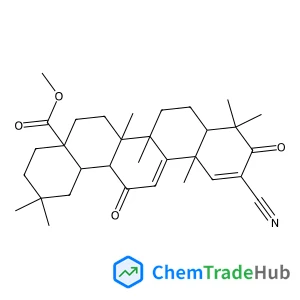
Methyl 2-cyano-3,12-dioxooleana-1,9(11)-dien-28-oate
CAS Number:
218600-53-4
Molecular Formula:
C32H43NO4
Thierry O. Wambo
Beta-lactoglobulin (BLG), a bovine dairy protein, is a promiscuously interacting protein that can bind multiple hydrophobic ligands. Fatty acids (FAs), common hydrophobic molecules bound to BLG, are important sources of fuel for life because they yield large quantities of ATP when metabolized. The binding affinity increases with the length of the ligands, indicating the importance of the van der Waals (vdW) interactions between the hydrocarbon tail and the hydrophobic calyx of BLG. An exception to this rule is caprylic acid (OCA) which is two-carbon shorter but has a stronger binding affinity than capric acid. Theoretical calculations in the current literature are not accurate enough to shed light on the underlying physics of this exception. The computed affinity values are greater for longer fatty acids without respect for the caprylic exception and those values are generally several orders of magnitude away from the experimental data. In this work, we used hybrid steered molecular dynamics to accurately compute the binding free energies between BLG and the five saturated FAs of 8 to 16 carbon atoms. The computed binding free energies agree well with experimental data not only in rank but also in absolute values. We gained insights into the exceptional behavior of caprylic acid in the computed values of entropy and electrostatic interactions. We found that the electrostatic interaction between the carboxyl group of caprylic acid and the two amino groups of K60/69 in BLG is much stronger than the vdW force between the OCA's hydrophobic tail and the BLG calyx. This pulls OCA to the top of the beta barrel where it is easier to fluctuate, giving rise to greater entropy of OCA at the binding site.
Dong Myung Jang, Hyung Soon Im, Yoon Myung, Yong Jae Cho, Han Sung Kim, Seung Hyuk Back, Jeunghee Park, Eun Hee Cha, Minyung Lee
DOI: 10.1039/C3CP50769F
Viraj P. Modak, Harshad Pathak, Mitchell Thayer, Sherwin J. Singer
DOI: 10.1039/C3CP44490B
Qian Gou, Gang Feng, Luca Evangelisti, Alberto Lesarri, Emilio J. Cocinero, Walther Caminati
DOI: 10.1039/C3CP50306B
ZhenHua Zeng, Mårten E. Björketun, Sune Ebbesen, Mogens B. Mogensen, Jan Rossmeisl
DOI: 10.1039/C3CP51099A
Yi Yang, Dan Xie, Tian-Ling Ren, Yi Shu, Hui Sun, Chang-Jian Zhou, Xuan Liu, Lu-Qi Tao, Jie Ge, Cang-Hai Zhang, Yuegang Zhang
DOI: 10.1039/C3CP50538C
Shien-Ping Feng, Ya-Huei Chang, Jian Yang, Bed Poudel, Bo Yu, Zhifeng Ren, Gang Chen
DOI: 10.1039/C3CP50993A
Haoguang Li, Mickael Rivallan, Frederic Thibault-Starzyk, Arnaud Travert
DOI: 10.1039/C3CP50442E
Sunghyun Uhm
DOI: 10.1039/C3CP50885D
Yi Lin Yang, Yu-Chieh Ho, Yuri A. Dyakov, Wen-Hsin Hsu, Yi-Lun Sun, Wan-Chen Tsai, Wei-Ping Hu
DOI: 10.1039/C3CP44674C
When handling 4-(2-Furylmethyl)thiomorpholine 1,1-dioxide (CAS: 79206-94-3), it ...
When handling 4-Chloro-N-[2-(4-morpholinyl)ethyl]benzamide (CAS: 71320-77-9), it...
Waste containing this compound (CAS: 62921-74-8) should be handled according to ...
Waste containing (S)-Methyl 2-amino-3-cyclohexylpropanoate should be collected i...
This compound can be synthesized using a multi-step process involving the conjug...
There are several alternatives to (2E)-3-(3,4-Dichlorophenyl)acrylic acid in syn...
Ethyl 6-(2-nitrophenyl)imidazo[2,1-b][1,3]thiazole-3-carboxylate (CAS: 925437-84...
Waste containing 2-(1,3-Thiazol-2-yl)ethanamine (CAS: 18453-07-1) should be coll...
Methyl 5-iodo-2-methylbenzoate can be synthesized through the iodination of meth...
5-Chloro[1,2,4]triazolo[1,5-a]pyridine is commonly synthesized via the condensat...

Physical Chemistry Chemical Physics (PCCP) is an international journal co-owned by 19 physical chemistry and physics societies from around the world. This journal publishes original, cutting-edge research in physical chemistry, chemical physics and biophysical chemistry. To be suitable for publication in PCCP, articles must include significant innovation and/or insight into physical chemistry; this is the most important criterion that reviewers and Editors will judge against when evaluating submissions. The journal has a broad scope and welcomes contributions spanning experiment, theory, computation and data science. Topical coverage includes spectroscopy, dynamics, kinetics, statistical mechanics, thermodynamics, electrochemistry, catalysis, surface science, quantum mechanics, quantum computing and machine learning. Interdisciplinary research areas such as polymers and soft matter, materials, nanoscience, energy, surfaces/interfaces, and biophysical chemistry are welcomed if they demonstrate significant innovation and/or insight into physical chemistry. Joined experimental/theoretical studies are particularly appreciated when complementary and based on up-to-date approaches.