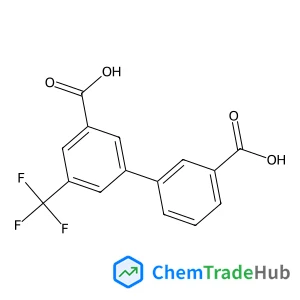
3-(3-Carboxyphenyl)-5-(trifluoromethyl)benzoic acid
CAS Number:
1261930-96-4
Molecular Formula:
C15H9F3O4
Daniel P. Zaleski, Susanna L. Stephens, David P. Tew, Dror M. Bittner, Nicholas R. Walker, Anthony C. Legon
A new molecule C2H2⋯CuF has been synthesized in the gas phase by means of the reaction of laser-ablated metallic copper with a pulse of gas consisting of a dilute mixture of ethyne and sulfur hexafluoride in argon. The ground-state rotational spectrum was detected by two types of Fourier-transform microwave spectroscopy, namely that conducted in a microwave Fabry–Perot cavity and the chirped-pulse broadband technique. The spectroscopic constants of the six isotopologues 12C2H2⋯63Cu19F, 12C2H2⋯65Cu19F, 13C2H2⋯63Cu19F, 13C2H2⋯65Cu19F, 12C2D2⋯63Cu19F and 12C2D2⋯65Cu19F were determined and interpreted to show that the molecule has a planar, T-shaped geometry belonging to the molecular point group C2v, with CuF forming the stem of the T. Quantitative interpretation reveals that the ethyne molecule is distorted when subsumed into the complex in such manner that the CC bond lengthens (by δr) and the two H atoms cease to be collinear with the CC internuclear line. The H atoms move symmetrically away from the approaching Cu atom of CuF, to increase each *C–H angle by δA = 14.65(2)°, from 180° to 194.65(2)°. Ab initio calculations at the explicitly-correlated level of theory CCSD(T)(F12*)/aug-cc-pVTZ lead to good agreement with the experimental geometry. It is shown that similar distortions δr and δA, similarly determined, for four complexes C2H2⋯MX (M = Cu or Ag; X = F, Cl or CCH) are approximately linearly related to the energies De for the dissociation process C2H2⋯MX = C2H2 + MX.
Mariem Bouzrati-Zerelli, Nicolas Zivic, Frédéric Dumur, Didier Gigmes, Bernadette Graff, Jean Pierre Fouassier, Jacques Lalevée
DOI: 10.1039/C7PY00202E
Chun Feng, Guolin Lu, Gang Sun, Xunwei Liu, Xiaoyu Huang
DOI: 10.1039/C4PY00772G
Jaipal Gupta, Daniel J. Keddie, Chaoying Wan, David M. Haddleton, Tony McNally
DOI: 10.1039/C6PY00522E
Ruixue Chang, Heng An, Xu Li, Ruyi Zhou, Jianglei Qin, Yuelan Tian, Kuilin Deng
DOI: 10.1039/C6PY02122K
Yang Wu, Yanyan Zhou, Jian Zhu, Wei Zhang, Xiangqiang Pan, Zhengbiao Zhang, Xiulin Zhu
DOI: 10.1039/C4PY00732H
Khama Rani Ghosh, Sukanta Kumar Saha
DOI: 10.1039/C4PY00673A
Mariolino Carta, Matthew Croad, Keith Bugler, Kadhum J. Msayib, Neil B. McKeown
DOI: 10.1039/C4PY00608A
Y. Huang, M. A. Shaw, M. R. Warmin, E. S. Mullins, N. Ayres
DOI: 10.1039/C6PY00616G
Chen Gao, Liwei Wang, Xiaoyu Li
DOI: 10.1039/C4PY00389F
Hyeonuk Yeo, Nam-Ho You, Se Gyu Jang, Seokhoon Ahn, Kwang-Un Jeong, Seung Hee Lee, Munju Goh
DOI: 10.1039/C7PY00243B
4-Amino-3-bromophenol (CAS: 74440-80-5) falls under the classification of a haza...
(17beta)-3-Oxoestr-4-en-17-yl acetate should be stored in a cool, dry place away...
2-[(2,2-Diethoxyethyl)disulfanyl]-1,1-diethoxyethane (CAS: 76505-71-0) is a colo...
The market and research for 1-(β-D-ribofuranosyl)-1H-imidazo[4,5-c]pyridin-4-ami...
Waste containing Conjugated Estrogen (CAS: 12126-59-9) should be collected and d...
The market for Bis(2,2,2-trifluoroethyl) (methoxycarbonylmethyl)phosphonate (CAS...
There are several alternatives to 3,4'-Di-O-methylellagic acid (CAS: 57499-59-9)...
2-Chloro-N,N-dimethylpyridin-4-amine (CAS: 59047-70-0) is regulated under the Gl...
Cerium(3+);oxygen(2-);vanadium(5+) (CAS: 13597-19-8) is a complex inorganic comp...
7-Chloro-1-iodoisoquinoline (CAS: 1203579-27-4) is generally considered safe whe...

Physical Chemistry Chemical Physics (PCCP) is an international journal co-owned by 19 physical chemistry and physics societies from around the world. This journal publishes original, cutting-edge research in physical chemistry, chemical physics and biophysical chemistry. To be suitable for publication in PCCP, articles must include significant innovation and/or insight into physical chemistry; this is the most important criterion that reviewers and Editors will judge against when evaluating submissions. The journal has a broad scope and welcomes contributions spanning experiment, theory, computation and data science. Topical coverage includes spectroscopy, dynamics, kinetics, statistical mechanics, thermodynamics, electrochemistry, catalysis, surface science, quantum mechanics, quantum computing and machine learning. Interdisciplinary research areas such as polymers and soft matter, materials, nanoscience, energy, surfaces/interfaces, and biophysical chemistry are welcomed if they demonstrate significant innovation and/or insight into physical chemistry. Joined experimental/theoretical studies are particularly appreciated when complementary and based on up-to-date approaches.

![Ethyl 5-[({[(2-methyl-2-propanyl)oxy]carbonyl}amino)methyl]-1,2-oxazole-3-carboxylate structure](https://static.chemtradehub.com/structs/253/253196-37-1-8450.webp "Ethyl 5-[({[(2-methyl-2-propanyl)oxy]carbonyl}amino)methyl]-1,2-oxazole-3-carboxylate structure")