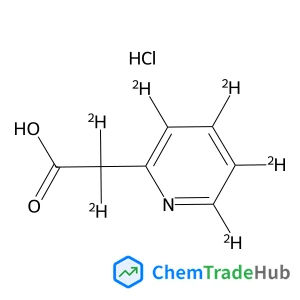
2,2-dideuterio-2-(3,4,5,6-tetradeuterio-2-pyridyl)acetic acid;hydrochloride
CAS Number:
1329799-67-8
Molecular Formula:
C7H2ClD6NO2
Y. Huang, M. A. Shaw, M. R. Warmin, E. S. Mullins, N. Ayres
The influence of polymer chemical structure and degree of sulfation of polyurea glycopolymers on blood compatibility is reported. Polymers were prepared using lactose-containing diamines with either toluene 2,4-diisocyanate (TDI), isophorone diisocyanate (IPDI), methylene bis(4-cyclohexyl isocyanate) (HMDI), or hexamethylene diisocyanate (HDI) and subsequntly sulfated with a sulfur trioxide reagent. The influence of degree of sulfation was investigated using a polymer. Polyurea glycopolymers with sulfur contents ranging from ∼3% to 15% were prepared from HMDI polymerized with the lactose-containing diamine. The obtained glycopolymers have been characterized using gel permeation chromatography, nuclear magnetic resonance spectroscopy, Fourier transform infrared spectroscopy, and elemental analysis. The blood compatibility of the polymers was determined by measuring the activated partial thromboplastin time, thrombin time, and prothrombin time. Poly(HMDI-sL) exhibited higher prolongation of the activated partial thromboplastin time than other diisocyanate-containing sulfated glycopolymers, and higher degrees of sulfation result in prolonged clotting times. The polymers ability bind thrombin in the presence and absence of antithrombin III was measured using a coloremtric thrombin inhibition assay and the results followed the trend observed in the activated partial thromboplastin time assay.

Russian Journal of General Chemistry

Crystallography Reports

Organic Process Research & Development

Russian Journal of Organic Chemistry

Russian Journal of Bioorganic Chemistry

Journal of Saudi Chemical Society

Current Opinion in Colloid & Interface Science

Chemistry Education Research and Practice

Russian Journal of Coordination Chemistry

Nature Medicine
Yanrong Jiang, Qinqin Yuan, Jonas Warneke, Zhubin Hu, Yan Yang, Xue-Bin Wang
DOI: 10.1039/D0CP00700E
E. Arthur-Baidoo, J. Pereira-da-Silva, M. Ryszka, I. Carmichael, L. M. Cornetta, M. T. do N. Varella, F. Ferreira da Silva, S. Denifl
DOI: 10.1039/D0CP00029A
Chuangchuang Wang, Yongpeng Yang, Xiaojing Liu, Yuanjie Li, Dandan Song, Yun Tian, Zhaojun Zhang
DOI: 10.1039/D0CP01005G
Amr A. A. Attia, Alexandru Lupan, R. Bruce King, Sundargopal Ghosh
DOI: 10.1039/C9CP04263F
Om Prakash, Ranjan K. Singh
DOI: 10.1039/C9CP03124C
Dipayan Chakraborty, Aranya Giri, Dhananjay Nandi
DOI: 10.1039/C9CP03973B
DOI: 10.1039/C9CP04113C
Jianhui Chen, Xiaolin Tan, Peng Lin, Baisheng Sa, Jian Zhou, Yinggan Zhang, Cuilian Wen, Zhimei Sun
DOI: 10.1039/C9CP04407H
4-Nitrophenyl phosphate disodium salt hexahydrate is primarily used as a substra...
2-(Trifluoromethyl)-1,3-oxazole-4-carboxylic Acid (CAS: 1060816-01-4) is widely ...
2-Fluoro-4-biphenylcarboxylic acid should be stored in a cool, dry place at room...
Prednisolone-21-Carboxylic Acid is primarily used in the pharmaceutical industry...
4-(Hydrazinomethyl)-1,2,3-benzenetriol (CAS: 3614-72-0) should be stored in a co...
4-Amino-1-methyl-1H-pyrazole-5-carboxylic acid hydrochloride (CAS: 92534-70-8) i...
Dehydropachymic acid (CAS: 77012-31-8) is regulated by various agencies. It fall...
The market and research trends for 6-[(2,2-Dimethylpropanoyl)amino]nicotinic aci...
1,10-Phenanthroline-2,9-dicarbaldehyde should be stored in a cool, dry place awa...
5-Carbamoyl-11-oxo-10,11-dihydro-5H-dibenzo[b,f]azepin-10-yl acetate can be synt...

Polymer Chemistry welcomes submissions in all areas of polymer science that have a strong focus on macromolecular chemistry. Manuscripts may cover a broad range of fields, yet no direct application focus is required.