












SnO2(β-Bi2O3)/Bi2Sn2O7 nanohybrids doped with Pt and Pd nanoparticles: applications in visible light photocatalysis, electrical conductivity and dye-sensitized solar cells
Literature Information
Publication Date
2015-07-20
DOI
10.1039/C5CP02066B
Impact Factor
3.676
Authors
M. Khairy, Mohamed Mokhtar Mohamed
View Original
Abstract
Bi2O3–SnO2 nanocomposites formed at a nominal molar ratio of 3 : 1 and loaded with Pd/Pt nanoparticles synthesized by a sol gel-hydrothermal method with the aid of a template were thoroughly characterized by X-ray diffraction, TEM-EDX, N2 sorptiometry, diffuse reflectance UV-Vis, FTIR, photoluminescence and electrical conductivity. It has been shown that Pd and Pt stimulate the existence of β-Bi2O3 and SnO2, respectively together with the key component Bi2Sn2O7. The photocatalytic results indicate that Pd/β-Bi2O3–Bi2Sn2O7 revealed a remarkable performance for the degradation of methylene blue (MB) dye as compared to the Pt/SnO2–Bi2Sn2O7 and Bi2O3–SnO2 samples in both the UV and visible regions. The enhanced photocatalytic activity of the Pd/β-Bi2O3–Bi2Sn2O7 nanocomposite is primarily attributed to the broad contact between the β-Bi2O3 and Bi2Sn2O7 phases, which indicates high mesoporosity and heterojunction structures resulting in separation efficacy between photo-induced electron–hole pairs. Specifically, the photosensitive β-Bi2O3 is easily excited and released electrons to be accepted by Bi2Sn2O7 and Pd that might be deposited in the interlayer between β-Bi2O3 and Bi2Sn2O7. The degradation mechanism of MB over Pd/β-Bi2O3–Bi2Sn2O7 in the visible region showed that the dye degradation proceeds through evolution of ˙O2− and ˙OH radicals as evaluated using photoluminescence and free radical trapping experiments. An insight into the electrical properties including the dielectric constant and impedance of the materials indicates that Pd/β-Bi2O3–Bi2Sn2O7 has the highest conductivity based on increasing the ionic transport and defects at the β-Bi2O3/Bi2Sn2O7 heterojunction. This material displayed an improved photocurrent response of a higher power conversion efficiency, exceeding that of Pt/SnO2–Bi2Sn2O7 and SnBi3 by 50% and 250%, respectively, in dye-sensitized solar cells. Picosecond-resolved photoluminescence (PL) and polarization gated PL anisotropy measurements were combined to clarify the process of FRET from the excited Pd/β-Bi2O3–Bi2Sn2O7 to SD N719. This indicates that the latter structure can be proposed as a multifunctional candidate for use in dye-sensitized solar cells, as an electrical material and as an efficient photocatalyst based on its versatile structure.
Related Literature
A regioregular polyalkylthiophene bearing covalently-linked biotin, and its interaction with avidin in solution and in thin films
Fouzi Mouffouk, Simon J. Higgins, Stewart J. Brown, Naser Sedghi, Bill Eccleston, Stuart Reeman
2004-09-06
Communication
DOI: 10.1039/B408935A
Photoinduced production of NAD(P)H from an activated fluorescein–DNA monolayer
Heinz-Bernhard Kraatz, Jeremy S. Lee
2004-08-10
Communication
DOI: 10.1039/B406689H
Highly efficient epoxidation method of olefins with hydrogen peroxide as terminal oxidant, bicarbonate as a co-catalyst and oxodiperoxo molybdenum(vi) complex as catalyst
Narottam Gharah, Santu Chakraborty, Alok K. Mukherjee, Ramgopal Bhattacharyya
2004-09-28
Communication
DOI: 10.1039/B408946D
Racemic d,l-asparagine causes enantiomeric excess of other coexisting racemic d,l-amino acids during recrystallization: a hypothesis accounting for the origin of l-amino acids in the biosphere
Shosuke Kojo, Hiromi Uchino, Mayu Yoshimura, Kyoko Tanaka
2004-09-07
Communication
DOI: 10.1039/B409941A
Structurally diverse Rh(i) and Mn(i) complexes derived from the new ambidentate indeneligand, (1-{iPr2P(S)}-2-{NMe2})C9H6
Dominik Wechsler, Robert McDonald, Michael J. Ferguson, Mark Stradiotto
2004-09-21
Communication
DOI: 10.1039/B410328A
Oligomer preparation from hexane by radical polyaddition with bis(α-trifluoromethyl-β,β-difluorovinyl) terephthalate
Tadashi Narita, Hiroshi Hamana, Satoshi Hattori
2004-09-07
Communication
DOI: 10.1039/B406116K
A p-phosphinophenolate ligand for the palladium-catalysed arylation of alkenes
Eiji Shirakawa, Keijiro Ishii, Teruhisa Tsuchimoto
2004-10-19
Communication
DOI: 10.1039/B411125G
Unsaturated 1,2-amino alcohols and ethers from aziridines and organolithiums
David M. Hodgson, Bogdan Štefane, Timothy J. Miles, Jason Witherington
2004-08-24
Communication
DOI: 10.1039/B409486G
Electrophilicity parameters for σ-complexation by uncharged electron-deficient aromatic and heteroaromatic structures
François Terrier, Régis Goumont, Taoufik Boubaker, Erwin Buncel
2004-09-30
Communication
DOI: 10.1039/B410356D
Synthesis of core–shell polyurethane–ureananoparticles containing 4,4′-methylenedi-p-phenyl diisocyanate and isophorone diisocyanate by self-assembled neutralization emulsification
In Woo Cheong, Jung Hyun Kim
2004-09-14
Communication
DOI: 10.1039/B409755F
You might also like
Compound Q&A
What is 1-(2,4,6-Trifluorophenyl)ethanol (CAS: 1250113-83-7)?
1-(2,4,6-Trifluorophenyl)ethanol is an organic compound with the CAS number 1250...
1250113-83-71-(2,4,6-Trifluoroph...
Compound Q&A
Is 1-(2,4-Dimethoxybenzyl)-4-(hydroxymethyl)-2-pyrrolidinone (CAS: 919111-34-5) safe?
1-(2,4-Dimethoxybenzyl)-4-(hydroxymethyl)-2-pyrrolidinone (CAS: 919111-34-5) is ...
919111-34-51-(2,4-Dimethoxybenz...
Compound Q&A
What are the physical and chemical properties of (7S,15R)-6β,15-Diacetoxy-7α,20-epoxy-7-hydroxykaura-2,16-dien-1-one (CAS: 51419-51-3)?
(7S,15R)-6β,15-Diacetoxy-7α,20-epoxy-7-hydroxykaura-2,16-dien-1-one is a crystal...
51419-51-3(7S,15R)-6β,15-Diace...
Compound Q&A
What regulatory guidelines apply to rac-ethyl (1r,4r)-4-hydroxycyclohexane-1-carboxylate, trans (CAS: 3618-04-0)?
The compound rac-ethyl (1r,4r)-4-hydroxycyclohexane-1-carboxylate, trans (CAS: 3...
3618-04-0rac-ethyl (1r,4r)-4-...
Compound Q&A
What is the market or research trend for 2-(2,4-Difluorophenoxy)-3-nitropyridine (CAS: 175135-62-3)?
The market for 2-(2,4-Difluorophenoxy)-3-nitropyridine (CAS: 175135-62-3) is cur...
175135-62-32-(2,4-Difluoropheno...
Compound Q&A
What are the main uses of 6-Diazo-5-oxo-L-norleucine (CAS: 157-03-9)?
The main uses of 6-Diazo-5-oxo-L-norleucine (CAS: 157-03-9) include research in ...
157-03-96-Diazo-5-oxo-L-norl...
Compound Q&A
What precautions should be taken when handling 2-Aminoethyl-mono-amide-DOTA-tris(tBu ester) (CAS: 173308-19-5)?
When handling 2-Aminoethyl-mono-amide-DOTA-tris(tBu ester) (CAS: 173308-19-5), i...
173308-19-52-Aminoethyl-mono-am...
Compound Q&A
How is 5-Methylimidazo[1,2-a]pyridine-3-carbaldehyde (CAS: 178488-37-4) typically synthesized?
5-Methylimidazo[1,2-a]pyridine-3-carbaldehyde (CAS: 178488-37-4) can be synthesi...
178488-37-45-Methylimidazo[1,2-...
Compound Q&A
Are there alternatives to 2,4,6-Trihydroxyisophthalaldehyde (CAS: 4396-13-8) in synthesis?
There are alternative reagents that can be used in the synthesis of 2,4,6-Trihyd...
4396-13-82,4,6-Trihydroxyisop...
Compound Q&A
What is (2Z)-3-(5-Fluoro-1H-indol-3-yl)-2-sulfanylacrylic acid (CAS: 179461-52-0)?
(2Z)-3-(5-Fluoro-1H-indol-3-yl)-2-sulfanylacrylic acid is a chemical compound wi...
179461-52-0(2Z)-3-(5-Fluoro-1H-...
Source Journal
Physical Chemistry Chemical Physics

CiteScore:
5.5
Self-citation Rate:
10.3%
Articles per Year:
3036
Physical Chemistry Chemical Physics (PCCP) is an international journal co-owned by 19 physical chemistry and physics societies from around the world. This journal publishes original, cutting-edge research in physical chemistry, chemical physics and biophysical chemistry. To be suitable for publication in PCCP, articles must include significant innovation and/or insight into physical chemistry; this is the most important criterion that reviewers and Editors will judge against when evaluating submissions. The journal has a broad scope and welcomes contributions spanning experiment, theory, computation and data science. Topical coverage includes spectroscopy, dynamics, kinetics, statistical mechanics, thermodynamics, electrochemistry, catalysis, surface science, quantum mechanics, quantum computing and machine learning. Interdisciplinary research areas such as polymers and soft matter, materials, nanoscience, energy, surfaces/interfaces, and biophysical chemistry are welcomed if they demonstrate significant innovation and/or insight into physical chemistry. Joined experimental/theoretical studies are particularly appreciated when complementary and based on up-to-date approaches.
Recommended Compounds


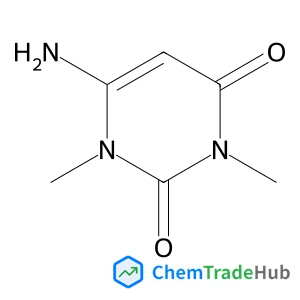
6-amino-1,3-dimethyl-1,2,3,4-tetrahydropyrimidine-2,4-dione
CAS Number:
6642-31-5
Molecular Formula:
C6H9N3O2
Recommended Suppliers






Disclaimer
This page provides academic journal information for reference and research purposes only. We are not affiliated with any journal publishers and do not handle publication submissions. For publication-related inquiries, please contact the respective journal publishers directly.
If you notice any inaccuracies in the information displayed, please contact us at support@chemtradehub.com. We will promptly review and address your concerns.