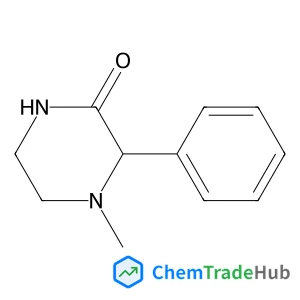
![5-Methyl-4,5,6,7-tetrahydropyrazolo[1,5-a]pyrazin-2-amine structure](https://static.chemtradehub.com/structs/122/1227210-33-4-8d64.webp "5-Methyl-4,5,6,7-tetrahydropyrazolo[1,5-a]pyrazin-2-amine structure")
5-Methyl-4,5,6,7-tetrahydropyrazolo[1,5-a]pyrazin-2-amine
CAS Number:
1227210-33-4
Molecular Formula:
C7H12N4
Christian Alexander Schaumberg, Markus Wollgarten, Klaus Rademann
Pulsed laser ablation in liquids (PLAL) is a versatile route to stable colloids without the need for stabilizing agents. The use of suspensions instead of bulk targets further simplifies the experimental set-up and even improves the productivity. However, the utilization of this approach is hindered by limited knowledge about the underlying mechanisms of the nanoparticle formation. We present the synthesis of copper(I) iodide nanoparticles via ns-pulsed laser irradiation of CuI powder suspended in water or ethyl acetate. A thorough study of the nanoparticle size by transmission electron microscopy reveals a log-normal distribution with a mean diameter of 31 nm (±11 nm) in water and 18 nm (±7 nm) in ethyl acetate. The duration of the laser irradiation appears to have only a minor influence on the size distribution. Selected area diffraction and electron energy-loss spectroscopy verify the chemical composition of the generated CuI nanoparticles. While comparable precursors like CuO and Cu3N follow a reductive ablation mechanism, a fragmentation mechanism is found for CuI. With a productivity of 1.7 μg J−1 this pulsed laser fragmentation in liquids (PLFL) proves to be an efficient route to colloidal CuI nanoparticles.
Jupeng Chen, Xiaolin Wu, Shaowen Zhang, Xiangqian Yan, Xiaolu Wu, Qingbin Cao, Huan Xu, Xiaofang Li
DOI: 10.1039/D2PY00490A
Salvador León, Sejin Oh, Antxon Martínez de Ilarduya
DOI: 10.1039/D1PY01721G
Nicolas Illy, Emma Mongkhoun
DOI: 10.1039/D2PY00731B
Li-Hong Wang, Xian-Jie Chen, Dong-Nai Ye, Hui Liu, Yan Chen, Ai-Guo Zhong, Chang-Zhi Li, Shi-Yong Liu
DOI: 10.1039/D2PY00139J
Atsushi Narumi, Shin-ichiro Sato
DOI: 10.1039/D1PY01449H
Vikram Baddam, Lauri Välinen, Linus Kuckling, Heikki Tenhu
DOI: 10.1039/D2PY00301E
Nicholas G. Taylor, Marcus H. Reis, Travis P. Varner, Johann L. Rapp, Alexis Sarabia, Frank A. Leibfarth
DOI: 10.1039/D2PY00603K
Jiabei Zhou, Xianzhu Zhong, Yang Liu, Kenji Takada, Tatsuo Kaneko
DOI: 10.1039/D2PY00548D
This compound is mainly used as an intermediate in the synthesis of antipsychoti...
Waste containing 1-(D-Ribofuranosyl)-1,4-dihydro-3-pyridinecarboxamide (CAS: 191...
2-Methyl-2-propanyl 3-bromo-3-(hydroxymethyl)-1-azetidinecarboxylate (CAS: 20079...
N-(4-Chloro-2-pyridinyl)acetamide (CAS: 245056-66-0) is a chemical compound with...
5-Chloro-2-hydroxybenzoic acid, also known as 5-chlorosalicylic acid, is an arom...
When handling 1,1-Dichloro-1-fluoroethane (CAS: 1717-00-6), it is important to u...
Fmoc-(2S,3R)-3-phenylpyrrolidine-2-carboxylic acid is a white crystalline solid ...
4-Amino-5-bromo-2-pyridinecarboxylic acid is primarily used as a precursor in th...
Handling this compound should be done with personal protective equipment (PPE) i...
When handling 8-bromo-2,2-dimethyl-3,4-dihydro-2H-1,4-benzoxazin-3-one, use prop...

Physical Chemistry Chemical Physics (PCCP) is an international journal co-owned by 19 physical chemistry and physics societies from around the world. This journal publishes original, cutting-edge research in physical chemistry, chemical physics and biophysical chemistry. To be suitable for publication in PCCP, articles must include significant innovation and/or insight into physical chemistry; this is the most important criterion that reviewers and Editors will judge against when evaluating submissions. The journal has a broad scope and welcomes contributions spanning experiment, theory, computation and data science. Topical coverage includes spectroscopy, dynamics, kinetics, statistical mechanics, thermodynamics, electrochemistry, catalysis, surface science, quantum mechanics, quantum computing and machine learning. Interdisciplinary research areas such as polymers and soft matter, materials, nanoscience, energy, surfaces/interfaces, and biophysical chemistry are welcomed if they demonstrate significant innovation and/or insight into physical chemistry. Joined experimental/theoretical studies are particularly appreciated when complementary and based on up-to-date approaches.
![6-Benzyl-4,5,6,7-tetrahydro-1H-pyrazolo[3,4-c]pyridin-3(2H)-one structure](https://static.chemtradehub.com/structs/909/909187-64-0-f54f.webp "6-Benzyl-4,5,6,7-tetrahydro-1H-pyrazolo[3,4-c]pyridin-3(2H)-one structure")
![2,6-Di(thiophen-2-yl)dithieno[3,2-b:2',3'-d]thiophene structure](https://static.chemtradehub.com/structs/910/910788-24-8-5b70.webp "2,6-Di(thiophen-2-yl)dithieno[3,2-b:2',3'-d]thiophene structure")