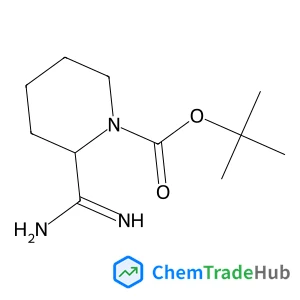
2-Methyl-2-propanyl 2-carbamimidoyl-1-piperidinecarboxylate
CAS Number:
1258640-98-0
Molecular Formula:
C11H21N3O2
Romain Gautier, Luc Bousset, Ronald Melki, Stefano Vanni
Alpha-synuclein (AS) is a synaptic protein that is directly involved in Parkinson's disease due to its tendency to form protein aggregates. Since AS aggregation can be dependent on the interactions between the protein and the cell plasma membrane, elucidating the membrane binding properties of AS is of crucial importance to establish the molecular basis of AS aggregation into toxic fibrils. Using a combination of in vitro reconstitution experiments based on Giant Unilamellar Vesicles (GUVs), confocal microscopy and all-atom molecular dynamics simulations, we have investigated the membrane binding properties of AS, with a focus on the relative contribution of hydrophobic versus electrostatic interactions. In contrast with previous observations, we did not observe any binding of AS to membranes containing the ganglioside GM1, even at relatively high GM1 content. AS, on the other hand, showed a stronger affinity for neutral flat membranes consisting of methyl-branched lipids. To rationalize these results, we used all-atom molecular dynamics simulations to investigate the influence of methyl-branched lipids on interfacial membrane properties. We found that methyl-branched lipids promote the membrane adsorption of AS by creating shallow lipid-packing defects to a larger extent than polyunsaturated and monounsaturated lipids. Our findings suggest that methyl-branched lipids may constitute a remarkably adhesive substrate for peripheral proteins that adsorb on membranes via hydrophobic insertions.
Fuwen Zhao
DOI: 10.1039/D3CC05559K
Marlene Vuillemin, Bo Pilgaard, Emma Kiehn, Folmer Fredslund, Ditte H. Welner, Anne S. Meyer, Finn L. Aachmann, Casper Wilkens
DOI: 10.1039/D3CC04256A
Rafal Zuzak, Mariusz Krawiec, Szymon Godlewski
DOI: 10.1039/D3CC05486A
Jun Dong, Zhuang Tang, Luqian Zou, Yongyun Zhou
DOI: 10.1039/D3CC05048C
Elishua D. Litle, François P. Gabbaï
DOI: 10.1039/D3CC04729F
Jérémie Mitteaux, Sandy Raevens, Zi Wang, Marc Pirrotta, Ibai E. Valverde, Robert H. E. Hudson, David Monchaud
DOI: 10.1039/D3CC05155B
Haosen Yang, Pengfei Wu, Jiajing Pei, Bo Peng, Qingqing Liu
DOI: 10.1039/D3CC04930B
Aisa Mohanty, Smruti Rekha Rout, Rambabu Dandela, Prosenjit Daw
DOI: 10.1039/D3CC04490D
Moeka Ishida, Rina Adachi, Kazuki Kobayashi, Yukiko Yamamoto, Chinatsu Kawahara, Tsuyoshi Yamada, Hiroshi Aoyama, Kyohei Kanomata, Shuji Akai, Patrick Y. S. Lam, Hironao Sajiki, Takashi Ikawa
DOI: 10.1039/D3CC05447K
Teresa Eisner, Arseni Kostenko, Fiona J. Kiefer, Shigeyoshi Inoue
DOI: 10.1039/D3CC05090D
Waste containing 6-Chloro-5-(2'-hydroxy-3'-methoxy-4-biphenylyl)-3-(3-methoxyphe...
(3alpha,5alpha)-3-Hydroxypregnane-11,20-dione is primarily used in the pharmaceu...
The market for 4-Amino-6-chloro-2-pyridinecarboxylic acid (CAS: 546141-56-4) is ...
Alternatives to (2-Benzoylethyl)trimethylammonium chloride (CAS: 24472-88-6) in ...
N-[4-Nitro-3-(trifluoromethyl)phenyl]acetamide (CAS: 393-12-4) is generally safe...
Alternative reagents such as other phosphates or similar functional groups can b...
There are alternatives to N,N'-Bis(3-aminopropyl)-1,3-propanediamine (CAS: 4605-...
When handling Aluminium trihexadecanoate, it is important to use appropriate per...
(1,1-Dioxido-3-oxo-1,2-benzothiazol-2(3H)-yl)acetic acid is a chemical compound ...
Several alternatives to 5,5-dimethyloxolan-2-one (CAS: 3123-97-5) can be used in...

Physical Chemistry Chemical Physics (PCCP) is an international journal co-owned by 19 physical chemistry and physics societies from around the world. This journal publishes original, cutting-edge research in physical chemistry, chemical physics and biophysical chemistry. To be suitable for publication in PCCP, articles must include significant innovation and/or insight into physical chemistry; this is the most important criterion that reviewers and Editors will judge against when evaluating submissions. The journal has a broad scope and welcomes contributions spanning experiment, theory, computation and data science. Topical coverage includes spectroscopy, dynamics, kinetics, statistical mechanics, thermodynamics, electrochemistry, catalysis, surface science, quantum mechanics, quantum computing and machine learning. Interdisciplinary research areas such as polymers and soft matter, materials, nanoscience, energy, surfaces/interfaces, and biophysical chemistry are welcomed if they demonstrate significant innovation and/or insight into physical chemistry. Joined experimental/theoretical studies are particularly appreciated when complementary and based on up-to-date approaches.
![1-(1-Benzyl-1,2,3,6-tetrahydropyridin-4-yl)-1H-benzo[d]imidazol-2(3H)-one structure](https://static.chemtradehub.com/structs/603/60373-71-9-7dfb.webp "1-(1-Benzyl-1,2,3,6-tetrahydropyridin-4-yl)-1H-benzo[d]imidazol-2(3H)-one structure")