











Multimodal chemical imaging of molecular messengers in emerging Pseudomonas aeruginosa bacterial communities
Literature Information
Publication Date
2015-08-24
DOI
10.1039/C5AN01149C
Impact Factor
4.616
Authors
Nameera F. Baig, Sage J. B. Dunham, Jonathan V. Sweedler, Paul W. Bohn
View Original
Abstract
Two label-free molecular imaging techniques, confocal Raman microscopy (CRM) and secondary ion mass spectrometry (SIMS), are combined for in situ characterization of the spatiotemporal distributions of quinolone metabolites and signaling molecules in communities of the pathogenic bacterium Pseudomonas aeruginosa. Dramatic molecular differences are observed between planktonic and biofilm modes of growth for these bacteria. We observe patterned aggregation and a high abundance of N-oxide quinolines in early biofilms and swarm zones of P. aeruginosa, while the concentrations of these secreted components in planktonic cells and agar plate colonies are below CRM and SIMS detection limits. CRM, in conjunction with principal component analysis (PCA) is used to distinguish between the two co-localized isomeric analyte pairs 4-hydroxy-2-heptylquinoline-N-oxide (HQNO)/2-heptyl-3-hydroxyquinolone (PQS) and 4-hydroxy-2-nonylquinoline-N-oxide (NQNO)/2-nonyl-hydroxyquinolone (C9-PQS) based on differences in their vibrational fingerprints, illustrating how the technique can be used to guide tandem-MS and tandem-MS imaging analysis. Because N-oxide quinolines are ubiquitous and expressed early in biofilms, these analytes may be fundamentally important for early biofilm formation and the growth and organization of P. aeruginosa microbial communities. This study underscores the advantages of using multimodal molecular imaging to study complex biological systems.
Related Literature
Ru(ii)-Catalyzed C–H activation/annulation reactions of N-aryl-pyrazolidinones with sulfoxonium ylides: synthesis of cinnoline-fused pyrazolidinones
Hai-Shan Jin, Ya-Zhen Du, Qing-Yang Zhao, Li-Ming Zhao
2021-09-13
Research Article
DOI: 10.1039/D1QO01001H
Phenolate anion-catalyzed direct activation of inert alkyl chlorides driven by visible light
Delian Wei, Xipan Li, Lei Shen, Yuzhen Ding, Kangjiang Liang, Chengfeng Xia
2021-09-17
Research Article
DOI: 10.1039/D1QO01128F
Molecularly imprinted artificial esterases with highly specific active sites and precisely installed catalytic groups
Lan Hu, Yan Zhao
2018-07-24
Communication
DOI: 10.1039/C8OB01584H
Tandem isonitrile insertion/azacyclopropylidene-annulated cyclohexenone–tropone rearrangement of p-QMs and TosMIC: de novo synthesis of pyrrolotropones with anti-cancer activity
Chuan-Hua Qu, Gui-Ting Song, Jiu-Hong Huang, Run Huang, Yuan Chen, Tong Liu, Dian-Yong Tang, Zhi-Gang Xu, Zhong-Zhu Chen
2021-09-22
Research Article
DOI: 10.1039/D1QO01256H
Guanidine functionalized anthranilamides as effective antibacterials with biofilm disruption activity
Rajesh Kuppusamy, Muhammad Yasir, Eugene Yee, Mark Willcox, David StC. Black, Naresh Kumar
2018-07-19
Paper
DOI: 10.1039/C8OB01699B
Conformation-guided analogue design identifies potential antimalarial compounds through inhibition of mitochondrial respiration
Erik M. Larsen, Chia-Fu Chang, Tomoyo Sakata-Kato, Joseph W. Arico, Vince M. Lombardo, Dyann F. Wirth, Richard E. Taylor
2018-07-11
Communication
DOI: 10.1039/C8OB01257A
Organocatalytic enantioselective Diels–Alder reaction between hydroxymaleimides and in situ generated nitrosoalkenes for direct preparation of chiral hemiketals with 1,2-oxazine skeleton
Fang Tian, Wen-Juan Wan, Li-Xin Wang
2021-08-30
Research Article
DOI: 10.1039/D1QO01022K
Asymmetric iodine catalysis-mediated enantioselective oxidative transformations
Aurélie Claraz, Géraldine Masson
2018-07-13
Review Article
DOI: 10.1039/C8OB01378K
You might also like
Compound Q&A
What are the main uses of 4-Nitrophenyl phosphate disodium salt hexahydrate (CAS: 333338-18-4)?
4-Nitrophenyl phosphate disodium salt hexahydrate is primarily used as a substra...
333338-18-44-Nitrophenyl phosph...
Compound Q&A
What are the main uses of 2-(Trifluoromethyl)-1,3-oxazole-4-carboxylic Acid (CAS: 1060816-01-4)?
2-(Trifluoromethyl)-1,3-oxazole-4-carboxylic Acid (CAS: 1060816-01-4) is widely ...
1060816-01-42-(Trifluoromethyl)-...
Compound Q&A
How should 2-Fluoro-4-biphenylcarboxylic acid (CAS: 137045-30-8) be stored?
2-Fluoro-4-biphenylcarboxylic acid should be stored in a cool, dry place at room...
137045-30-82-Fluoro-4-biphenylc...
Compound Q&A
What industries use Prednisolone-21-Carboxylic Acid (CAS: 61549-70-0)?
Prednisolone-21-Carboxylic Acid is primarily used in the pharmaceutical industry...
61549-70-0Prednisolone-21-Carb...
Compound Q&A
How should 4-(Hydrazinomethyl)-1,2,3-benzenetriol (CAS: 3614-72-0) be stored?
4-(Hydrazinomethyl)-1,2,3-benzenetriol (CAS: 3614-72-0) should be stored in a co...
3614-72-04-(Hydrazinomethyl)-...
Compound Q&A
What industries use 4-Amino-1-methyl-1H-pyrazole-5-carboxylic acid hydrochloride (CAS: 92534-70-8)?
4-Amino-1-methyl-1H-pyrazole-5-carboxylic acid hydrochloride (CAS: 92534-70-8) i...
92534-70-84-Amino-1-methyl-1H-...
Compound Q&A
What regulatory guidelines apply to dehydropachymic acid (CAS: 77012-31-8)?
Dehydropachymic acid (CAS: 77012-31-8) is regulated by various agencies. It fall...
77012-31-8Dehydropachymic acid
Compound Q&A
What is the market or research trend for 6-[(2,2-Dimethylpropanoyl)amino]nicotinic acid (CAS: 898561-66-5)?
The market and research trends for 6-[(2,2-Dimethylpropanoyl)amino]nicotinic aci...
898561-66-56-[(2,2-Dimethylprop...
Compound Q&A
How should 1,10-Phenanthroline-2,9-dicarbaldehyde (CAS: 57709-62-3) be stored?
1,10-Phenanthroline-2,9-dicarbaldehyde should be stored in a cool, dry place awa...
57709-62-31,10-Phenanthroline-...
Compound Q&A
How is 5-Carbamoyl-11-oxo-10,11-dihydro-5H-dibenzo[b,f]azepin-10-yl acetate (CAS: 113952-21-9) typically synthesized?
5-Carbamoyl-11-oxo-10,11-dihydro-5H-dibenzo[b,f]azepin-10-yl acetate can be synt...
113952-21-95-Carbamoyl-11-oxo-1...
Source Journal
Analyst

CiteScore:
7.8
Self-citation Rate:
5.6%
Articles per Year:
653
Analyst publishes analytical and bioanalytical research that reports premier fundamental discoveries and inventions, and the applications of those discoveries, unconfined by traditional discipline barriers.
Recommended Compounds
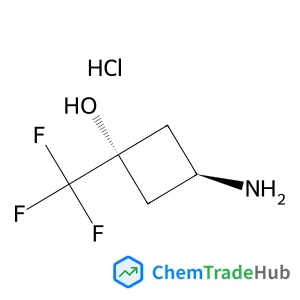
cis-3-Amino-1-(trifluoromethyl)cyclobutanol hydrochloride (1:1)
CAS Number:
1408075-16-0
Molecular Formula:
C5H9ClF3NO


Recommended Suppliers





Disclaimer
This page provides academic journal information for reference and research purposes only. We are not affiliated with any journal publishers and do not handle publication submissions. For publication-related inquiries, please contact the respective journal publishers directly.
If you notice any inaccuracies in the information displayed, please contact us at support@chemtradehub.com. We will promptly review and address your concerns.